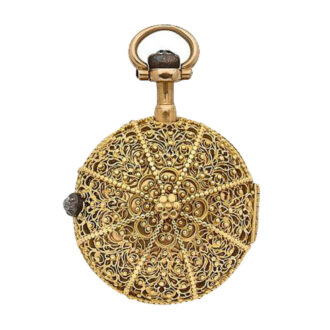
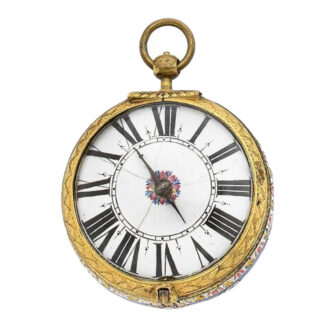
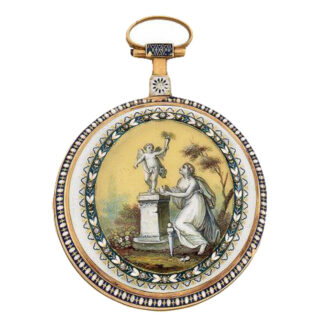
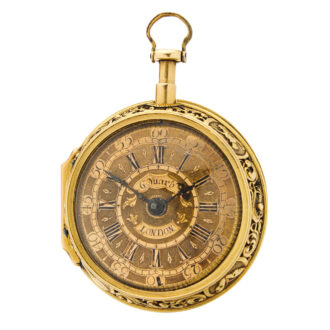
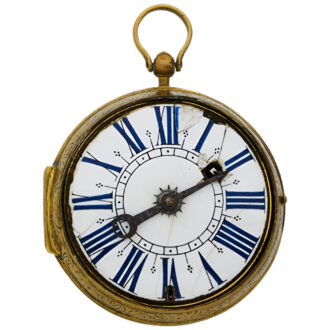
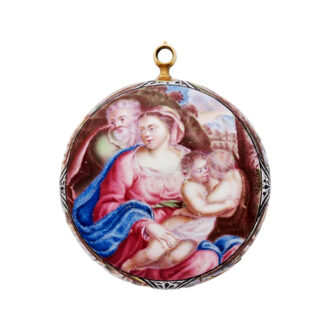
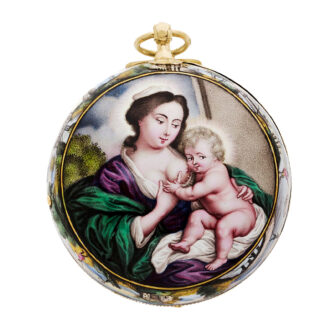
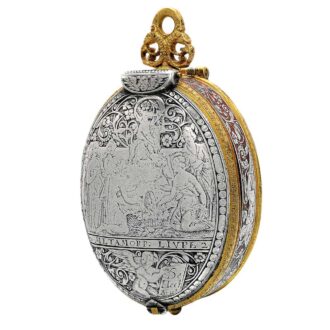
Important silver and gilt metal astronomical watch Circa 1618
- Kenmerk
- SA0004
- Diameter
- 65 mm
- Estimate
- € 150.000 - 500.000
- Price sold
- € 1.150.000
Silver and gilt metal astronomical watch
–
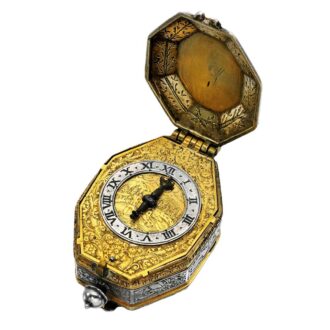
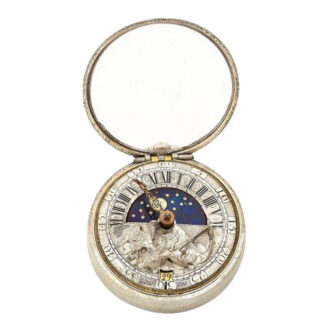
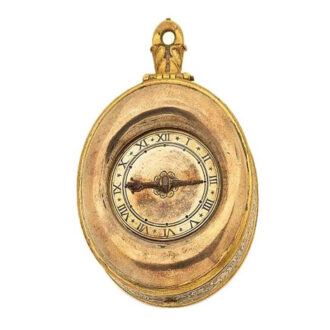
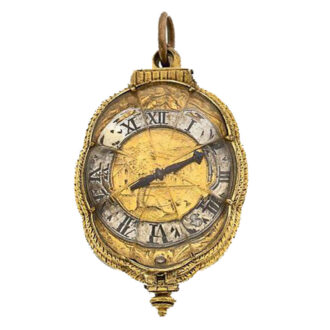
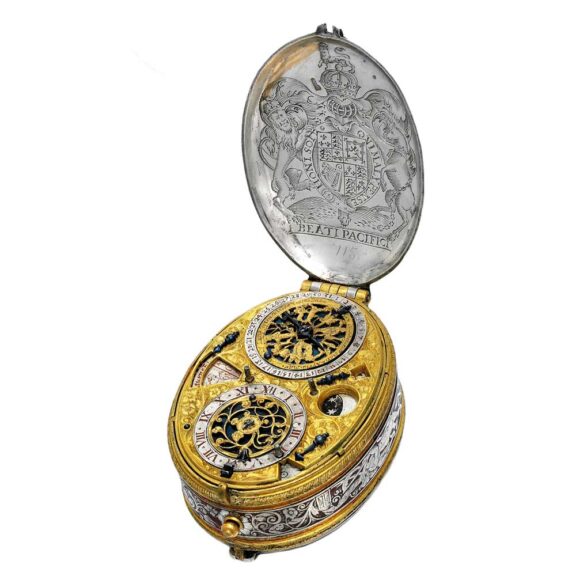
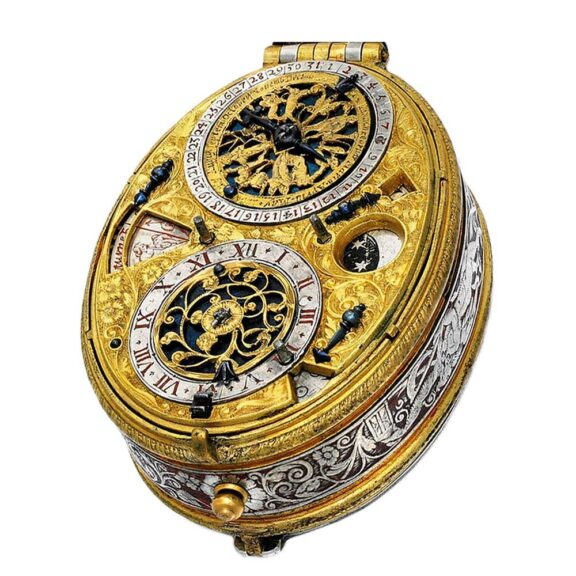
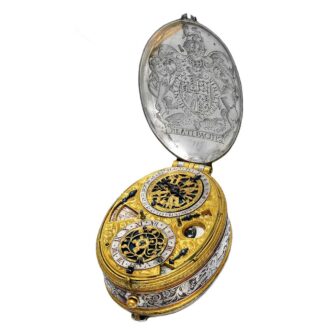
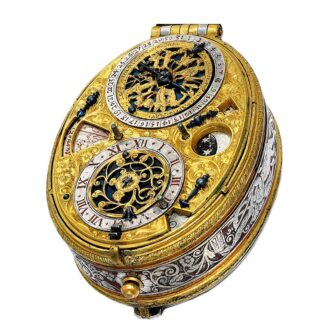
An English watch with a portrait engraving of King James I and indications for the months with signs of the Zodiac, days with the ruling planet, the lunar date, moon phase and planet hour, circa 1618. Gilt brass oval full plate movement with a verge escapement, three wheel train, engraved border, plain flat balance, ratchet set up, fusee and gut line.
–
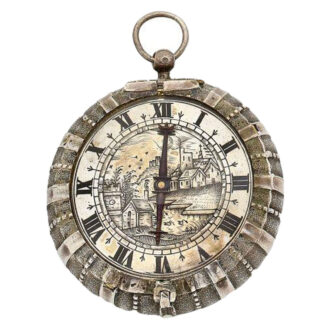
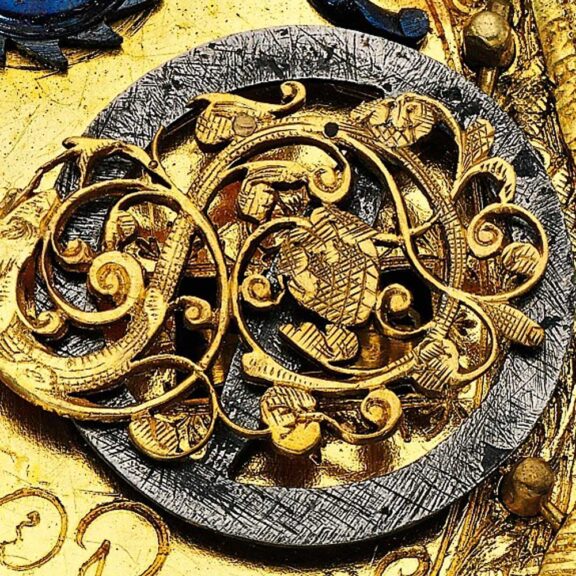
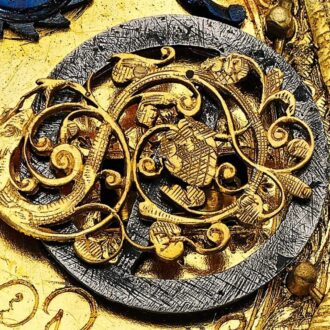
Engraved dial plate, an applied silver chapter ring with red Roman numerals, a pierced rotating central disc with blued steel ground indicating the time, silver chapter ring with days of the month indicated by a blued steel bug mounted on a revolving gilt metal center pierced and engraved with the months and the corresponding signs of the Zodiac, to the left: a wedge shaped aperture for the day of the week with an engraving of the ruling planet, apertures for the lunar date above the moon phases, a further small aperture for the planet hour to the lower right, the days of the week and planet hours with fixed blued steel hands indicating the direction of disc rotation, and a fixed hand by the lunar date aperture.
–
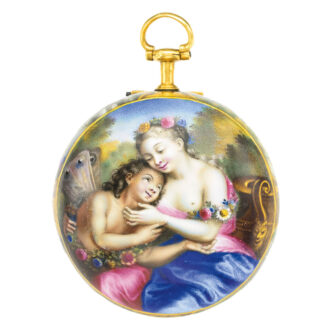
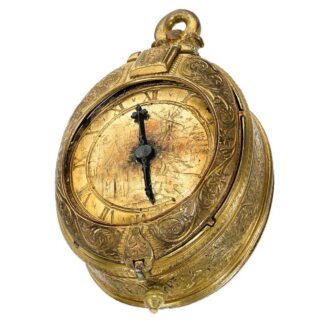
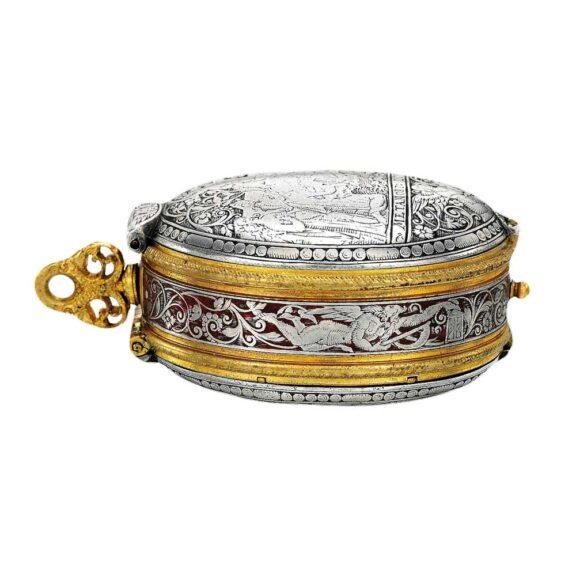
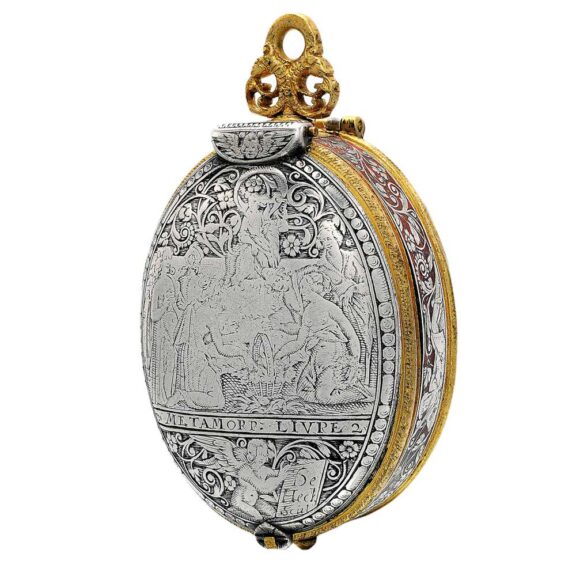
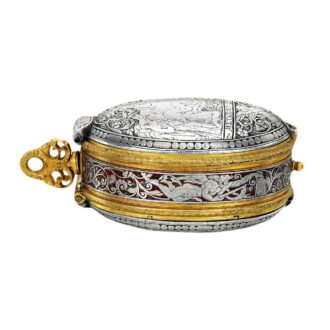
Engraved scenes on the case covers from Ovid’s Metamorphoses, the front with a putto beneath holding a tablet, the inside of the upper cover engraved with the Royal coat of arms of King James I, the inside of the back cover with an engraved miniature of King James after Simon de Passe, the band depicting Chronos supporting an hourglass and Saint James the Greater with a petasus hat holding his sword, surrounded by flowers and foliage, heightened with red wax and a gilt metal pendant in the form of addorsed reptiles.
–
Diameter: 65 mm
–
Signed: David Ramsay Scotte Me Fecit
–
A similar watch by David Ramsay can be found on permanent loan at the Victoria & Albert Museum. The case of that watch features scenes from St. Luke’s Gospel and a portrait of King James I to the inside cover which is after the same engraving by Simon de Passe. These watches were presumably made around the same time by order of the King. A third watch, similar to the above, signed David Ramsay Scotus me Fecit is in the collection of the National Museum of Scotland. It is possible that the present watch was commissioned as a gift for another family member. For example, as the Metamorphoses are to a large extent tales of the love adventures of the gods with nymphs and the daughters of men, it would perhaps have been a suitable present to give to Frederick V (1596-1632), Elector Palatine and King of Bohemia, husband of James’s daughter Elizabeth.
–
David Ramsay, born in Scotland circa 1585, was one of the finest early watchmakers. He made this magnificent piece and was the first Master of the Worshipful Company of Clockmakers at its formation in 1632, by whom he was known as Squire Ramsay, but scarcely ever attended except between 1652 and 1654, when he suffered under the Commonwealth and voted himself grants from the Clockmakers’ Company funds.
–
Ramsay first worked in France and arrived in England around 1610, at the request of King James I. His workshop was located at Tothill Street, Westminster and later in Holborn within ‘two doors of the Wounded Heart’. Ramsay was appointed chief clockmaker to James I in 1613.
–
When he was granted a pension in 1618, he received the grant of the office of Chief Clockmaker to the King and in 1619 a grant of denization because he was born in Scotland.
–
David Ramsay sometimes signed his work with ‘T David Ramsay Scotus’.
Signed: David Ramsay Scotte Me Fecit
Share this page: