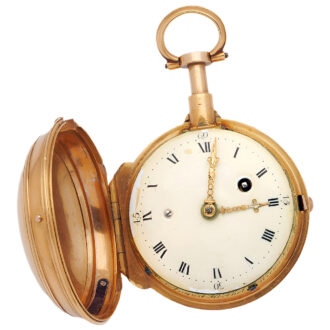
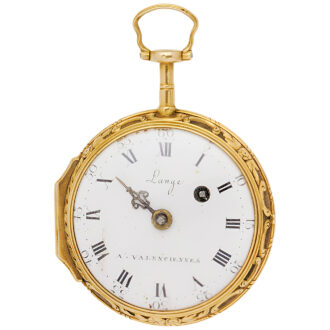
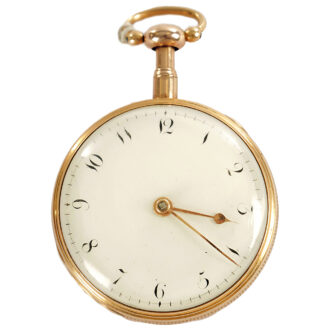
English rare gold and enamel cylinder watch Circa 1781
- Kenmerk
- SA0064
- Diameter
- 46 mm
- Estimate
- € 15.000 - 30.000
- Price sold
- -
Significant gold and enamel cylinder watch
–
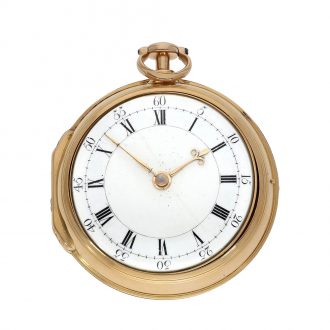
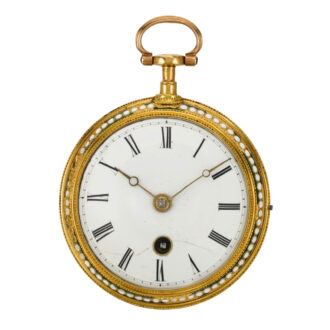
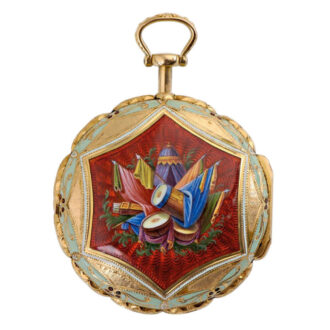
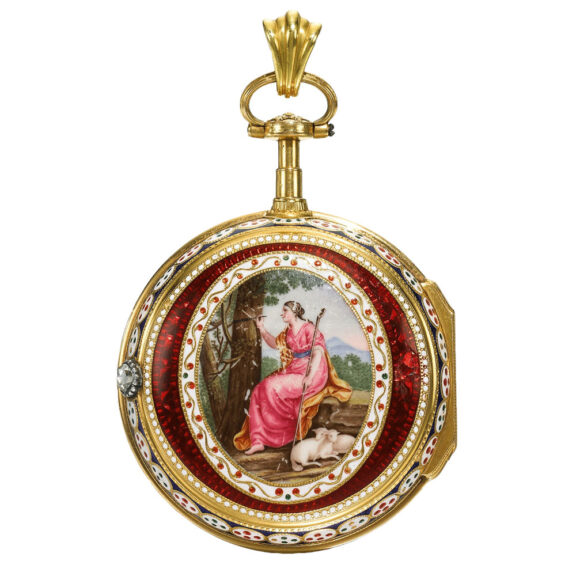
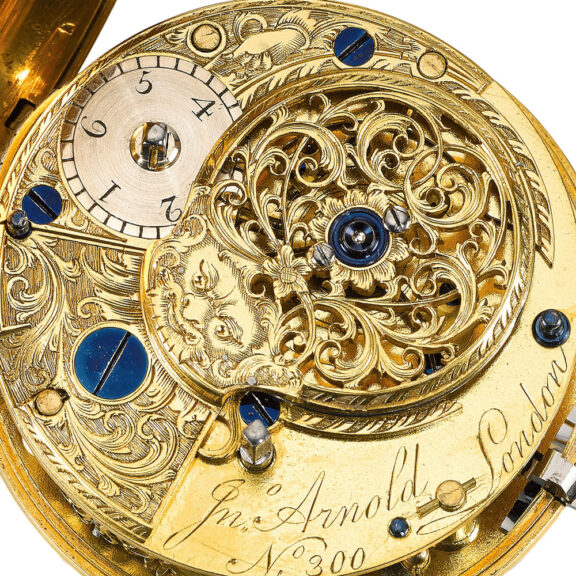
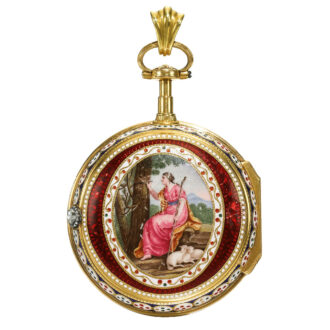
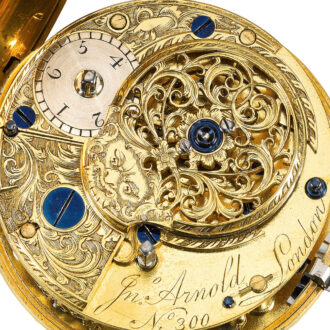
An English rare and significant gold and enamel cylinder watch with portrait miniature attributed to William Hopkins Craft, circa 1781, gilt full plate movement, ruby cylinder escapement, decoratively pierced and engraved masked balance cock, diamond endstone, fusee and chain, round baluster pillars, white enamel dial, Roman numerals, outer Arabic minute track, gold hands, gilt metal dust cap, gold case decorated with champlevé enamel to front and rear bezels, case back center with polychrome enamel painted scene of a landscape with Shepherdess, framed by decorative champlevé surround and an outer border of translucent red enamel over engine turning, case back hinged to reveal winding square, maker’s mark ITP for John Terrill Pain, dust cap and movement signed Jn Arnold, London
–
Diameter: 46 mm
–
Signed: Jn Arnold London
–
The enamel panel is attributed to William Hopkins Craft 1731-1811 based on an engraving by John Sherwin 1751-1790 after a painting by Angelica Kaufman, 1741-1807
For another similar enamel that is signed and dated 1782 by Craft, with a movement signed Windmills, see Camerer Cuss, The English Watch.
The scene on the panel is inspired by Jerusalem Delivered written by Italian poet, Toquato Tasso 1544-1595. Erminia, daughter of the Saracen King of Antioch is depicted writing the name of the Christian knight, with whom she is in love, ‘Tancred’ on a tree while holding a staff in her other hand. Craft’s miniatures are sometimes signed on their reverse, as in the example with the movement by Windmills referred to above. The scene has been identified by Ian White.
It has a ruby cylinder escapement which Arnold probably introduced. This escapement was employed in the late 18th century and early 19th century by some of the best London makers and more widely on the Continent.
Arnold is recorded as becoming free of the Clockmakers’ company in 1783. Born in Cornwall, John Arnold 1736-1799 represents one of the most famous English makers. He was apprenticed to his father and then traveled abroad where he learned to speak German. He came to London in 1762 and shortly thereafter presented a repeating watch mounted on a ring to King George III. This, and his ability to speak German, enabled him to establish himself at court. After about 1768, he began experiments to make an accurate timekeeper for use at sea. He realized that a detached escapement would be highly desirable and this led him to invent a detent escapement, circa 1781, which bears his name. To overcome isochronal variation, he invented the helical balance spring. In 1787 he took his son, John Roger Arnold, into partnership, changing the business name to “Arnold & Son”, which was retained until his death.
Signed: Jn Arnold London
Share this page: