Rare English gold inking key wind chronograph Circa 1823
- Kenmerk
- SA0080
- Diameter
- 58 mm
- Estimate
- € 15.000 - 30.000
- Price sold
- € 28.000
Gold historically important cylinder watch
–
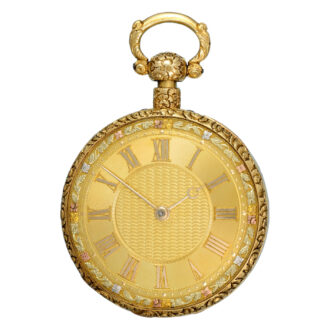
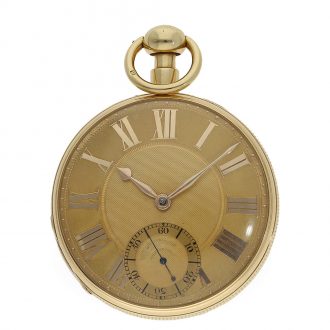
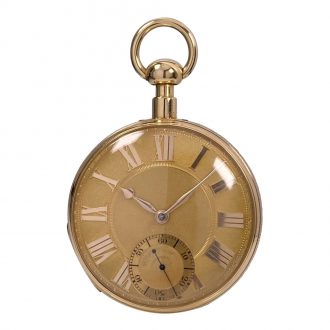
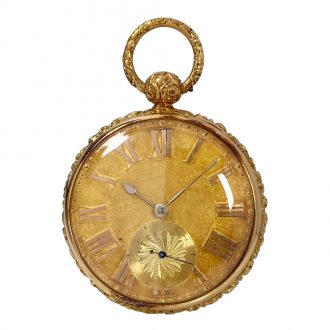
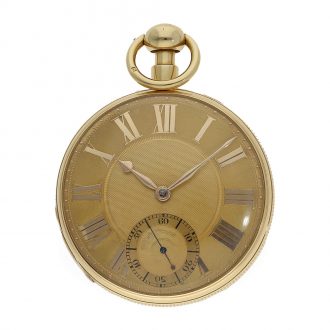
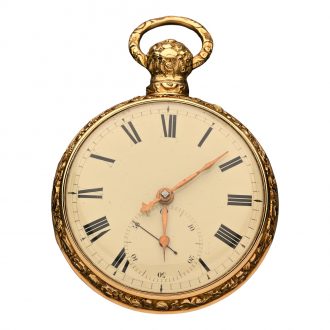
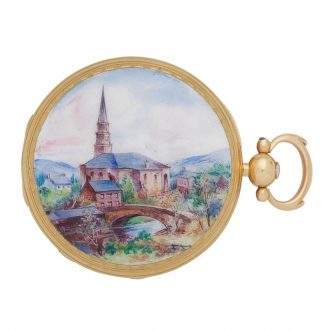
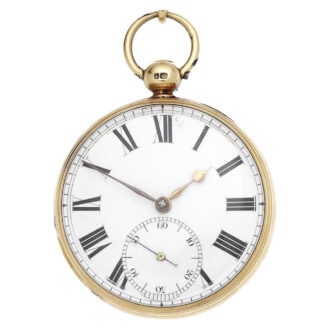
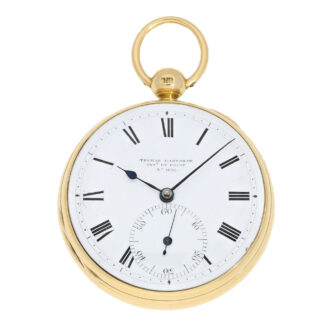
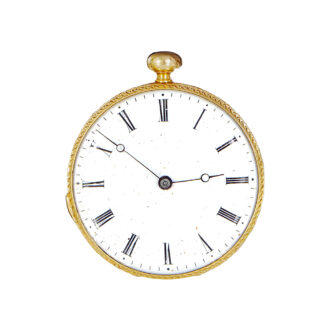
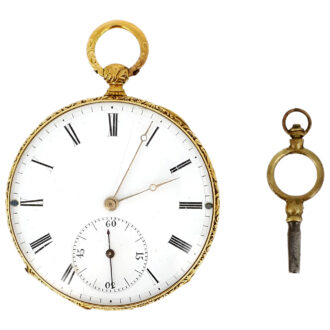
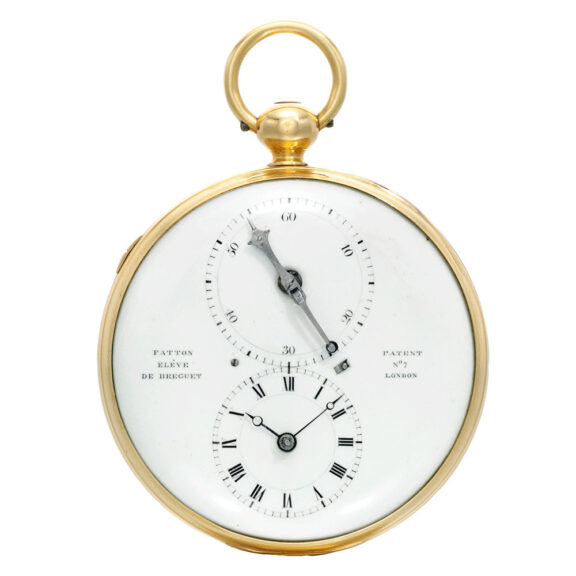
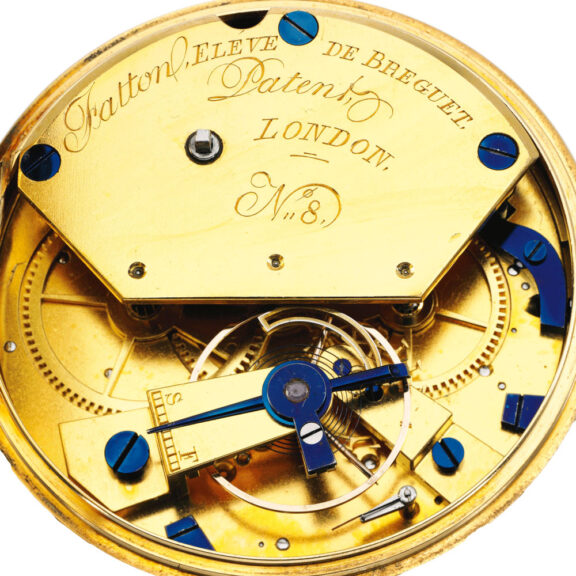
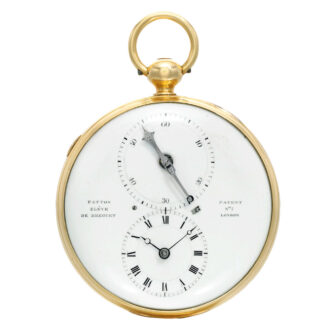
A historically important and rare English 18 carat yellow gold open faced inking chronograph pocket watch, circa 1823. The gilt half plate movement with a cylinder escapement, gold three arm balance and compensation curb. White enamel dial with eccentric time indication at 6 o’clock featuring Roman hour numerals, an outer minute track and moon hands, a subsidiary 60 second chronograph at 12 with a hand of which the extremity carries the nib over an ink well and a slide towards the center to switch off the chronograph mechanism. The case with an engine turned back, a stop slide to the band, pendant with a push piece to activate/drop the nib and a polished hinged gold cuvette. Dial, movement and case signed Fatton Elève de Breguet Patent London, the case is further stamped with maker’s mark LC for Louis Comtesse.
–
Diameter: 58 mm
–
Signed: Fatton Elève de Breguet Patent London
–
Fredrick Louis Fatton first worked for Abraham Louis Breguet in Russia between 1801 and 1807. By 1814, he was Breguet’s independent agent in London. Interestingly, Fatton is one of several men who signed their work with ‘Elève de Breguet’. Fatton invented the ‘Inking Chronograph’. He obtained two patents for inking chronographs in 1822.
–
Inking chronographs were usually made in silver. Therefore, the present example of gold is rare. It was purchased in the 1990s from the wife of a descendant of Isambard Kingdom Brunel. It was believed through family legend that the watch had belonged to the famous engineer.
–
Isambard Kingdom Brunel was a 19th century engineering genius and a giant of the Industrial Revolution. His most famous works included the Great Western Railway, Paddington Station, a series of steamships, dockyards and an early design of Clifton Bridge, England’s first suspension bridge.
–
Brunel was sent to France for schooling, where he became acquainted with Breguet through an introduction by a cousin. At the age of 14 he lived with the Breguet family and was given tuition in the workshops (see Adrian Vaughan’s biography of Isambard Kingdom Brunel, 1991). Brunel returned to England in 1822.
–
Interestingly, Brunel had a second connection to watchmaking, through his mother Sophia Kingdom who was the niece of Thomas Mudge. Sadly Brunel would never have met the famous maker, who died more than a decade before Brunel’s birth.
Signed: Fatton Elève de Breguet Patent London
Share this page: