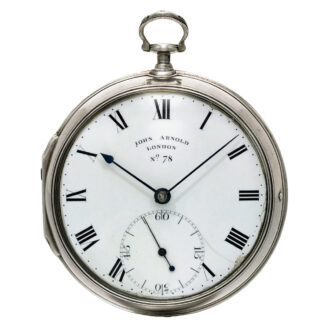
English pocket chronometer made by John Arnold Circa 1781
- Kenmerk
- SA0138
- Diameter
- 73 mm
- Estimate
- € 100.000 - 500.000
- Price sold
- € 615.00
Important English pocket chronometer with double S balance
–
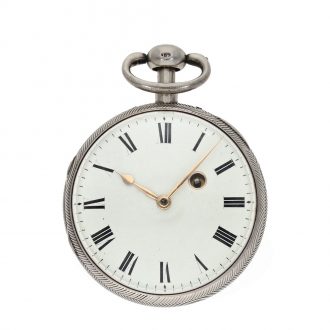
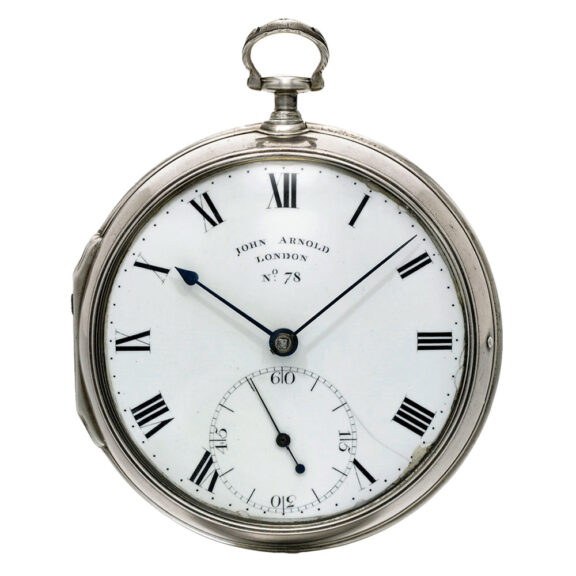
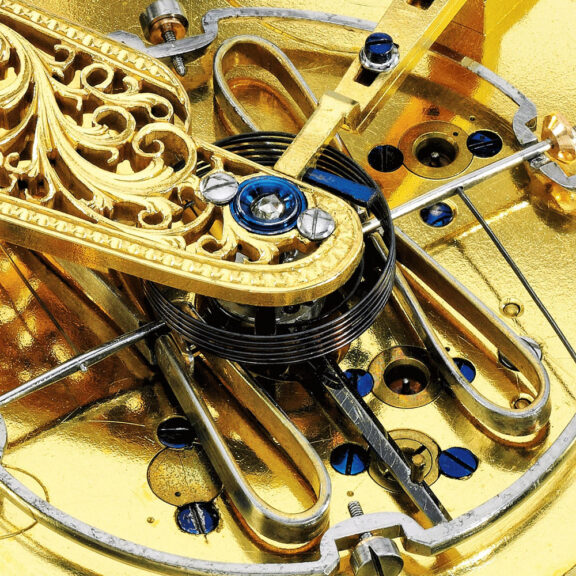
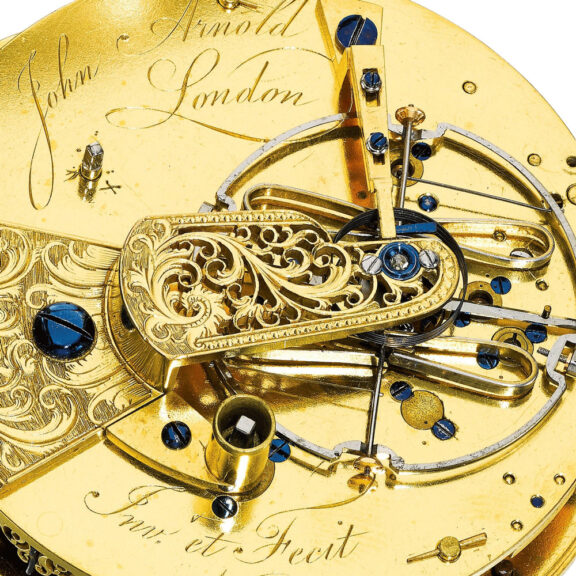
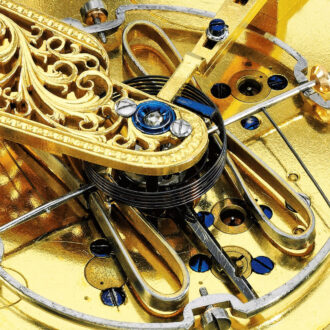
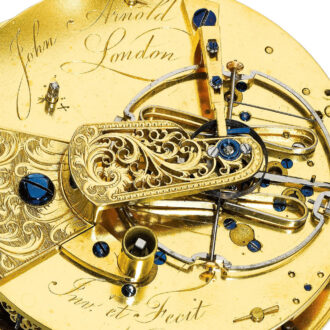
A highly important English large silver consular cased pocket chronometer of “the best kind” and the only known example to survive in its original state with double S balance, circa 1781. Gilded full plate movement with Arnold pivoted detent escapement, free sprung S balance, blued steel helical spring, decoratively pierced and engraved balance cock, fusee and chain, turned pillars.
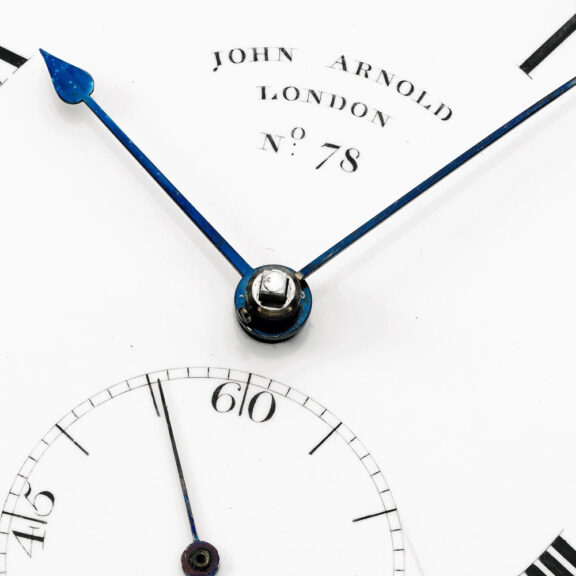
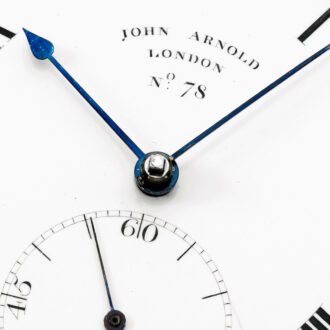
White enamel dial with Roman numerals, outer minute ring, large subsidiary seconds and blued steel hands.
Plain polished double bottomed case, the back opening to reveal fixed cuvette with winding aperture. Maker’s mark ITP incuse for John Terrill Pain.
Movement signed, dial signed and numbered.
–
Diameter: 73 mm
–
Signed: John Arnold London, Inv. et Fecit London
–
John Arnold used the pivoted detent escapement up to 1782 and the spring detent thereafter. Arnold introduced the ‘double S’ balance in 1780. The ‘S’ sections of the balance were shaped bi metallic bars that were designed to overcome the changing elasticity of the balance spring and expansion of the balance’s rim. Arguably amongst the most elegant compensated balances ever made, only around a dozen watches survive with the double ‘S’ or ‘T’ balances. Only two watches survive complete with their original cases, dials and pivoted detents, having a ‘double T’ balance (number 1/36 and 2/43, although the balance of the latter has been restored). Only the present watch, survives without restoration and with its original case, dial, pivoted detent, and ‘double S’ balance.
–
Born in Cornwall, John Arnold 1736-1799 is one of England’s most famous and important watchmakers. Initially apprenticed to his father, a Clockmaker from Bodmin, John Arnold almost certainly worked for a time as a gunsmith with his Uncle, William, see Vaudrey Mercer, John Arnold and Son. In the mid-1750s, John Arnold traveled to Holland where he continued work as a watchmaker’s assistant and it is here that he learned German which doubtless proved a great asset in his later connections with King George III’s court. In 1762 he moved to London and shortly thereafter presented a repeating watch mounted on a ring to King George III. The watch created a sensation and was widely reported upon with details included in the “Annual Register” for 1764 and the “Gentleman’s Magazine” of the same year. It has been suggested by several researchers, including Cedric Jagger in his book Royal Clocks, that John Arnold was encouraged by King George III to “enter the ‘longitude’ arena” and make an accurate timekeeper for use at sea. Arnold’s first attempt at a marine timepiece was completed in 1768 and presented before the Board of Longitude in 1770. Arnold realized that a detached escapement would be highly desirable and this led him to invent his early detached escapement in c.1770, followed by his spring detent (which bears his name) in c.1782. To overcome isochronal variation, Arnold took out a patent for a helical spring in December 1775 and used this with his ‘double T’ and ‘double S’ balances. Arnold realized that a detached escapement would be highly desirable and this led him to invent a detent escapement, circa 1781, which bears his name. In 1787 he took his son, John Roger Arnold, into partnership, changing the business name to “Arnold and Son”, which was retained until his death. A detailed examination of the life and work of John Arnold is given in Vaudrey Mercer’s definitive work on the maker entitled John Arnold and Son, published by the Antiquarian Horological Society in 1972.
Signed: John Arnold London, Inv. et Fecit London
Share this page: