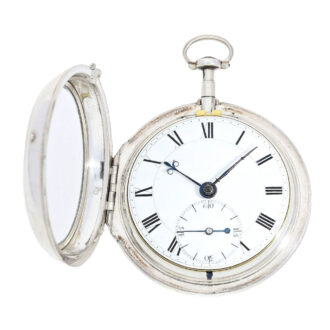
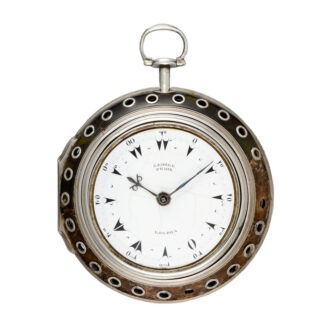
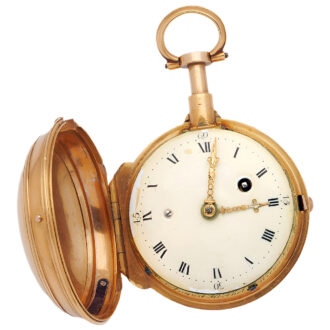
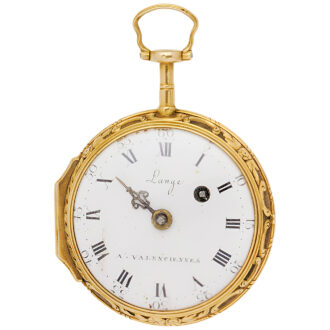
English astronomical watch with annual calendar Circa 1783
- Kenmerk
- SA0140
- Diameter
- 66 mm
- Estimate
- € 25.000 - 50.000
- Price sold
- -
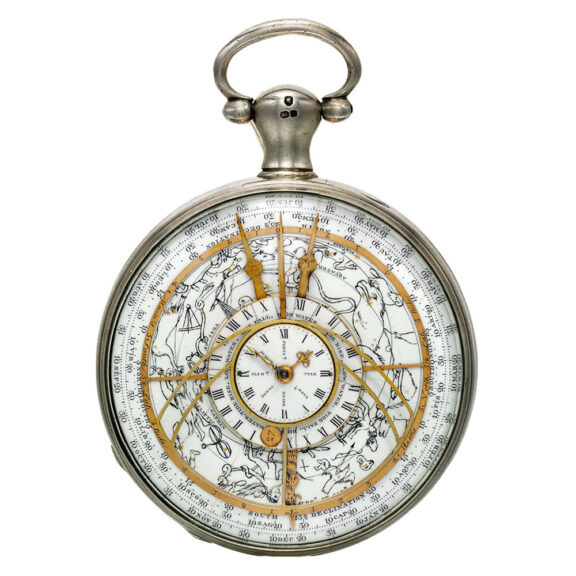
Cylinder watch with an annual calendar and astronomical indications
–
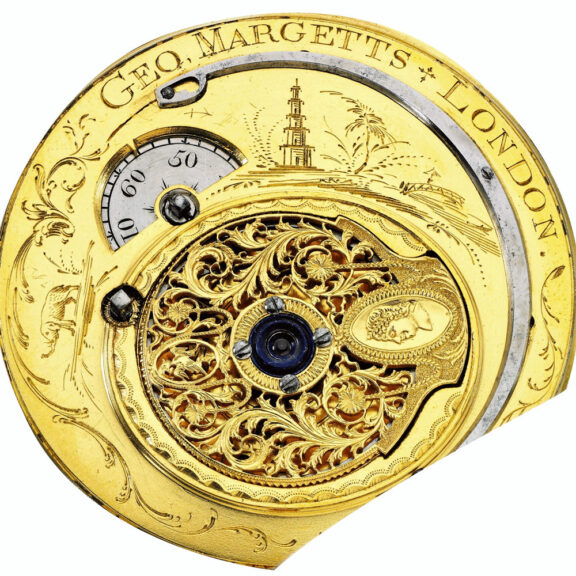
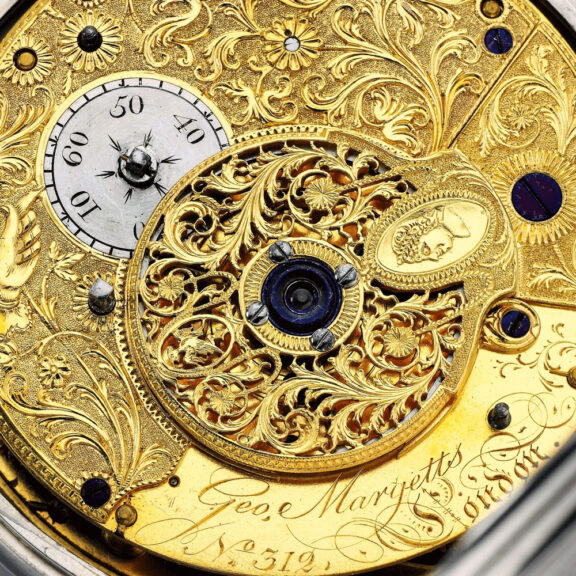
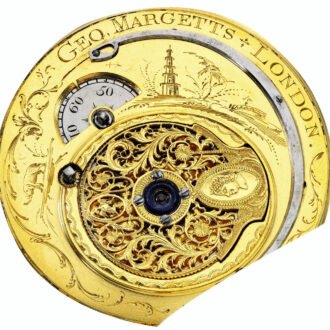
A very rare English fine cylinder watch with a tidal dial, annual calendar and astronomical indications in a later custom made case, movement circa 1783. Gilded full plate movement, cylinder escapement with steel wheel, decoratively pierced and engraved balance cock with classical bust to its neck, ruby end stone, fusee and chain with Harrison’s maintaining power, signed gilt metal dust cap engraved with an elephant and a pagoda within an Oriental landscape, Geo. Margetts, London.
–
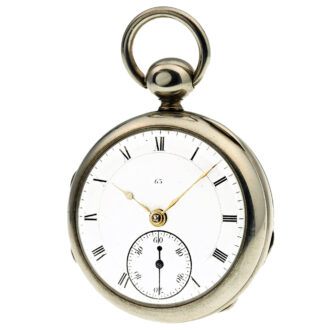
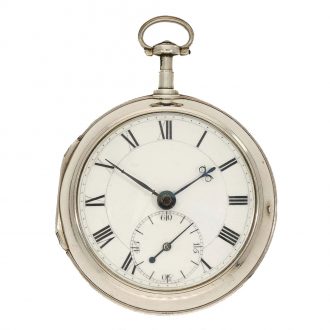
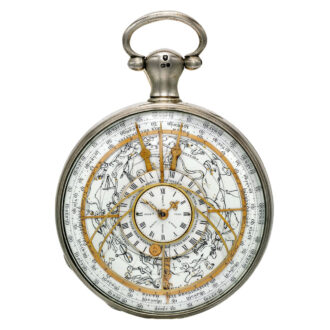
Astronomical dial with white enamel ground, 16 gear train for dial indications advancing clockwise (except fixed mean time dial with Roman numerals, gold north indicator and two gold parallel parabolas) tidal dial indicating tides at eight English ports: Portsmouth, London, Hull, Yarmouth, Dover, Downs (a safe anker point in the English Channel), Plymouth and Dublin, the fixed moon hand indicating on the gold rim with four spokes the latitude of the planet together with its position in the Zodiac and declination in degrees on the nearest calibration of the main dial, one spoke to rim engraved with a dragon whose extended tail points to sign and degree of Zodiac marked on the middle calibration, dial edge with annual calendar read against sun hand which also indicates sun’s declination and position in the Zodiac, observer’s horizon indicated by tangential parabola, space between it and inner parabola is astronomical twilight zone, viewed in area of dial enclosed by them is rise, southing and fall of constellations, age of moon engraved on gold through circular aperture to tidal dial which also shows black spot for an eclipse – large for lunar and small for solar eclipses
–
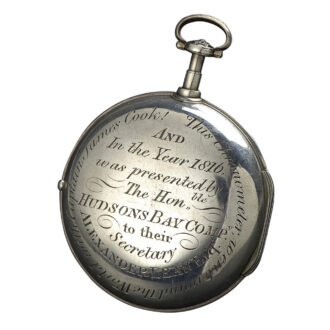
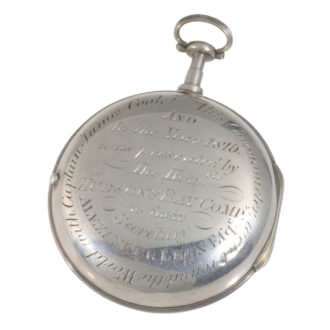
Later silver custom made case, maker’s mark FC for Frederick Comtesse over possibly FHB (rubbed), pendant with maker’s mark M.A. for Michael Atkins.
–
Diameter: 66 mm
–
Signed: Geo. Margetts London
–
Although the present watch, has a later silver case, it can be dated with a fair degree of certainty since a similar watch belonging to the Royal Institution (sadly stolen some years ago) is numbered 311 and hallmarked for 1783. Four or five astronomical watches of this type by Margetts are known, together with two large tripod mounted timepieces (nos. 341 and 342).
–
The late Dr. George Daniels made a detailed examination of the Royal Institution’s astronomical watch, Margetts, no. 311, and published an illustrated article in Antiquarian Horology. In his article, Daniels noted that although the astronomical information that Margetts’ watches gave was remarkably accurate, the watch’s usefulness would always have been limited due to the incorporation of the cylinder escapement which would inevitably have allowed considerable errors in the meantime to accumulate.
–
It is not certain for whom these astronomical watches were intended, F. J. Britten in his book “Old Clocks and Watches and their Makers”, suggested that they were made as presentation pieces for captains within the East India Company. However, as George Daniels wrote: “It should be remembered that in the late 18th century navigation was a hotly discussed and fashionable scientific subject. The motions of the heavenly bodies are basic to the subject and Margetts was, no doubt, astute enough to realize that watches would appeal to those gentlemen of scientific bent who could afford to indulge their fancy with an expensive oracle”.
–
George Margetts was born in Woodstock, Oxfordshire on 17th June 1748. It is thought that he was apprenticed as a clockmaker locally, perhaps working for the first 10 years of his career close to Woodstock. Margetts was made free of the Clockmakers’ Company in 1779, by which time he had presumably moved to London. He was elected to the Livery of the Clockmakers’ Company in 1799. Margetts, was a petitioner to the Board of Longitude on several occasions, with the goal to secure funds for his various projects that related to finding Longitude and improvements in astronomy. The Board did grant him some funding as did the East India Company. The latter he supplied with tables to assist navigators. Though little is known about his life, he remains remembered for his astronomical watches and eight day chronometers. Margetts died at home in 1804 after a time spent in St. Luke’s lunatic asylum. For further information on Margetts, see Anthony J Turner, “New Light on George Margetts”, Antiquarian Horology, vol. VII, no. 4, 1970 and Anthony G. Randall, The Time Museum Catalogue of Chronometers, 1992.
Signed: Geo. Margetts London
Share this page: