Historical interesting German gunmetal lever watch Circa 1889
- Kenmerk
- DB0004
- Diameter
- 51 mm
- Estimate
- € 7.500 - 15.000
- Price sold
- -
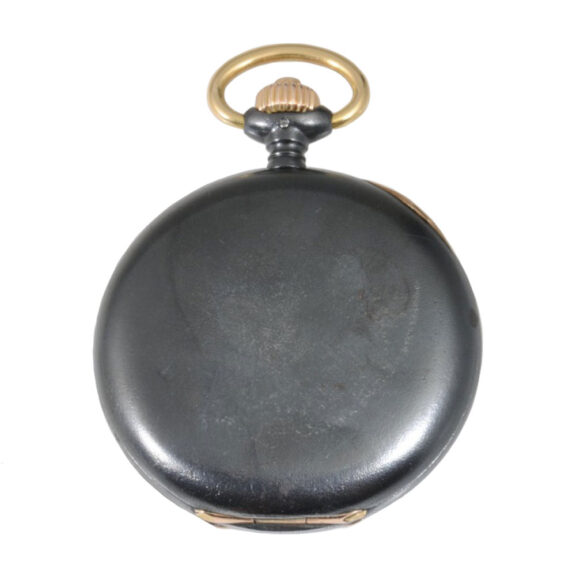
Gunmetal full hunter by A. Lange & Söhne
–
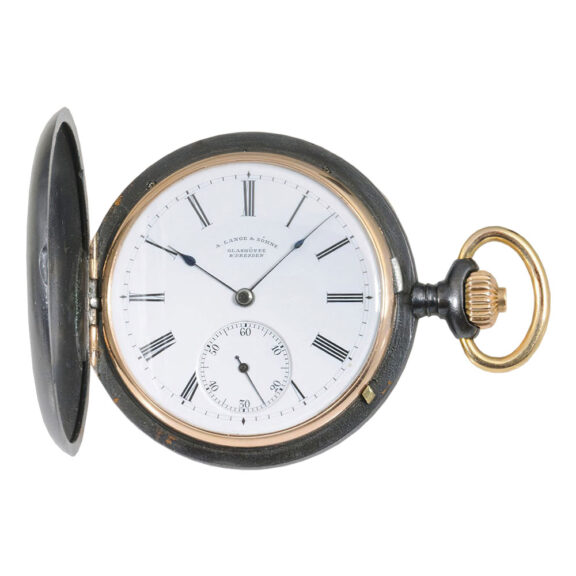
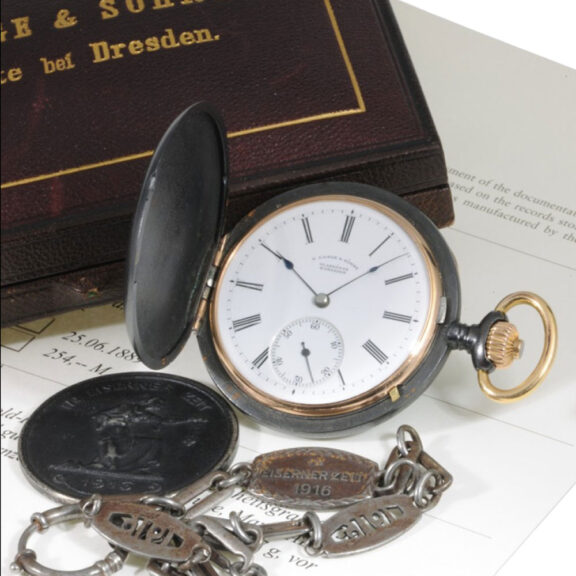
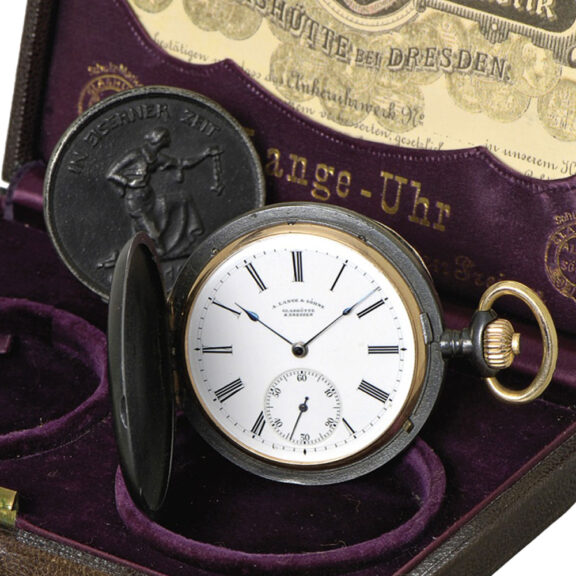
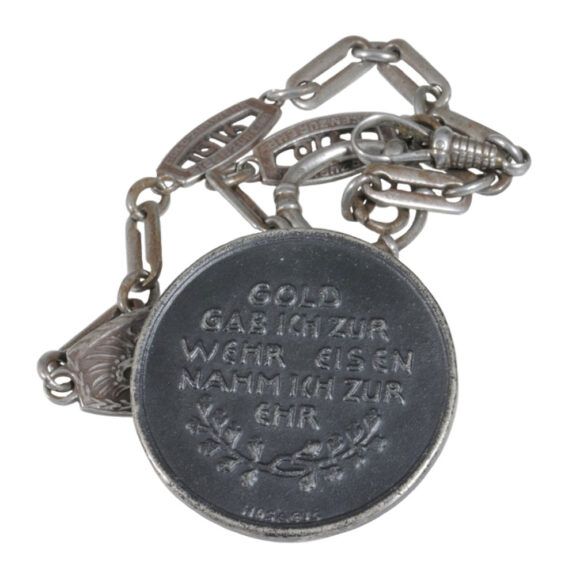
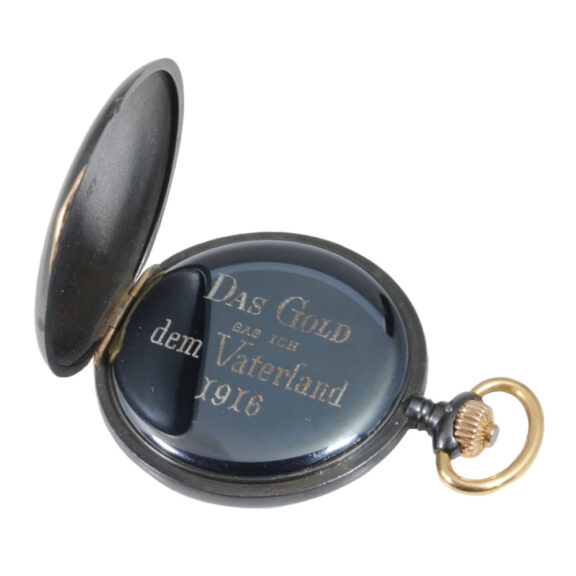
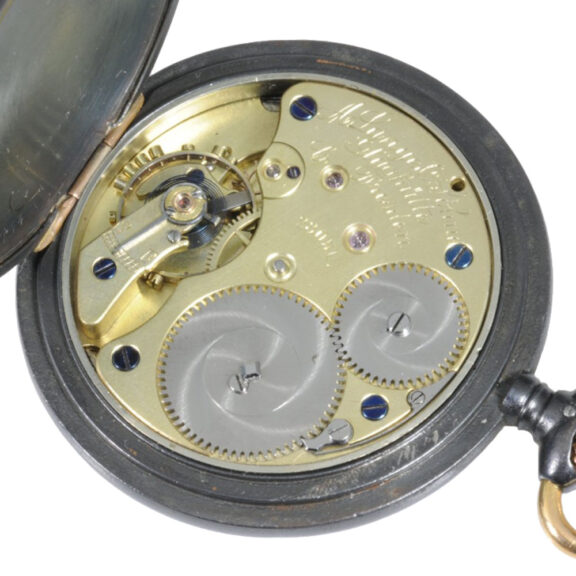
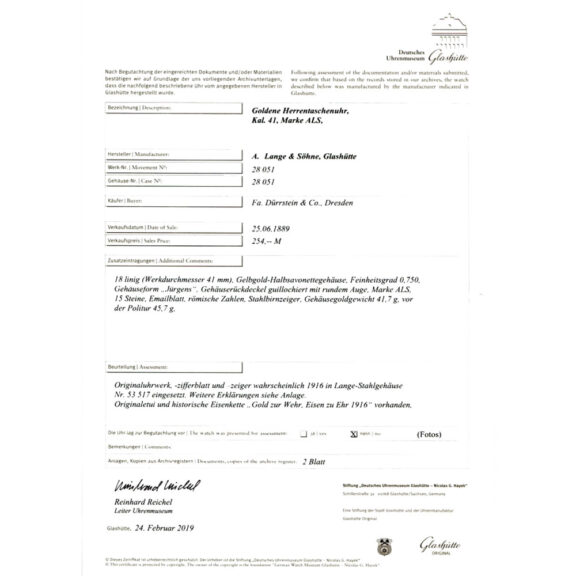
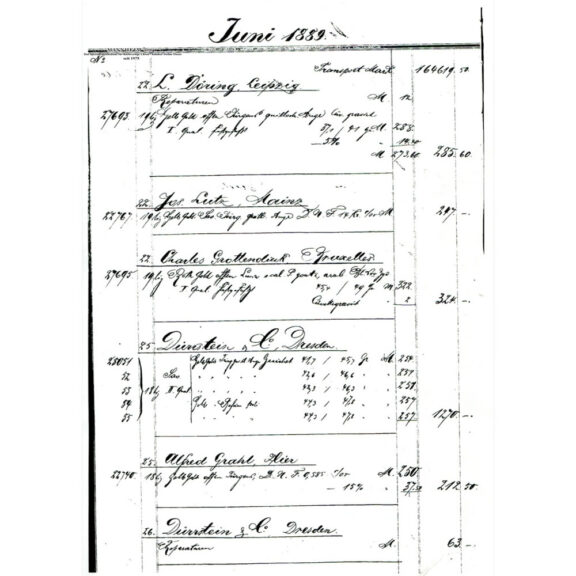
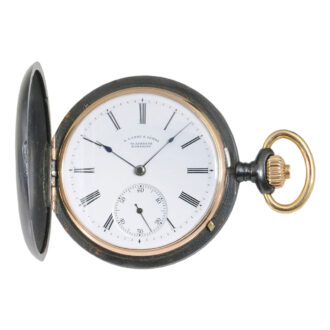
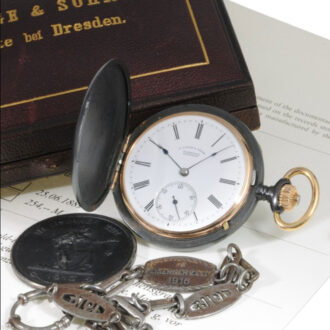
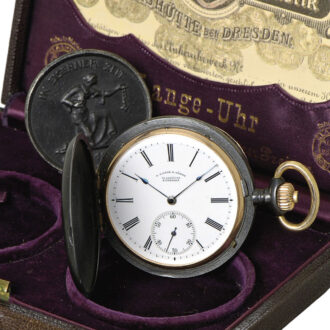
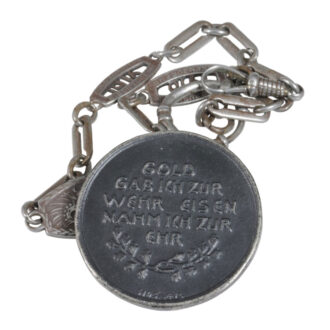
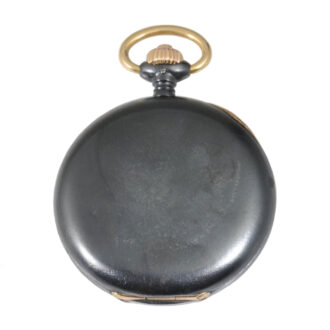
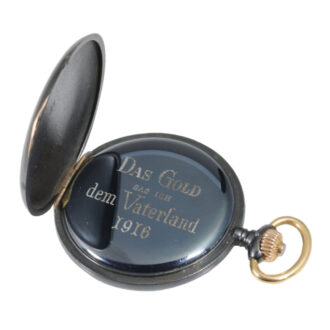
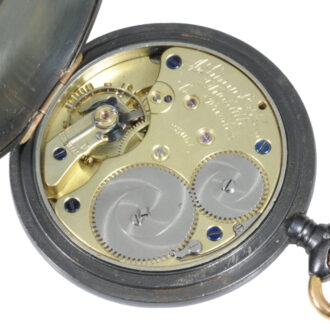
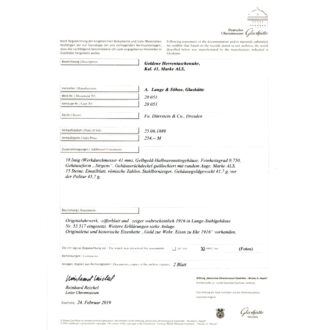
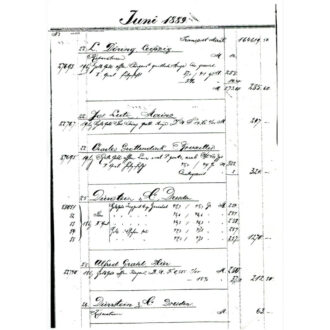
A historically interesting German gunmetal hunting cased lever pocket watch, circa 1889. Sold on 25th June 1889 to Dürrstein & Co in Dresden for 254 Marks. 3/4 Plate movement, screw compensation balance. Cuvette with the inscription Gold gab ich dem Vaterland 1916. White enamel with Roman hours and outer minute divisions, subsidiary seconds. Plain iron case, gunmetal finished, gold mountings. Dial signed, movement signed and numbered. Comes with the original box, an Extract from the Archives, a personal statement from the curator of the foundation Deutsches Uhrenmuseum Glashütte (German watch and clock museum Glashütte), a watch chain and medal inscribed Gold gab ich zur Wehr, Eisen nahm ich zur Ehr (I gave gold for the country and took iron for honour).
–
Diameter: 51 mm
–
Weight: 91 g
–
Signed: A. Lange & Söhne Glashütte B/Dresden
–
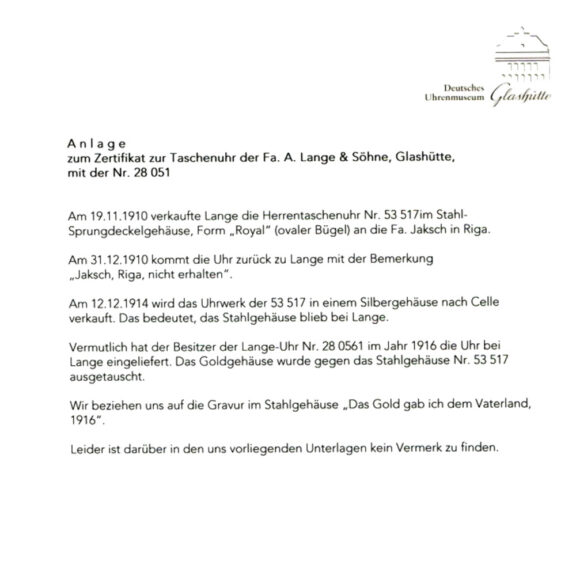
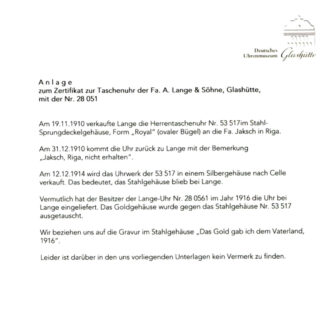
It is a changeful story that leads us from the making of this timepiece in the 1880s to World War I. It is one of the very few watches produced by Lange & Söhne, where the movement number and case number do not match. According to company records, the watch in its original gold case was made in Glashütte as number 28051 and sold to the Dürrstein company in Dresden in 1889. Around 20 years later, Lange & Söhne delivered another watch bearing the number 53517 in an iron case to the company Jaksch in Riga. The watch was returned, however, some weeks later because it was undeliverable. After another four years, in late 1914, the movement of this watch was sold to Celle, this time in a silver case. The iron case remained in Glashütte and in 1916 when wartime Germany was in need of resources and foreign currencies, watch number 28051 was taken from its gold case and fitted into the steel case. This is verified by the engraving on the cuvette: ‘Das Gold gab ich dem Vaterland’ (I gave the gold to the fatherland). To reward this dedication, the Bank of Germany awarded a medal with the inscription “Gold gab ich zur Wehr, Eisen nahm ich zur Ehr” (I gave gold for the country and took iron for honour). The inscription is repeated on the watch chain, which also bears the year “1916 – In eiserner Zeit” (1916 – an iron time). The watch was formerly the property of Johannes Hermann Gustav Remy, a member of the prominent Remy industrialist family. Lieutenant commander and submarine captain Remy went missing in action in 1918 in the Mediterranean near Malaga.
–
A similar call for donations had been made before in the time of the Prussian kingdom. Princess Marianne of Prussia asked Prussian women to donate their gold in exchange for iron jewellery with the inscription “Gold gab ich für Eisen” (I gave gold for iron). In World War I this call for donations was repeated and from 1916 on the donations were rewarded with medals such as this one, which was designed by Hermann Hosaeus (1875 – 1958). Hosaeus was famous for his war memorials and medals.
–
Ferdinand Adolph Lange was the founder of A. Lange & Söhne. He was born in 1815 as the son of Johann Samuel Lange. Early in life, his parents separated and he was adopted by a foster family. Luckily this family offered him a chance at proper education and in 1829, he joined the Technical University of Dresden. Lange’s master was Christian Friedrich Gutkaes, the maker of the famous five-minute clock in the Dresden Opera House and the court watchmaker later on. Lange finished his apprenticeship with honours and went on to work with Gutkaes as his assistant for more than two years. In 1837, Lange decided he wanted to learn the watchmaking craft from the best of the time and this decision took him to Paris, Switzerland and England. He spent four years with the master watchmaker Winnerl, a student of Breguet, in Paris. Lange returned to Dresden in 1841 and took over his now father-in-law Gutkaes’ business in 1842. He had the ambition to bring prosperity to the once rich, now unfortunate Erzgebirge region, Glashütte, he wanted to build a watchmaking industry and create jobs. He received funding from the high council of Saxony and on December 7th, 1845, Ferdinand Adolph Lange founded A. Lange & Cie. He started with fifteen young men who were obliged to work with him for at least five years and following Lange encouraged his apprentices to found their own specialized firms in Switzerland. He set up a watchmaking cluster in the region along with his colleagues Julius Assmann, Adolf Schneider and Moritz Grossmann. At the time, there was a specialist for every part, producing individual pieces of the highest quality. Ferdinand Adolph developed numerous mechanisms, from the remontoir to dead-seconds and repeaters and he introduced the metric system to watchmaking. Eventually, it took Glashütte watchmaking 20 years to develop. After two successful decades and as the mayor of Glashütte Ferdinand Adolph Lange retired in 1868. He enjoyed his spacious house built adjacent to the factory, which today serves as the headquarters of the modern A. Lange & Söhne. He gave the reigns of his legacy to his sons Richard and Emil Lange, subsequently, the company’s name was changed from A. Lange & Cie to A. Lange & Söhne. Under their management A. Lange & Söhne expanded tremendously. Ferdinand Adolph Lange died in 1875.
Signed: A. Lange & Söhne Glashütte B/Dresden
Share this page: