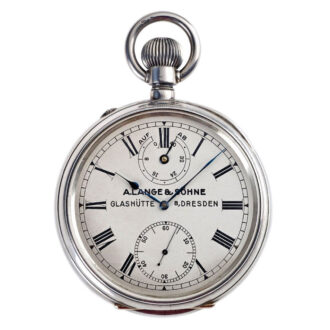
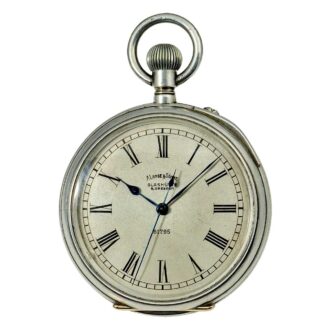
German chronometer with jumping half seconds Circa 1918
- Kenmerk
- DB0038
- Diameter
- 61 mm
- Estimate
- € 20.000 - 35.000
- Price sold
- € 25.000
Silver quality 1A deck chronometer by A. Lange & Söhne
–
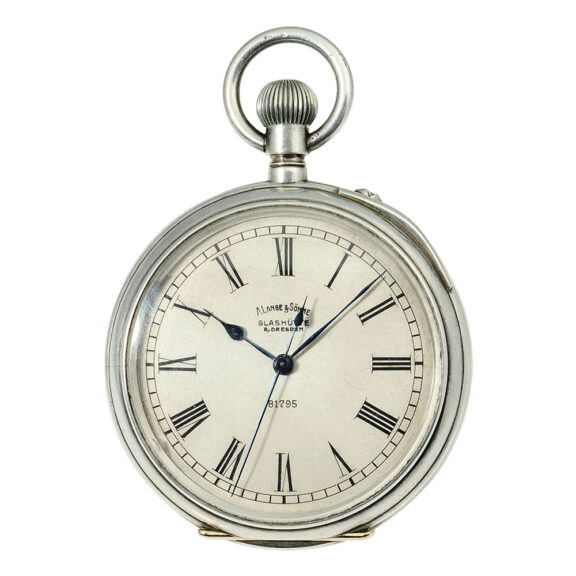
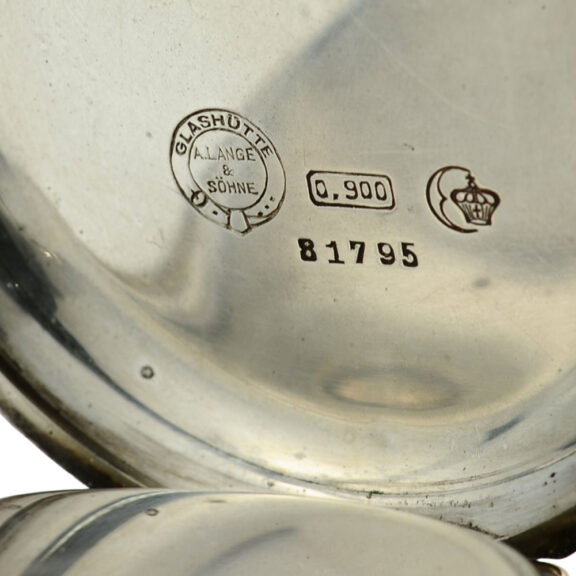
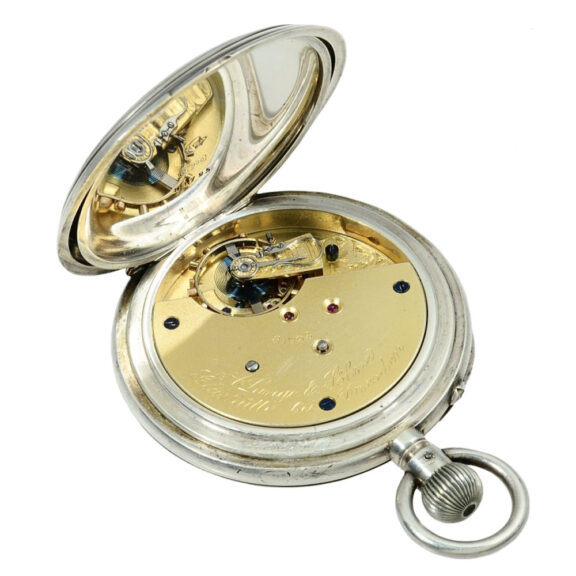
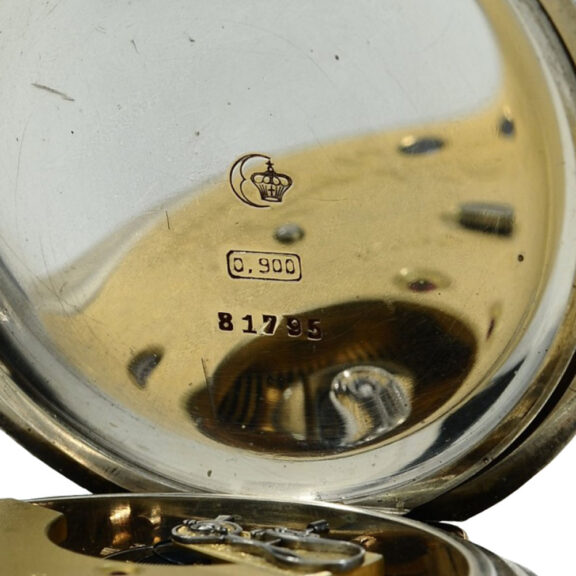
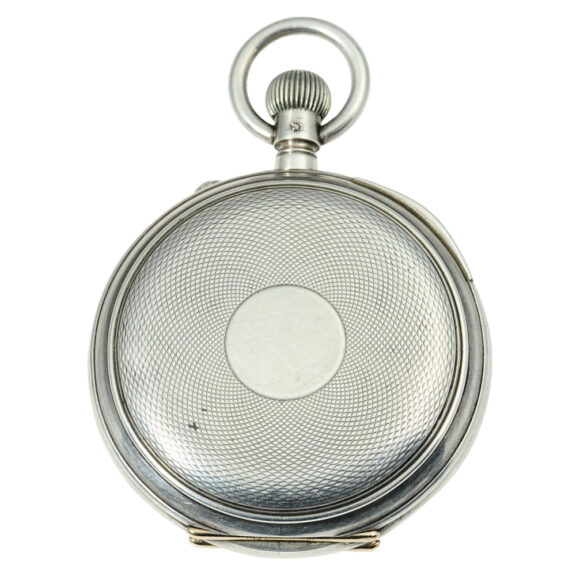
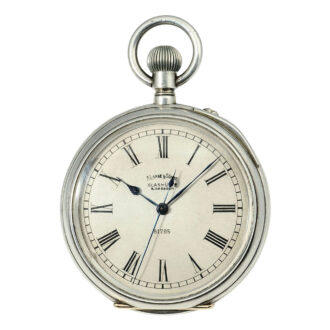
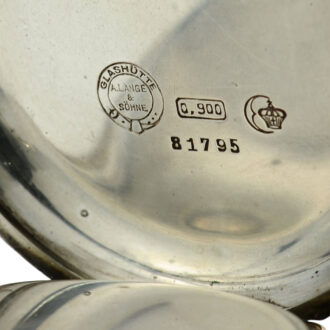
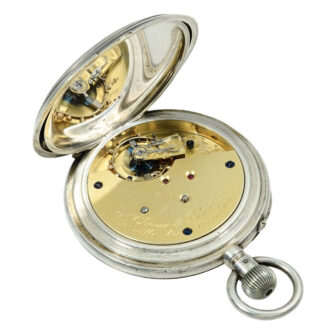
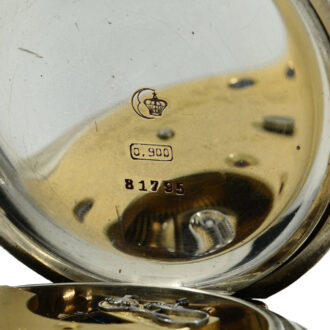
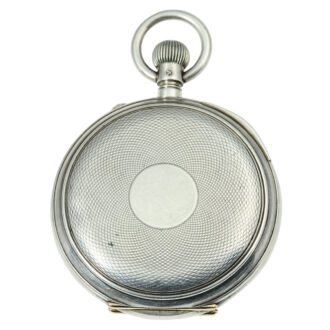
A German silver open faced half second jumping deck chronometer in quality 1A, circa 1918. Delivered to the Imperial Hydrographical Institute in Pola on May 17th, 1918, for 396 DM. 2/3 plate movement, pivoted detent chronometer escapement according to Julius Grossmann with two screwed gold chatons, gold screw compensation balance. Matt silvered dial with Roman hours and outer minute divisions. The case back is engine turned, both bezels smooth, a Jürgens case design.
Dial and movement signed and numbered, case numbered. Comes with an Extract from the Archives.
–
Diameter: 61 mm
–
Weight: 184 g
–
Signed: A. Lange & Söhne Glashütte B/Dresden
–
Only a total of 41 pieces were produced of this type of watch.
–
Pocket chronometers with a barrel. Pocket chronometers are considered to be the precursors to deck watches. Lange & Söhne originally produced pocket chronometers with going barrels for scientific purposes. Often set in wooden boxes, they were to be used as deck chronometers on ships. Following this style, the watches were designed with 14,400 alternations per hour, as a result, the second hand was able to jump every half second. The watches all have pivoted detent escapements, which were designed in two different styles: one version was the chronometer escapement according to Berthoud, and the other the escapement according to Julius Grossmann, which had an additional safety lever to prevent the escapement wheel from going on once the balance had been taken out.
–
Ferdinand Adolph Lange was the founder of A. Lange & Söhne. He was born in 1815 as the son of Johann Samuel Lange. Early in life, his parents separated and he was adopted by a foster family. Luckily this family offered him a chance at proper education and in 1829, he joined the Technical University of Dresden. Lange’s master was Christian Friedrich Gutkaes, the maker of the famous five-minute clock in the Dresden Opera House and the court watchmaker later on. Lange finished his apprenticeship with honours and went on to work with Gutkaes as his assistant for more than two years. In 1837, Lange decided he wanted to learn the watchmaking craft from the best of the time and this decision took him to Paris, Switzerland and England. He spent four years with the master watchmaker Winnerl, a student of Breguet, in Paris. Lange returned to Dresden in 1841 and took over his now father-in-law Gutkaes’ business in 1842. He had the ambition to bring prosperity to the once rich, now unfortunate Erzgebirge region, Glashütte, he wanted to build a watchmaking industry and create jobs. He received funding from the high council of Saxony and on December 7th, 1845, Ferdinand Adolph Lange founded A. Lange & Cie. He started with fifteen young men who were obliged to work with him for at least five years and following Lange encouraged his apprentices to found their own specialized firms in Switzerland. He set up a watchmaking cluster in the region along with his colleagues Julius Assmann, Adolf Schneider and Moritz Grossmann. At the time, there was a specialist for every part, producing individual pieces of the highest quality. Ferdinand Adolph developed numerous mechanisms, from the remontoir to dead-seconds and repeaters and he introduced the metric system to watchmaking. Eventually, it took Glashütte watchmaking 20 years to develop. After two successful decades and as the mayor of Glashütte Ferdinand Adolph Lange retired in 1868. He enjoyed his spacious house built adjacent to the factory, which today serves as the headquarters of the modern A. Lange & Söhne. He gave the reigns of his legacy to his sons Richard and Emil Lange, subsequently, the company’s name was changed from A. Lange & Cie to A. Lange & Söhne. Under their management A. Lange & Söhne expanded tremendously. Ferdinand Adolph Lange died in 1875.
Signed: A. Lange & Söhne Glashütte B/Dresden
Share this page: