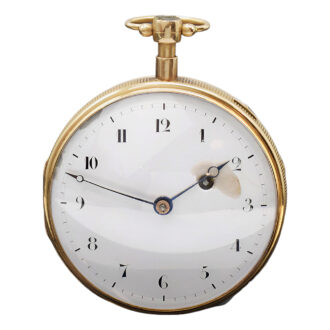
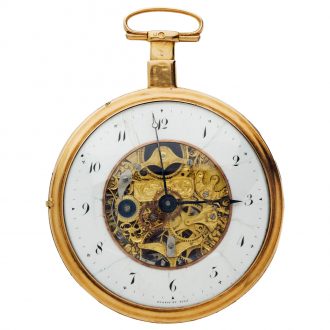
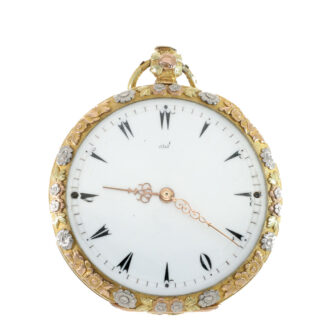
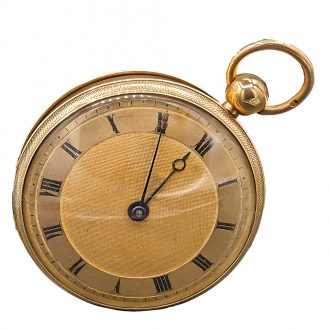
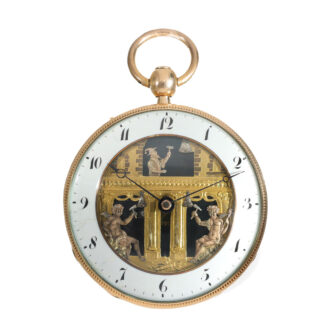
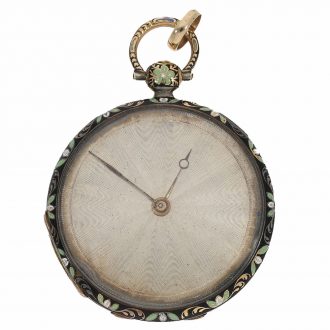
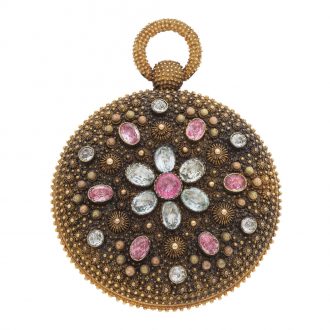
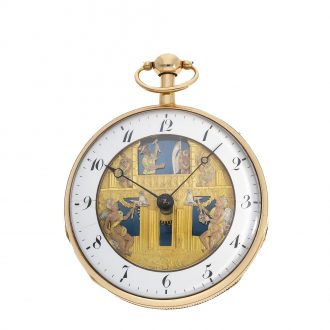
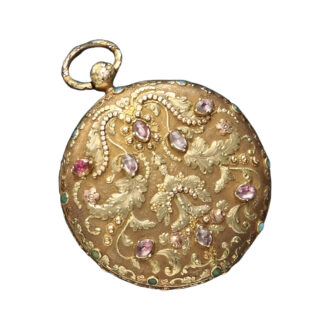
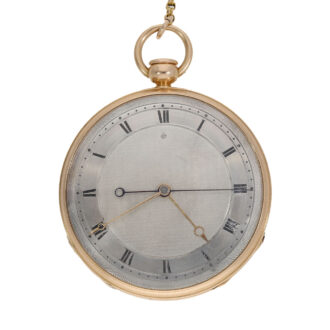
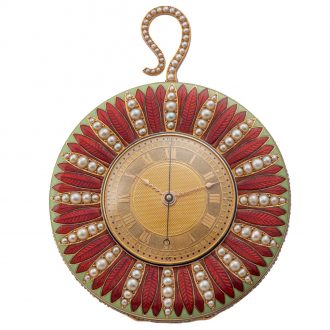
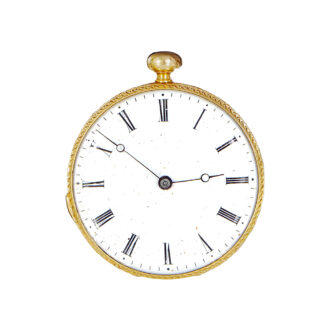
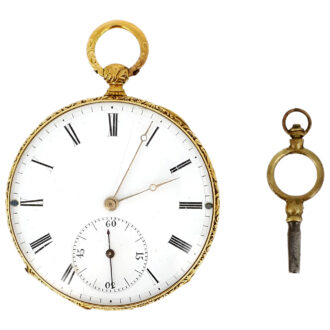
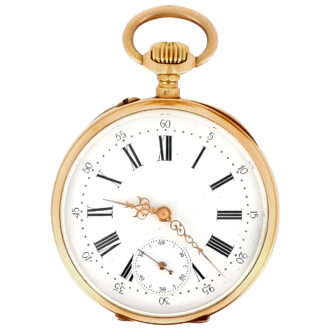
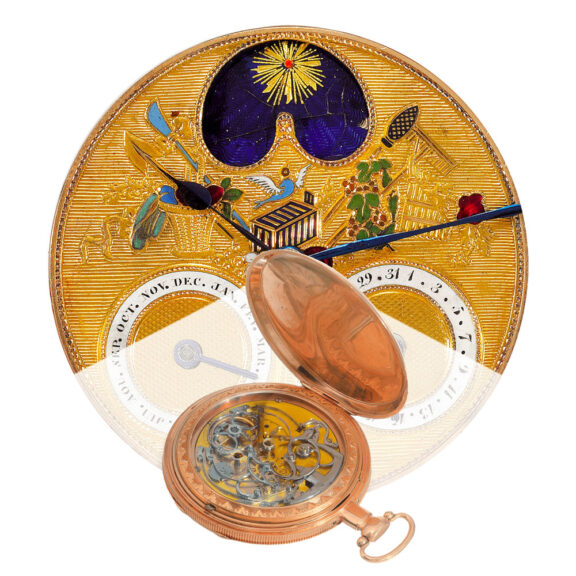
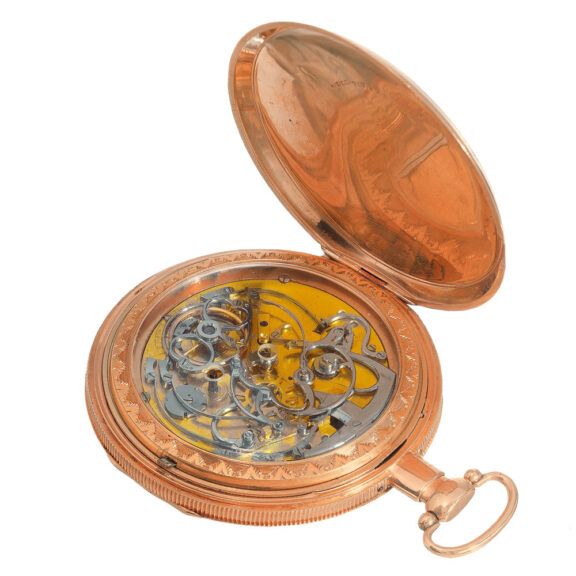
Swiss rose gold quarter repeating cylinder watch Circa 1820
- Kenmerk
- BA0232
- Diameter
- 62 mm
- Estimate
- € 20.000 - 35.000
- Price sold
- -
Rose gold repeater with complications
–
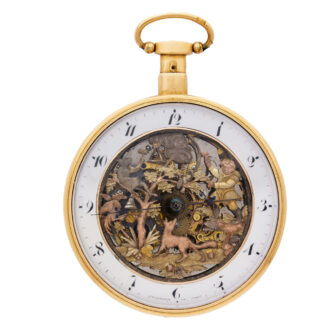
Very fine, extremely rare and large Swiss 18 carat rose gold quarter repeating pocket watch with sunrise and sunset, day and month indications, circa 1820. Attributed to Courvoisier Frères, La Chaux-de-Fonds. Frosted gilt full plate movement, cylinder escapement, three armed brass balance, flat balance spring, index regulator, repeating on gongs activated by depressing the pendant, polished steel repeating work on the back plate. Spring-loaded gilt metal glazed cuvette. White enamel chapter ring with Breguet numerals, outer minute track, the centre with gold guilloché and gold polychrome enamel decoration representing autumn, an aperture for sunrise and sunset indication at 12, the duration of the day lengthening and shortening by means of a rising and falling blued steel plate reducing the size of the aperture controlled by a cam on the month wheel, at 4 o’clock a white chapter ring for the days and at 8 for the indication of the months, later blued steel spade hands. An engine-turned case back with a vacant cartouche, stepped concave bezel, reeded band, makers mark DLG and a Neuchâtel gold mark.
–
Diameter: 62 mm
–
Signed: No name
–
Nicolas-Constant Lemaire or Le Maire, as he engraved on this box, learned watchmaking in Paris, but perfected his art by working for the famous automata maker Jaquet-Droz. He quickly showed great talent. Maillardet, Jaquet-Droz’s London associate, wrote to Leschot around 1793: “Le Maire left about 3 weeks ago, saying he was going to Geneva. You will have a great rival.”. Leschot learned about Lemaire’s talent first-hand: Lemaire when in Geneva, paid him a visit. In a letter to Frisard, Leschot, in a patronizing tone, wrote: “I forgot to tell you, in speaking of Lemaire, that he has come to see me since his arrival here and that he gave me proof of being a good copier, for he showed me a little bird, exceptionally well executed, which moves in all directions on a stick, like our large ones.”. “Exceptionally well executed.”, he wrote – Lemaire must have been not just good, he was exceptionally good. No wonder he went on his own. On September 25, 1793, Leschot wrote the following to Henry Maillardet, for he suspected Lemaire of representing rival merchants: “I open my letter again to tell you, dear friend, that I have just this instant heard that Mr Maire, your former workman, has arrived in Geneva. Please tell me in response, as quickly as possible, in case he desired to commission certain pieces, such as little birds to dress etc., if I may be assured these birds are commissions for you. If this were the case, I would have them feathered with pleasure, after my own. But if these birds etc. are intended for other people, I am determined not to touch them.”. This letter implies clearly that Lemaire went on his own and was capable of manufacturing complicated singing bird movements. This letter, along with the one cited below puts in doubt if the famous singing bird watch signed Breguet (now in the Patek Philippe Museum) is not a cooperation between Lemaire and Breguet. In a letter of January 16, 1796 Leschot wrote to Frisard: “I received a letter from Mr. Giroux of Paris, engraver, who wanted to give me the commission of Mr. Rossel of Paris for the mechanism of a box for which he enclosed a sketch… I thought it best to give you a copy of all this so that you will be … forewarned …. I hope that you will respond as I did…it is fitting that you and I … be cautious concerning any outside invitation … I mistrust Maire, Breguet and certain others.”. The letter clearly acknowledges the fear of competition from Lemaire, and, interestingly, joins Lemaire and Breguet. That the two worked together we know from Breguet records. Lemaire was one of his clock ebauche suppliers including the famous Pendules Pyramidales. The fact that Breguet himself cooperated with Lemaire leaves little doubt as to the talent and capabilities of the man. Lemaire proposed to the French Commission d’Agriculture et des Arts an establishment of a manufacture in which he would make automated clocks, singing bird boxes, ring watches, repeating and equation watches. Along with Glaezner, he was elected in 1796 as a director of the Manufacture de Versailles, an entity manufacturing high quality timepieces and possibly automata. At the Paris Exposition of 1798 (An VI) Lemaire exhibited, among other things, a box with a carillon (whereabouts unknown). This box is the only one by Lemaire known to have survived, making it extremely important for the history of French horology and automata.
–
Robert & Courvoisier are clock and watchmakers from La Chaux-de-Fonds, Switzerland. The firm was founded in 1795 as a successor to J. Robert & Fils, Courvoisier. In 1770 the firm was originally established by Josué Robert (1691–1771). After Robert’s death, a year after the company was founded, the firm was renamed Josué Robert & Fils and was led by his son Louis Benjamin Robert (1732–1781). They mainly produced large clockworks, but as Benjamin’s son-in-law, Louis Courvoisier became a companion, pocket watches were put into production. When Louis Benjamin died, Louis Courvoisier became the manager of the firm. From 1787 to 1795 the firm was called J. Robert & Fils, Courvoisier. From 1795 to 1805 it was renamed Robert & Courvoisier. Since 1805 the firm’s name was Robert, Courvoisier & Cie with Philip Grandjean as a business partner. In 1852 it became Courvoisier Frères. The firm continued under the direction of various members of the Courvoisier family until the 1930s. Along with the Jaquet-Droz firm, they were the most important makers of musical clocks and around the turn of the 18th and 19th centuries, their portable officers’ watches were famous.
Share this page: