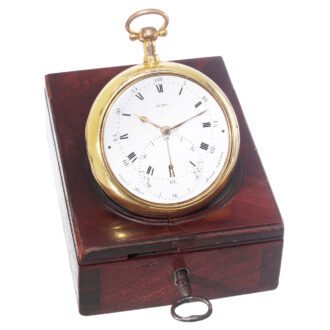
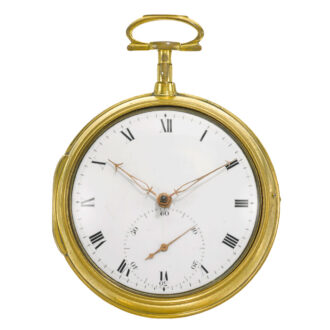
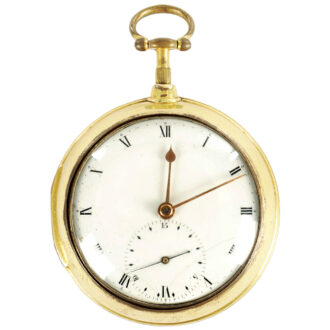
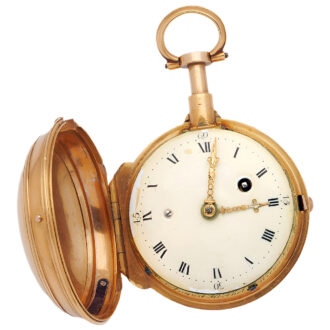
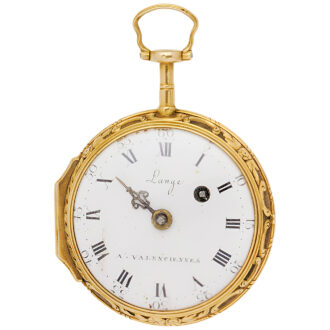
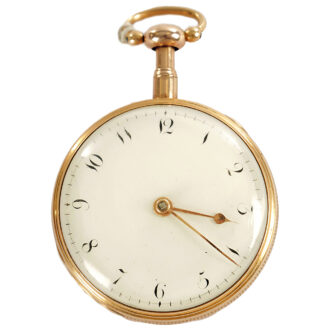
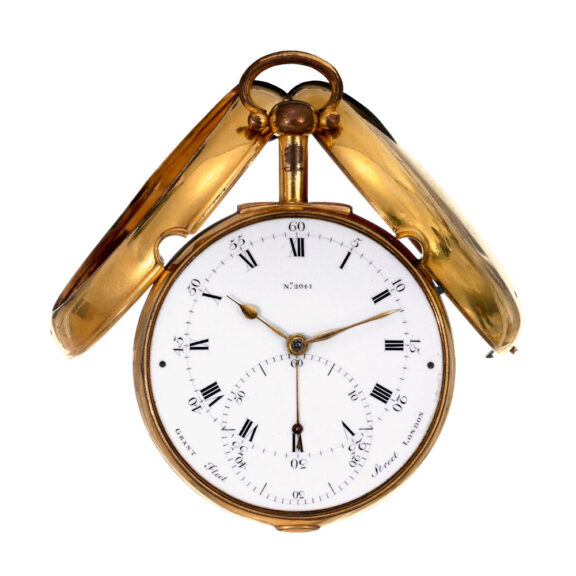
English gilt metal pair cased deck chronometer Circa 1795
- Kenmerk
- BA1146
- Diameter
- 62 mm
- Estimate
- € 5.000 - 10.000
- Price sold
- € 9.500
Gilt metal chronometer by John Grant
–
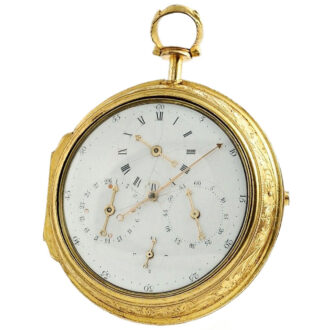
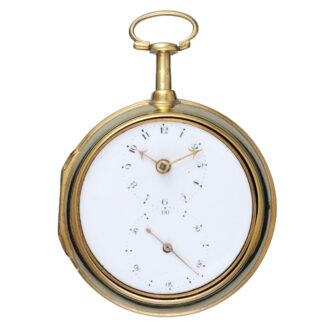
A very fine, extremely rare and large English gilt metal pair cased deck chronometer, circa 1795. Matte gilt movement, cylindrical pillars, large aperture for the balance staff, fusee and chain, the barrel with detachable plate with two screws, Harrison’s maintaining power, Arnold escapement with spring footed detent, brass bracket with screw for adjusting the depth of the detent, brass escape wheel, the impulse roller with unusually shaped recess, jeweled discharge roller, cut bimetallic compensation balance with two arms, peripheral gold temperature adjustment screws, balance and escape wheel pivots jeweled in screwed chatons, lower fourth wheel pivot jeweled for the seconds, blued steel flat balance spring, index regulator. White enamel dial, signed Henderson 24 on the reverse, secured by two small screws, eccentric chapter ring with Roman numerals, outer minute divisions and Arabic five minute numerals, bisecting large subsidiary seconds and original gold spade hands. Consular outer case, polished and concealed hinge, the inner case also polished, master mark AG. D. Dial and movement signed and numbered, underside of the balance cock punched I.R., dial plate numbered 25. Comes with the original fitted mahogany deck box with brass ring for wall mounting.
–
Diameter incl. outer case: 62 mm
–
Signed: Grant Fleet Street London
–
Only a very small number of watches by John Grant are known to exist and no two are the same. No marine chronometers are extant. Grant was one of the pioneers of the lever escapement and subsequently most of his watches are fitted with this escapement. Far fewer, as with the present watch, are fitted with Arnold’s spring detent escapement. This piece is very interesting because it was obviously intended for maritime use, the fact that it is fitted in a gilt metal case rather than gold confirms this. Only watches that were intended for practical service at sea were cased in this manner and a gilt metal case is not automatically, as is sometimes suggested, a sign of later replacement. The mahogany deck box appears to be original and is certainly of the same period as the watch. Grant, in common with other watchmakers, was very concerned with improving the rate of watches and the unusually shaped recess in the impulse roller of this watch is likely to be part of some experimentation to this end.
–
John Grant was apprenticed to his famous uncle, Alexander Cumming and became a Freeman of the Clockmakers’ Company in 1781. He was probably the last of the band of English experimenters with the lever escapement and his work is of the very highest quality. Grant died in 1810 and was succeeded by his son, also called John. Both traded from 75 Fleet Street.
Signed: Grant Fleet Street London
Share this page: