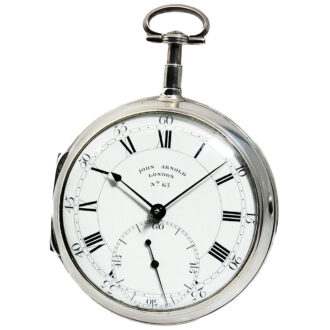
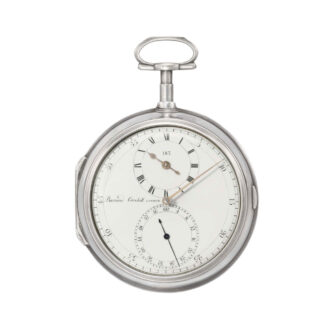
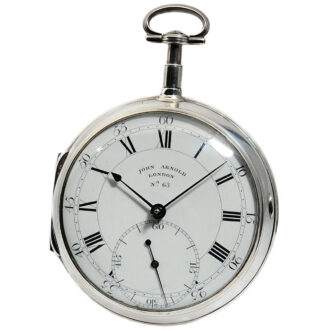
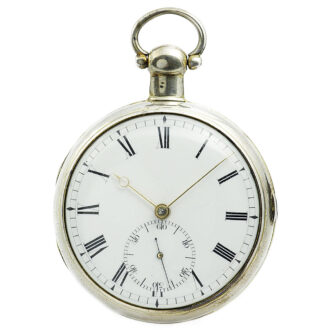
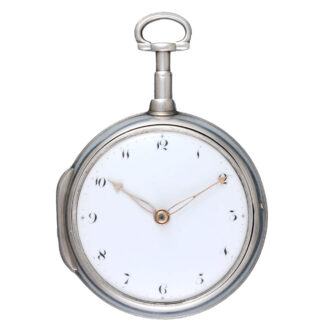
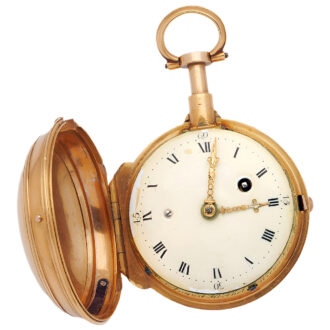
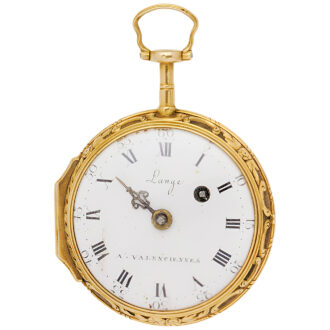
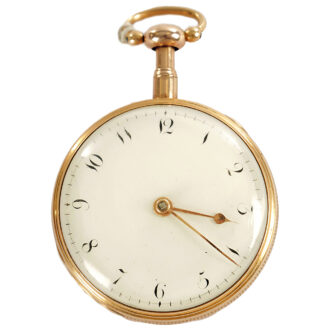
Very fine English silver George III chronometer Circa 1797
- Kenmerk
- BA1967
- Diameter
- 73 mm
- Estimate
- € 55.000 - 100.000
- Price sold
- -
Silver pocket and deck chronometer by John Arnold
–
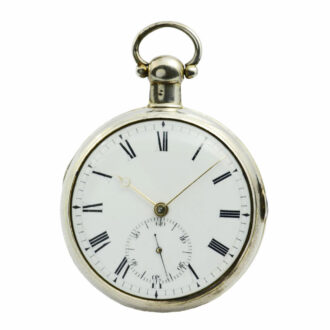
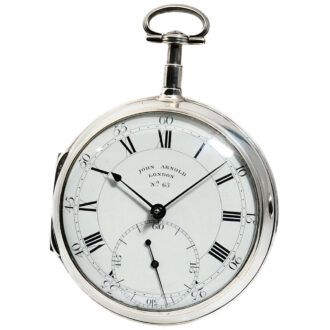
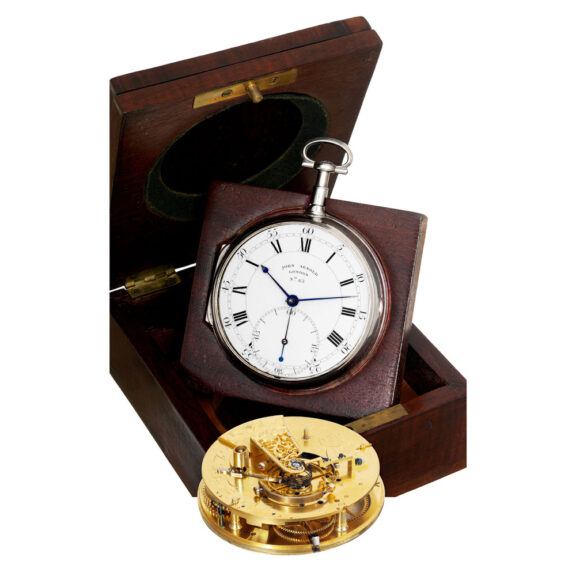
A very fine and extremely rare English silver George III pocket and deck chronometer, Hallmarked London 1797. Frosted gilt full plate movement, ringed cylindrical pillars, ten holes jewelled with screwed chatons, fusee with chain, Harrison’s maintaining power, Arnold spring footed detent escapement with large steel escape wheel, jewelled discharge roller, bimetallic steel and brass O-Z balance with meantime adjustment screws and temperature adjustment nuts, free-sprung blued steel helical balance spring with terminal curves, diamond endstone, pierced and engraved single footed cock. Flat white enamel dial with Roman numerals, outer dot minute markers and Arabic five-minute numerals, large subsidiary seconds, original blued steel spade hands, the minute hand secured by a screw. Polished case, maker’s mark TH, swivel pendant. Dial and movement signed, the case with Thomas Hardy’s punch mark TH. Accompanied by a three-tier mahogany fitted deck box.
–
Diameter: 73 mm
–
Signed: John Arnold London
–
John Arnold made a number of chronometers of this very large size, and it is known that they were both worn in the pocket and placed in the deck box.
–
John Arnold (1736-1799). After being apprenticed to his father in Cornwall, John Arnold established himself in London in 1760. Four years later, he presented George III with a half quarter repeating cylinder watch mounted in a ring. By the time he was 28 years old, his watches, whether verge or cylinder, displayed some original components such as straight-line compensation curbs and minute repeating by increments of 10 minutes instead of the more normal 15. It was towards 1768 that he had begun his research into marine chronometers. In 1771 he established himself at 2 Adam Street, Adelphi Buildings, Strand, where most of his research into marine chronometers was carried out over the next eleven years. By 1774 Arnold had constructed a marine chronometer with pivoted detents, in 1776 he invented terminal curves for the cylindrical balance spring and this was included in the patent for a bimetallic compensated balance that he took out in 1782. He subsequently devised numerous different balances such as the Double T, Double S, Z, O-Z and U. All the earliest chronometers were fitted with a pivoted detent escapement. His spring detent escapement, developed in 1782, was also included in the same patent. He was admitted to the Clockmakers’ Company in 1783. Arnold was the first to employ the term chronometer in the modern sense and successfully found a way to simplify Harrison’s timekeeper design. In 1787 he took his son, John Roger Arnold, into partnership, changing the business name to ‘Arnold & Son’, which it retained until his death.
Signed: John Arnold London
Share this page: