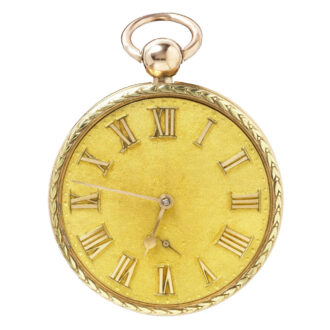
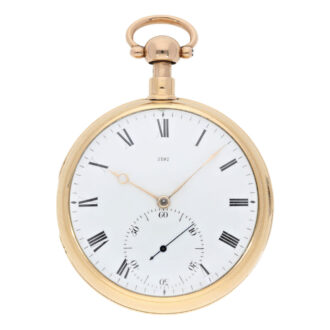
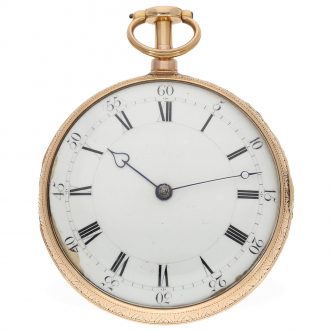
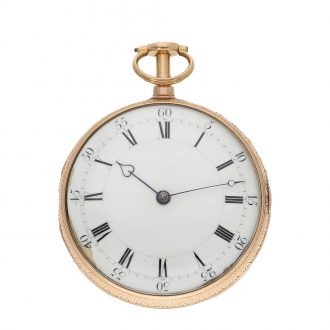
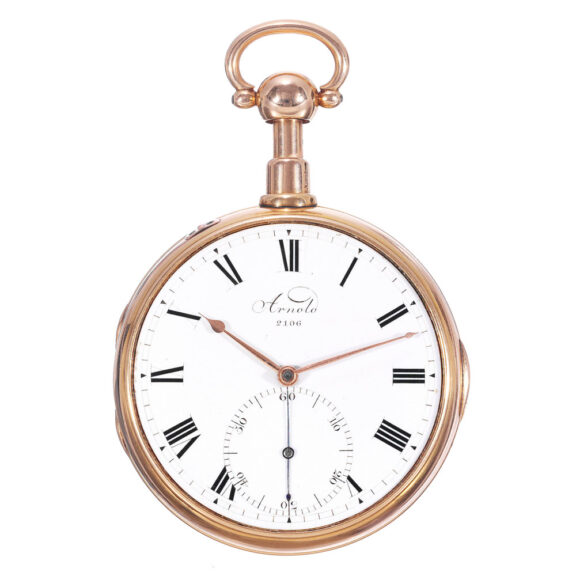
English 18k gold repeating deck chronometer Circa 1811
- Kenmerk
- BA0729
- Diameter
- 61 mm
- Estimate
- € 17.500 - 30.000
- Price sold
- -
Gold half quarter repeating deck chronometer by John Roger Arnold
–
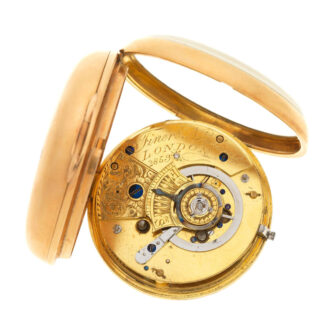
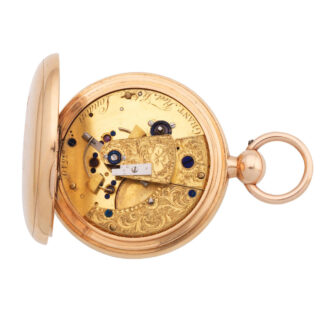
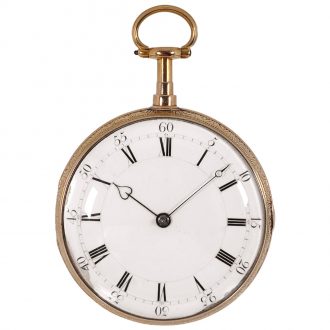
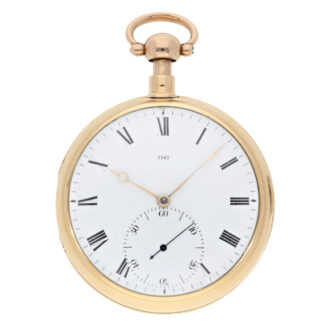
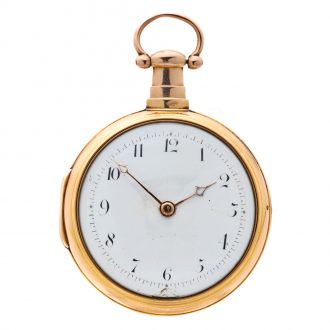
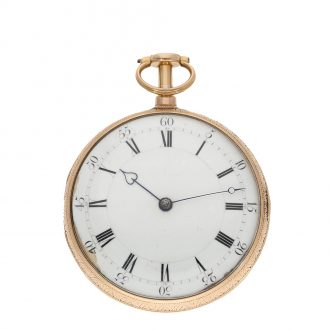
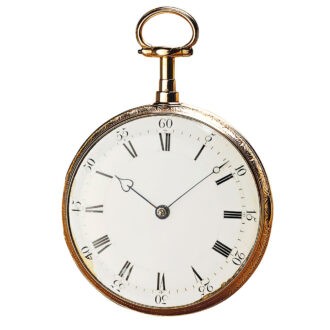
An extremely fine and equally rare English 18 carat gold open faced half quarter repeating pocket and deck chronometer with Arnold spring detent escapement and Z balance, Hallmarked London 1811. Matte gilt full plate movement, ringed cylindrical pillars, 6 holes jeweled with screwed chatons, fusee with chain, Harrison’s maintaining power, Arnold spring detent escapement with brass escape wheel, spring footed detent with jeweled locking stone, fitted into a slot in the backplate, steel roller with jeweled insert, bimetallic steel and brass Z balance with meantime adjustment screws and temperature adjustment nuts, freesprung blued steel helical balance spring with terminal curves, ruby endstone, single footed cock, Stogden type repeating work, repeating the hours, quarters and half quarters with two hammers on two square section gongs, activated by depressing the pendant. Fixed gold cuvette with aperture for winding. White enamel dial, the reverse signed C+H, radial Roman numerals, outer minute track, large subsidiary seconds, original gold spade hour and minute hands, the blued steel seconds hand secured by a screw. Consular case, polished, maker’s mark WW, bolt at 11 o’clock to lock the repeating. Dial and movement signed.
–
Diameter: 61 mm
–
Signed: Jno R. Arnold London Inv.t et Fecit
–
It is highly unusual, although not unprecedented, for a pocket chronometer of this quality to have repeating work. Any further complications added to a precision watch adversely affect the timekeeping. Consequently, very few chronometers feature repeating.
–
John Roger Arnold (1769-1843), was the son of eminent British horologist John Arnold, in 1792 he was apprenticed in Paris to A.L. Breguet. A member of the Clockmaker’s Company in 1796, in 1817 he became Master. In 1830 he entered into partnership with E.J. Dent. Much experimental work was done during this period, particularly on the effects of magnetism on chronometers. In 1840 Dent left Arnold, who continued on his own but died three years later, in February 1843. After Charles Frodsham’s purchase of the business, the company flourished until 1858 as Arnold and Frodsham.
–
The Stogden repeating mechanism. Around 1730, a workman for George Graham named Matthew Stogden invented a repeating mechanism different from the one used in most fine English repeaters. In his early years Breguet also used it, though later he used his own system, a modification of Stogden’s.
Signed: Jno R. Arnold London Inv.t et Fecit
Share this page: