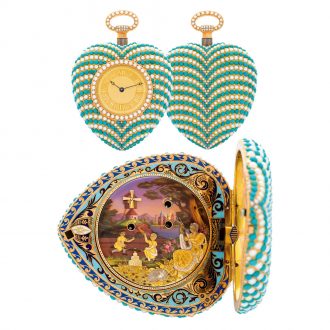
Important Swiss heart-shaped repeating musical automaton Circa 1820
- Kenmerk
- BA3048
- Diameter
- -
- Estimate
- € 150.000 - 300.000
- Price sold
- € 252.100
Gold decorative musical automaton The Heart by Isaac Daniel Piguet
–
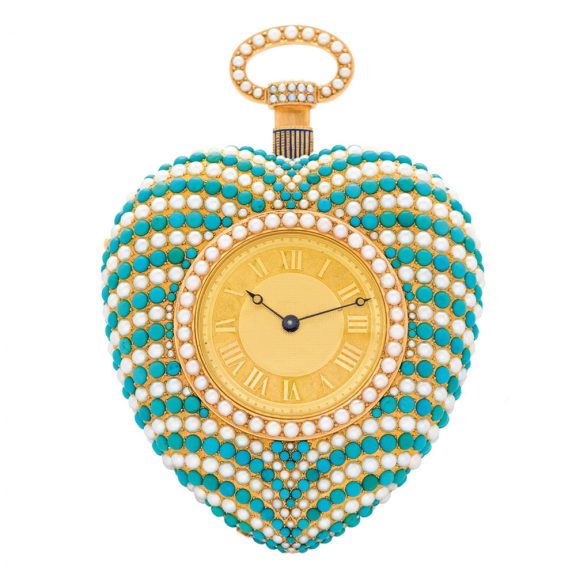
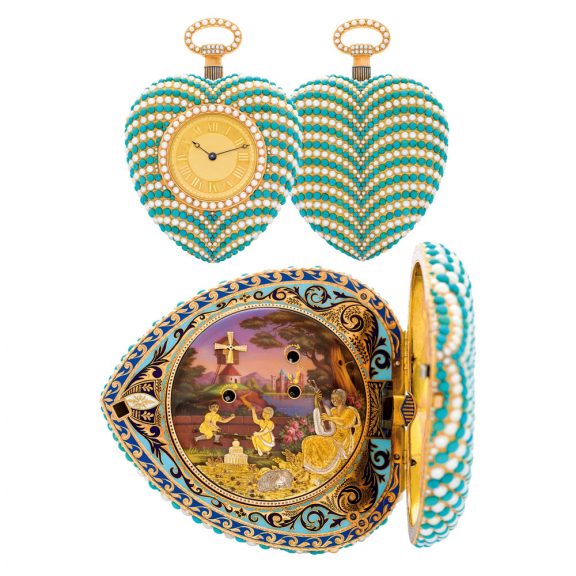
An extremely rare and important Swiss 18-carat gold, enamel, pearl and turquoise heart-shaped musical automaton pocket watch with quarter repeater, made for the Eastern market, circa 1820
–
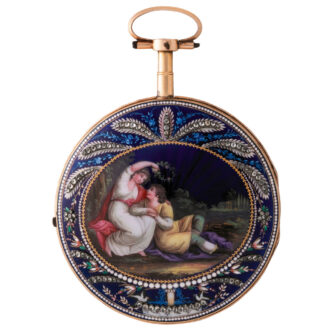
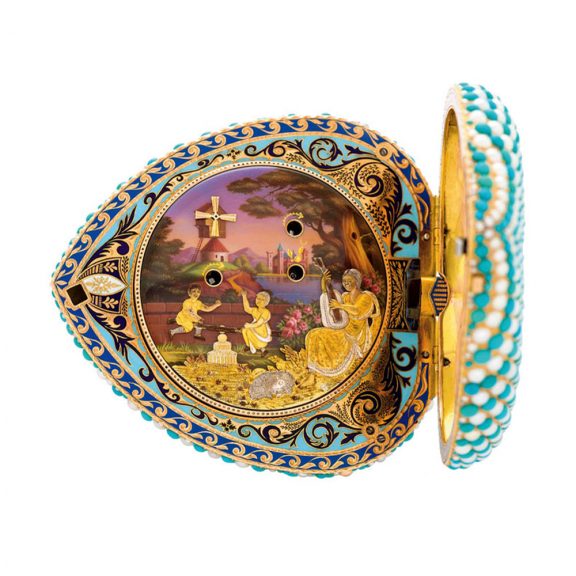
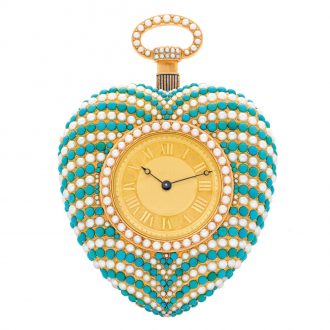
The heavy heart-shaped case is hinged at the top. The outside is entirely set with curving, alternating rows of graduated split pearls, and the bezel and bow are also set with split pearls. The pendant is decorated with lines of blue champlevé enamel and ends in a pearl. Inside, the case is decorated with fine turquoise, blue and white champlevé enamel, and a border of gold foliate scrolls frames the automaton.
–
The automaton scene is finely painted in enamel. It shows a river landscape with trees and a château on the far bank. On a small hill stands a windmill with moving gold sails. In the foreground, two children in gold of several colours play on a moving see-saw. On the right, a lady sits on a grassy bank playing the guitar, with her arm moving and a dog at her feet. The openings for winding and setting the hands are marked with gold foil.
–
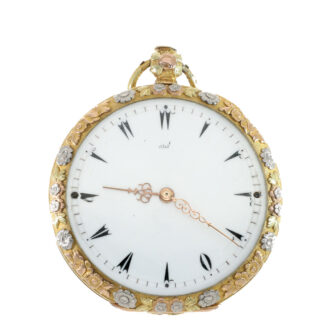
The gold dial is partly matte and partly polished, with an engine-turned centre. It has Roman hours, dots marking the minutes around the edge, and blued steel Breguet hands.
–
The gilt-brass movement measures 44.5 mm across. It has a standing barrel, a cylinder escapement with an inverted escape wheel, and a plain three-arm brass balance with a flat balance spring and a polished steel endpiece. The index regulator sticks out from the edge of the automaton scene. The watch repeats the quarters on gongs when the pendant is pressed. The music comes from an early sur plateau mechanism, with a fixed barrel and 17 tuned teeth in blued steel played by pins on both sides of a disc. A button on the side of the case starts the music.
–
The number 549 is stamped inside both halves of the case. The movement is scratch-signed “Isàc D.el Piguet Genève” on the dial plate, under the musical teeth, and stamped 549. The pinned disc is stamped with the same number and with the number 08.
–
Dimensions: 72 x 67 mm
–
Signed: Isàc D.el Piguet Genève
–
Isaac Daniel Piguet
Isaac Daniel Piguet was born in 1775 in Le Chenit, in the Vallée de Joux, the son of Pierre Moïse Piguet and Elisabeth Nicole. He married Jeanne Françoise Capt around 1795, and around 1800 he moved to Geneva with his family. On 10 February 1802 he went into business with his brother-in-law, Henry Daniel Capt. He later met Philippe Samuel Meylan, another watchmaker from his home region, and together they founded Piguet & Meylan, which lasted from 1811 to 1828. After that partnership ended, Piguet and his son David Auguste set up a new firm, Piguet Père & Fils, at 69 Rue Jean-Jacques Rousseau. Piguet died in Geneva on 20 January 1841, aged 66.
–
The heart-shaped watches
The remarkable heart-shaped watches made by Isaac Daniel Piguet and by Piguet & Meylan in the first quarter of the 19th century belong to a small group of Swiss musical and automaton pieces. They are among the most extraordinary and imaginative objects of their kind ever made. European courts thought them fit to present to the kings and emperors of the East. Perhaps only four or five other examples are known. One was in the collection of Gustave Loup and later in that of King Farouk of Egypt. It was sold by Sotheby’s in the Palace Collections of Egypt sale in 1954, as lot 471.
Signed: Isàc D.el Piguet Genève
Share this page: