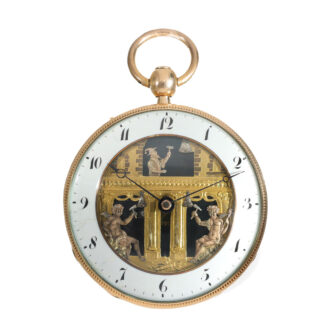
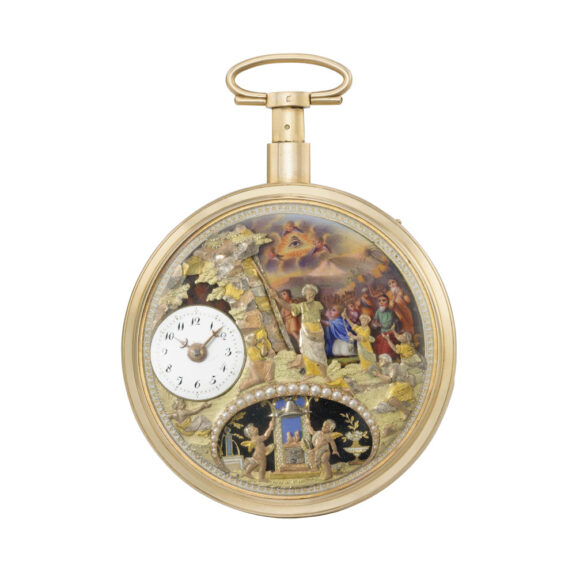
Important Swiss quarter repeater with automaton Circa 1820
- Kenmerk
- CH0329
- Diameter
- 64 mm
- Estimate
- € 250.000 - 350.000
- Price sold
- € 367.200
Gold and enamel open faced repeater with automaton by Charles Ducommun
–
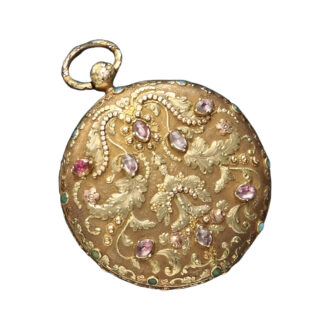
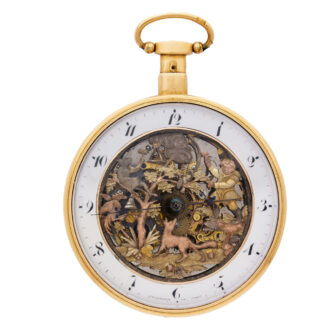
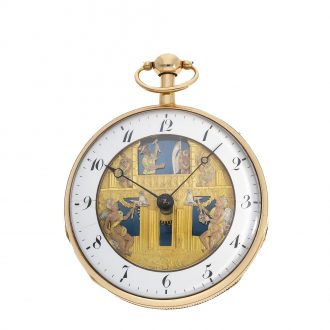
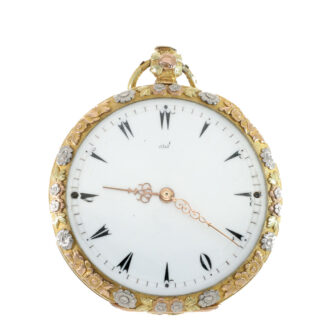
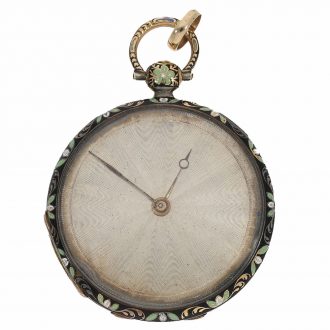
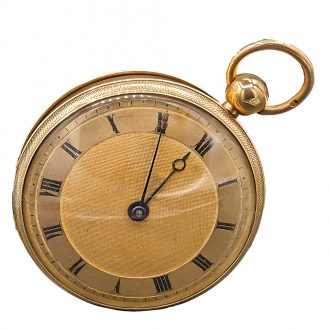
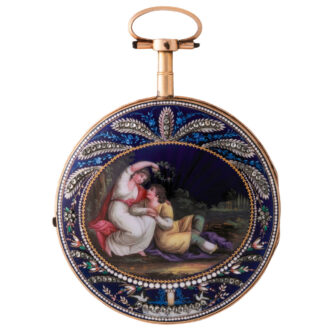
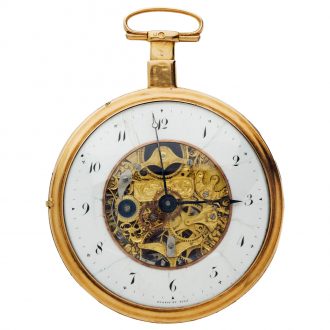
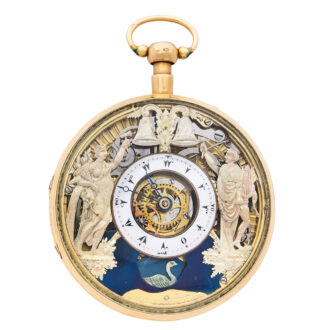
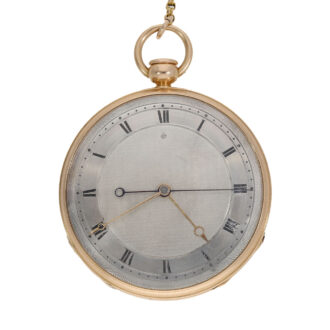
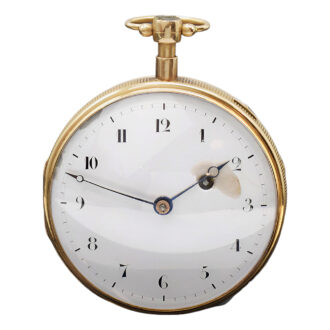
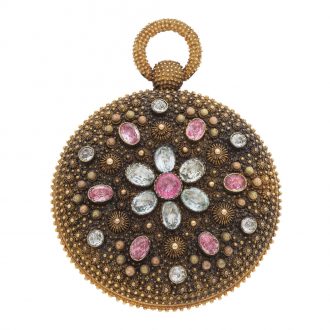
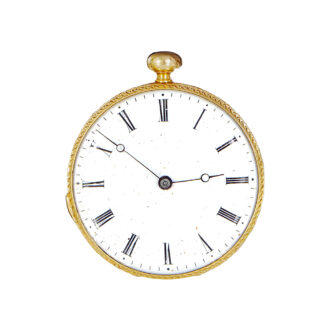
An extremely fine, rare and important Swiss 18 carat gold and enamel open faced quarter repeating watch with vari coloured gold automaton, circa 1820. Gilt finished cylinder movement, plain three armed balance, two scroll bridge, repeating on two gongs. Gilt cuvette. Small eccentric white enamel dial with Arabic numerals, applied vari coloured gold automaton scene depicting the prophet Moses hitting the rock with the staff in his right hand, after the second stroke the rock opens, revealing a waterfall with realistically flowing water, two kneeling Israelites drinking water from their chalices, a polychrome enamelled scene depicting the people of Israel beneath the Eye of God in the background, an oval aperture below framed by graduated split pearls revealing two putti striking a bell in unison with the repeating. Plain case, a slide in the band activating repeating and automaton, when set to repeating mode the hours and quarters are struck in unison by the two putti, when set to automaton Moses is striking the rock. Case stamped with casemaker’s initials ‘FTD’ and numbered, cuvette signed, pendant numbered and stamped with French import and assay marks.
–
Diameter: 64 mm
–
Signed: Ch. Ducommun dit Boudrit
–
This watch was allegedly given as a gift by Empress Eugénie of France, wife of Napoleon III, to Field Marshal Lintorn Simmons GCB GCMG and was handed down through the latter’s family.
–
Doña María Eugenia Ignacia Augustina de Palafox-Portocarrero de Guzmán y Kirkpatrick, 16th Countess of Teba and 15th Marquise of Ardales (5 May 1826 – 11 July 1920), known as Eugénie de Montijo, was the last Empress consort of the French from 1853 to 1871 as the wife of Napoleon III, Emperor of the French. The daughter of a Spanish noble who fought on the French side during Napoleon I’s Peninsular War in Spain, Eugénie went to Paris when Louis-Napoléon became president of the Second Republic in December 1848. They were married in January 1853 after he had become the Emperor Napoleon III.
–
On 16 March 1856, Eugénie gave birth to an imperial heir, Napoléon-Eugène-Louis Bonaparte. Concerned about the future of her family line, she began to take an active role in political affairs. On at least three occasions she served as regent (1859, 1865, 1870) in her husband’s absence and was certainly more than just a figurehead. A devoted Roman Catholic, she supported Ultramontane causes (favouring a strong papacy) and opposed her husband’s Italian policies that resulted in a loss of temporal power for the pope. She is often credited with having a preponderant voice in the decision to create a French-sponsored kingdom of Mexico (1861). Eugénie, especially sensitive because of her origins, supported French opposition to a Prussian candidate for the vacant Spanish throne, in the controversy that precipitated the Franco-German War of 1870. After the Battle of Sedan (1 September 1870) she joined her family in exile in England and, after the death of her husband (1873), continued to play a dominant role in Bonapartist political activities. When her son died (1879), she assumed the role of the grande dame in exile. Field Marshal Lintorn Simmons (1821-1903) and his wife were close personal friends of the exiled Emperor and Empress. Sir Lintorn Simmons was also Governor of the Royal Military Academy at Woolwich in south-east London and thus in charge of the Prince Imperial’s military education. He later helped the Empress find Farnborough Hill in Hampshire, where she moved to from Chislehurst in Kent following the death of her husband the Emperor in 1873 and the death of their son, the Prince Imperial, six years later. Lady Simmons is reported to have been the first person to visit the mourning Empress Eugénie upon the news that the Prince Imperial had fallen in the Anglo-Zulu War in South Africa in 1879.
Signed: Ch. Ducommun dit Boudrit
Share this page: