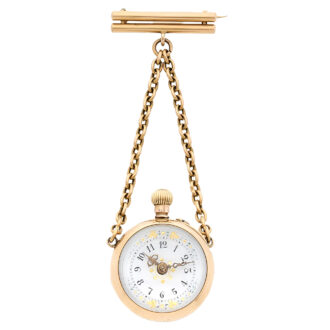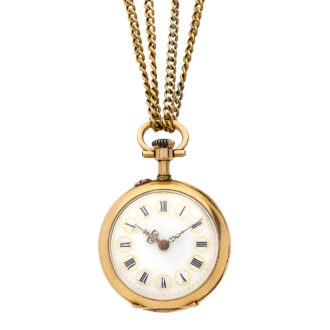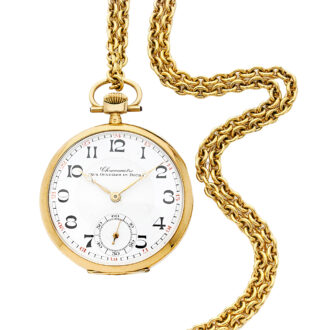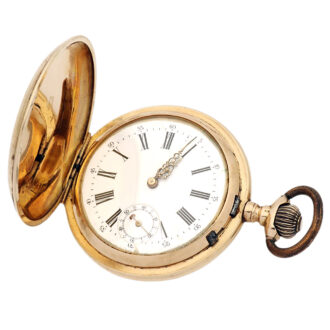
Important Swiss quarter repeater with automaton Circa 1820
- Kenmerk
- CH0329
- Diameter
- 64 mm
- Estimate
- € 250.000 - 350.000
- Price sold
- € 367.200
Gold and enamel quarter repeating watch with automaton
–
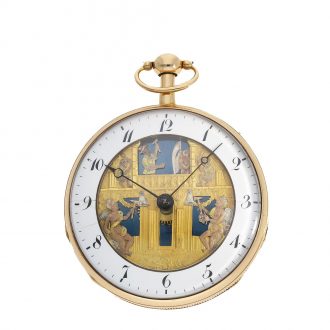
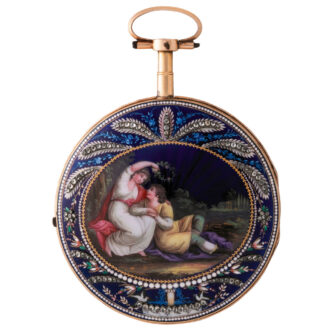
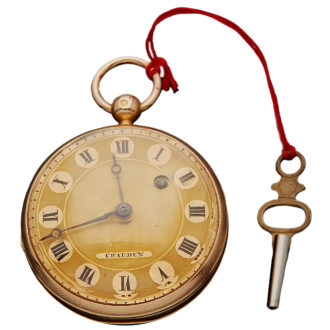
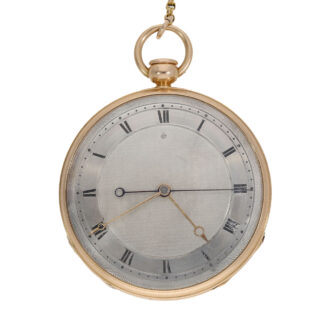
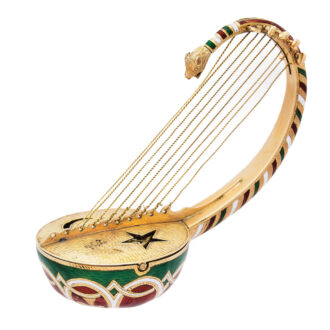
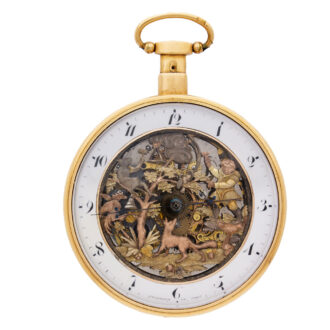
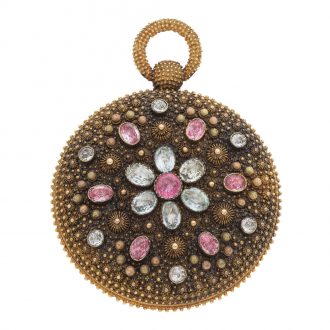
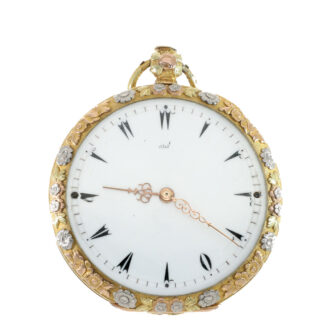
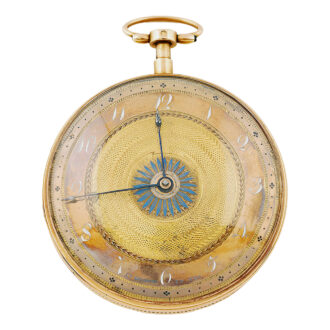
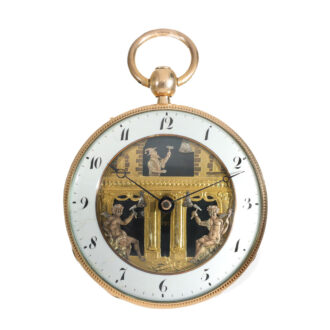
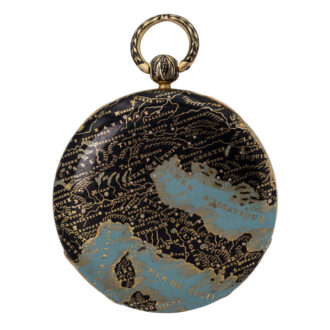
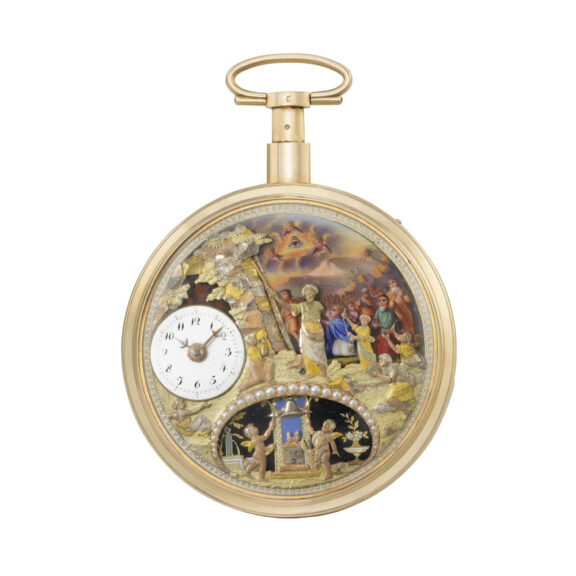
An exceptionally fine, rare, and important Swiss quarter repeating pocket watch from around 1820. It is made of 18 carat gold and enamel, with an open face and a moving scene (automaton) in various gold colours.
–
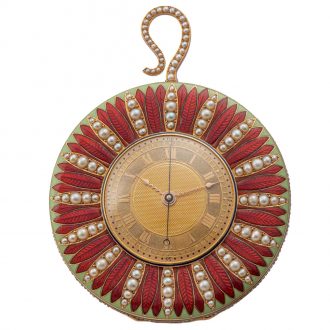
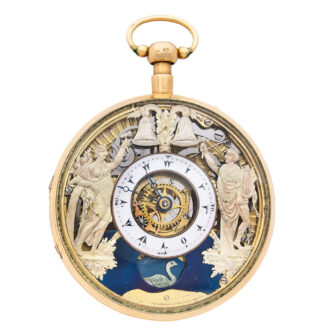
The small white enamel dial has Arabic numerals and sits off centre. Around it, Moses raises his staff in his right hand and strikes a rock. On the second strike, the rock opens to reveal a waterfall that seems to flow, while two kneeling Israelites drink from their cups. Behind them, a colourful enamel painting shows the people of Israel beneath the Eye of God. Below the dial, an oval window framed by small pearls shows two cherubs striking a bell in time with the chimes.
–
A slide on the side of the case controls the two functions. In repeating mode, the watch chimes the hours and quarters while the cherubs strike the bell with each chime. In automaton mode, Moses strikes the rock.
–
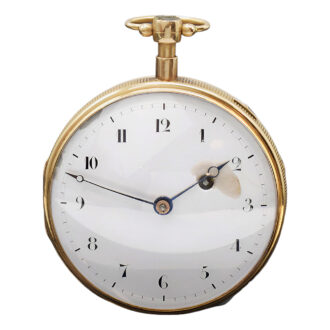
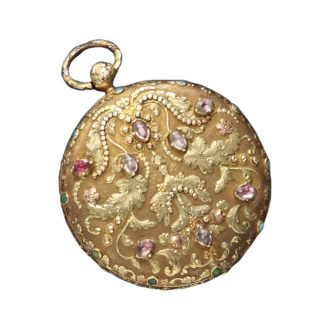
Inside is a gilt cylinder movement with a plain three-armed balance wheel and two scroll-shaped bridges. It chimes on two gongs. The case is plain and has a gilt inner cover that is signed. The case carries the maker’s initials FTD and a number. The pendant, the ring the watch hangs from, is numbered and stamped with French import and gold purity marks.
–
Diameter: 64 mm
–
Signed: Ch. Ducommun dit Boudrit
–
This watch is said to have been a gift from Empress Eugénie of France, wife of Napoleon III, to Field Marshal Sir Lintorn Simmons, GCB, GCMG. It was passed down through his family.
–
EugEugénie de Montijo (5 May 1826 – 11 July 1920) was the last Empress of the French. She was born Doña María Eugenia Ignacia Augustina de Palafox-Portocarrero de Guzmán y Kirkpatrick and held the titles 16th Countess of Teba and 15th Marquise of Ardales. Her father was a Spanish nobleman who fought for the French during Napoleon I’s Peninsular War in Spain.
In December 1848, Louis-Napoléon became President of France’s Second Republic, and Eugénie moved to Paris that year. By the time they married in January 1853, he had become Emperor Napoleon III. Eugénie was Empress from their marriage until 1871.
–
On 16 March 1856, Eugénie gave birth to a son and heir, Napoléon-Eugène-Louis Bonaparte, known as the Prince Imperial. Worried about her family’s future, she took an active part in politics. She ruled as regent at least three times while her husband was away, in 1859, 1865 and 1870, and was more than a figurehead.
–Eugénie was a devout Roman Catholic. She supported a strong papacy and opposed her husband’s policies in Italy, which cost the Pope his lands. She is often said to have played a leading role in the decision to establish a French-backed monarchy in Mexico in 1861. Because of her Spanish roots, she felt strongly about the dispute over a Prussian candidate for the empty Spanish throne. She backed France’s opposition to him, and that dispute led to the Franco-Prussian War of 1870..
–
After the French defeat at the Battle of Sedan on 1 September 1870, Eugénie joined her family in exile in England. Her husband died in 1873, but she remained a leading figure among the Bonapartists. After her son died in 1879, she became the head of the exiled family.
Field Marshal Sir Lintorn Simmons (1821–1903) and his wife were close friends of the exiled Emperor and Empress. As Governor of the Royal Military Academy at Woolwich in south-east London, he oversaw the Prince Imperial’s military training. The Empress first lived at Chislehurst in Kent. After she lost her husband in 1873 and her son six years later, Sir Lintorn helped her find a new home at Farnborough Hill in Hampshire. In 1879, when news came that the Prince Imperial had been killed in the Anglo-Zulu War in South Africa, Lady Simmons is said to have been the first person to visit the grieving Empress.
Signed: Ch. Ducommun dit Boudrit
Share this page: