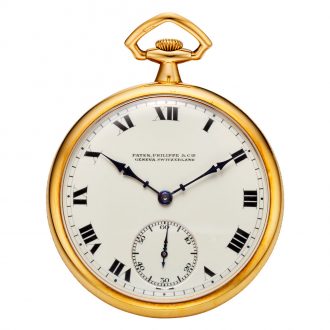
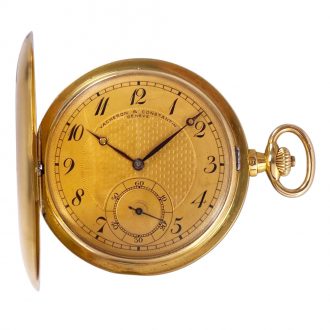
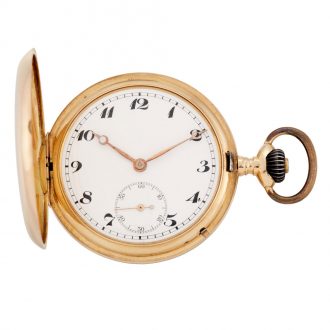
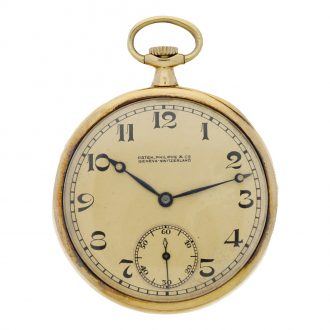
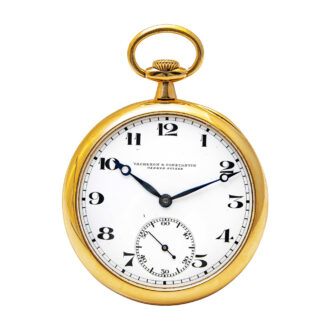
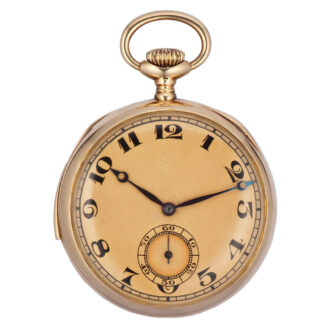
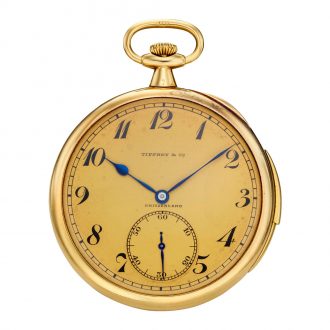
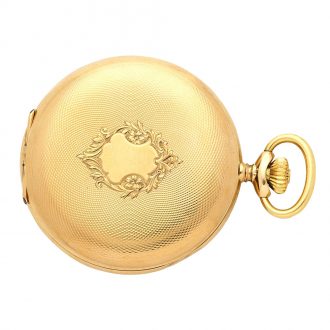
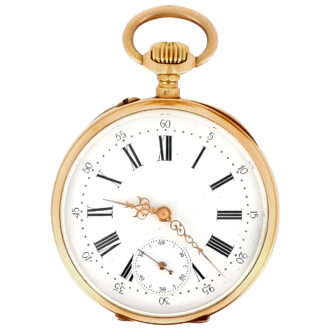
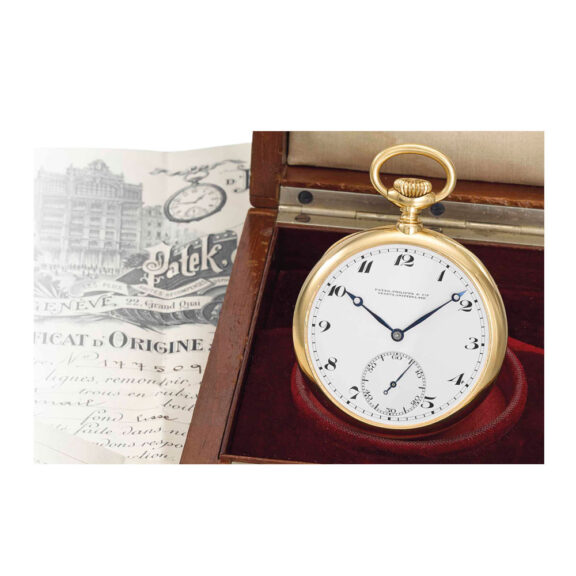
Swiss gold open faced lever with Guillaume balance Circa 1919
- Kenmerk
- CH1028
- Diameter
- 50 mm
- Estimate
- € 20.000 - 40.000
- Price sold
- € 39.950
Gold open faced keyless lever by Patek Philippe
–
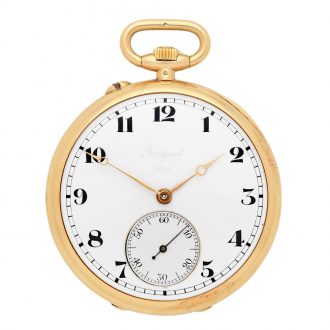
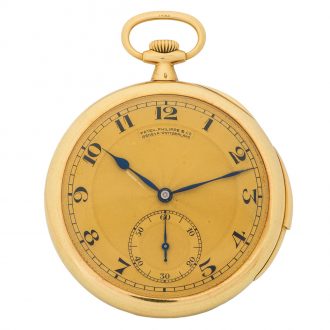
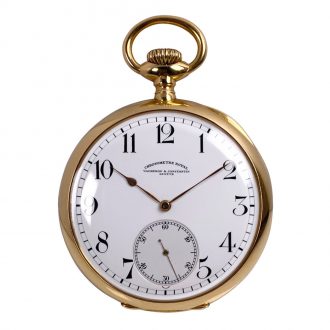
A very fine and rare Swiss 18 carat gold open faced keyless lever watch with Guillaume balance, circa 1919. Nickel finished Extra lever movement numbered twice and stamped twice with the Geneva seal, 20 jewels, Guillaume balance with gold poising screws, micrometer regulator, wolf’s tooth winding. Gold cuvette engraved Fait Spécialement pour son Excellence N. Titulescu, Premier Prix au Concours d’Observatoire de Genève 1923-1924. White enamel dial with Breguet numerals, subsidiary seconds. Plain case, hidden hinges. Case, cuvette, dial and movement signed. Comes with a Bulletin d’Observatoire, original certificate and box.
–
Diameter: 49.5 mm
–
Signed: Patek, Philippe & Cie Geneva, Switzerland
–
Nicolae Titulescu, born 4 October 1883, Craiova, Romania – died 17 March 1941, Cannes, Fr., Romanian statesman, was an outstanding diplomat who, as foreign minister (1927 – 1932/36) for his country, was one of the leading advocates of European collective security. As professor of civil law, Titulescu entered politics in 1912 and was appointed minister of finance in 1917. After World War I, he attended the peace negotiations at Paris and signed the Treaty of Trianon (1920). He was again appointed finance minister in 1920, and his unpopular fiscal reforms helped topple the government in December 1921. From 1922 to 1926 and again from 1928 to 1932, he served as Romanian minister plenipotentiary in London. In 1927-1930 and in 1935 he was a member of the League of Nations Council, and was twice elected president of the General Assembly (1930 and 1931). In 1928 he served as minister for foreign affairs and in 1932 he was again appointed to this post, a role during which he championed Romania’s accession to the French sponsored Little Entente of Czechoslovakia and Yugoslavia, engineered its attachment to the Balkan Entente (1934), consisting of Greece, Yugoslavia and Turkey, and pursued a policy of friendship with France and the U.S.S.R. His difficulties with King Carol II and the impending breakdown of collective security, however, led eventually to his dismissal (August 1936). He was also the author of several works on law and finance.
Signed: Patek, Philippe & Cie Geneva, Switzerland
Share this page: