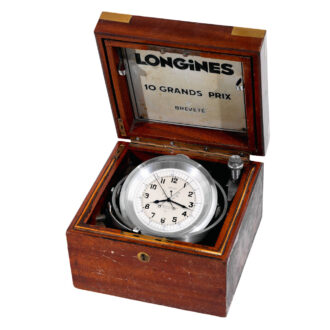
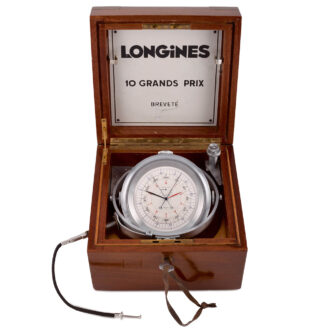
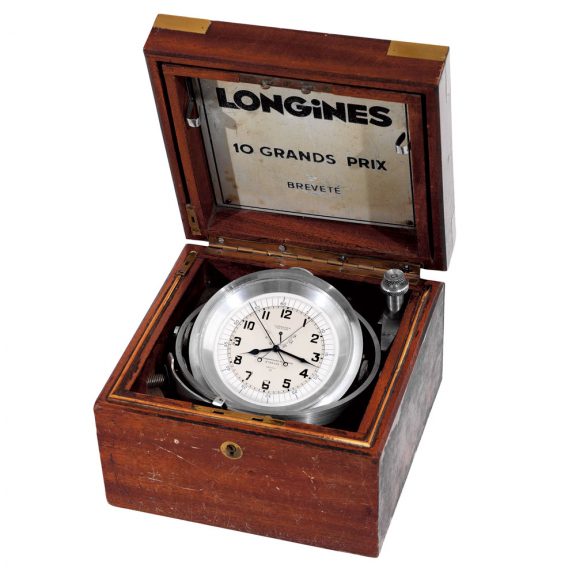
Swiss aluminium marine deck watch with power reserve Circa 1943
- Kenmerk
- TA4224
- Diameter
- 94 mm
- Estimate
- € 6.000 - 10.000
- Price sold
- € 7.950
Aluminium split seconds chronograph
–
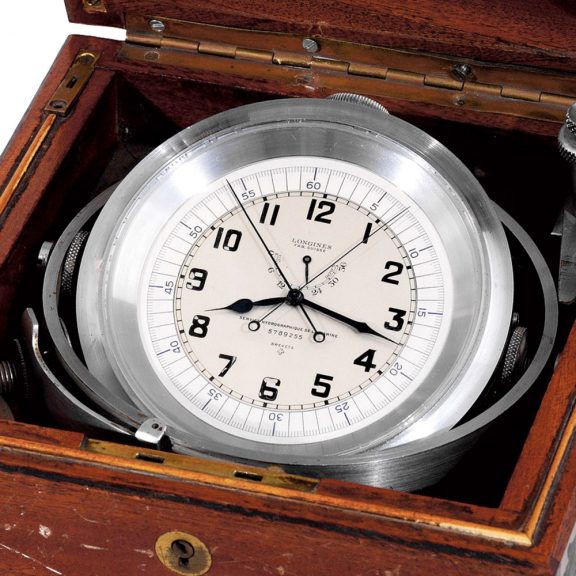
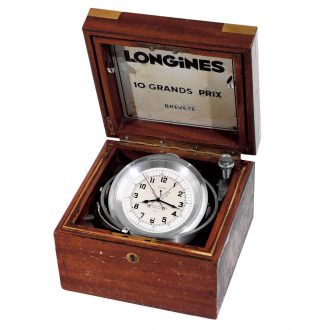
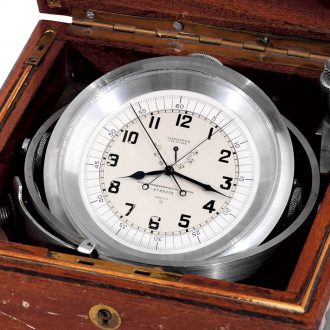
A rare Swiss aluminium siderograph marine deck watch with 36 hour power reserve, center seconds, split seconds chronograph and stop feature made by Longines Watch Co, circa 1943. The mahogany deck box with brass mounted corners, aluminium gimbal and an external start and stop feature for the chronograph. The massive, cylindrical case with a back secured by five screws, chronograph push button at 8 o’clock, a knob for setting the revolving 60 second dial at 5, winding/setting stem at 12, start/stop lever at 10, glazed back and removable screw on weight to work with the gimbals. Two tone silvered dial, with black Arabic hour numerals, an outer minute track, outer revolving blue chronograph chapter ring, power reserve sector below 12 o’clock and blued hands. Rhodium plated movement with Geneva striping decoration, 17 jewels, a straight line lever escapement with beryllium pallet fork, monometallic balance and self compensating blued steel Breguet balance spring with micrometric cam type regulator, the chronograph work visible on the back plate.
–
Diameter: 94 mm
–
Dimensions box: 153 x 153 x 100 mm
–
Signed: Longines Watch Co Swiss
–
Siderography
A mechanical process developed by Jacob Perkins in the early 1800s enabling the unlimited reproduction of engraved steel plates. The process enables the transfer of an impression from a steel plate to a steel cylinder in a rolling press.
–
Invented by Longines in 1938, the siderograph measures Greenwich (0 longitude) Sidereal or Civil Time in hour angles, minutes and minutes of arc, and can be considered the final evolution of the marine chronometer. These timepieces allow the user to navigate at night and during daylight hours more accurately than the Weems and Lindberg systems for nocturnal navigation that were heavily reliant on radio time signals.
–
The siderographs were based on chronometer caliber 2129 which was at the time Longines’s most accurate movement. The caliber was modified with the addition of the split second mechanisms and anti magnetic beryllium pallet fork. The movement was then cased in a heat toughened aluminium case. This is a non magnetic, light, non ferrous material suited for use in Aeronautic and Maritime applications.
–
This present timepiece is one of a handful of examples known to exist in a gimballed deck box, an indication it was intended for use aboard a ship.
Signed: Longines Watch Co. Swiss
Share this page: