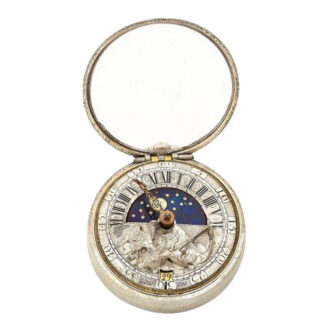
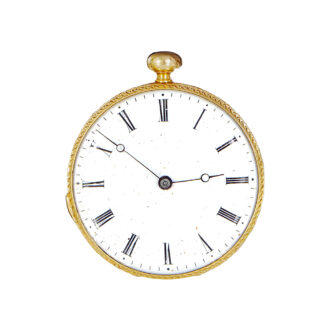
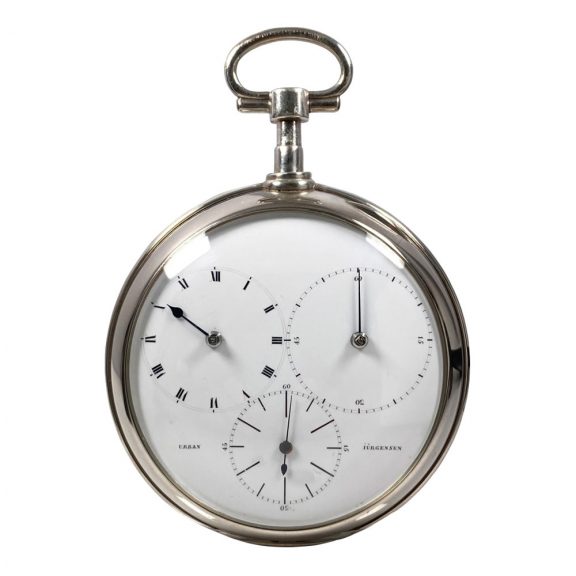
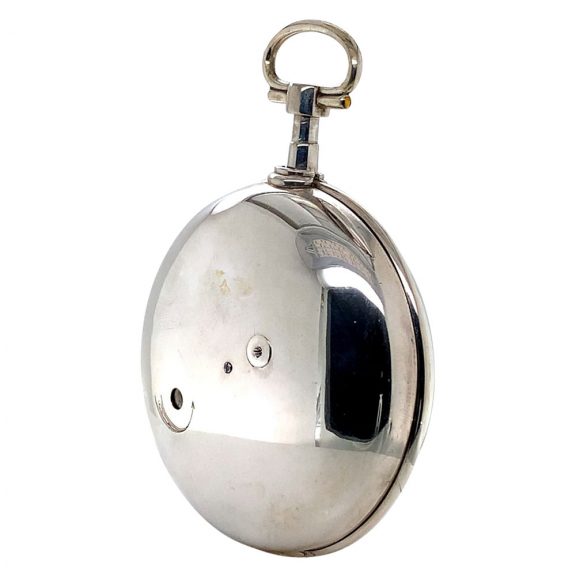
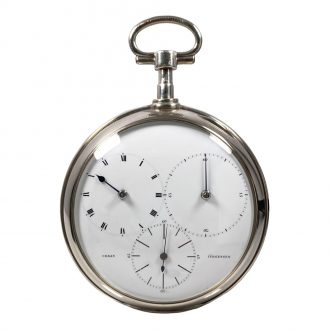
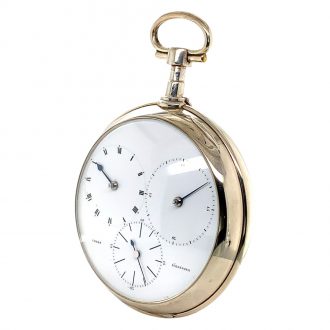
Danish silver deck chronometer with regulator dial Circa 1810
- Kenmerk
- DB0506
- Diameter
- 69 mm
- Estimate
- € 15.000 - 50.000
- Price sold
- € 37.500
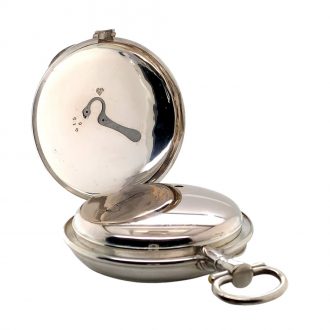
Silver deck watch by Urban Jürgensen
–
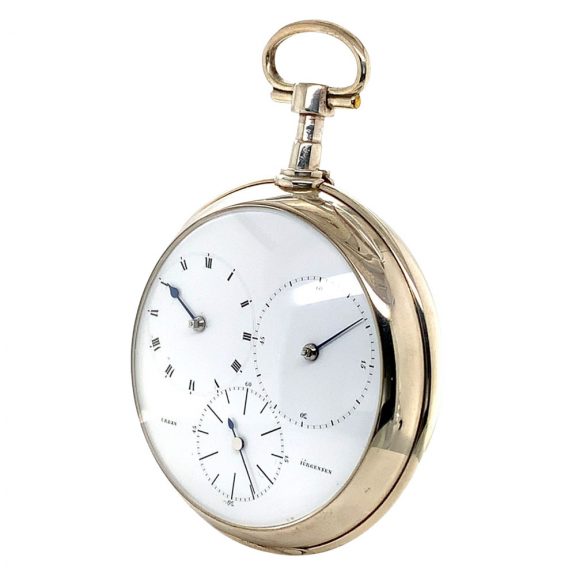
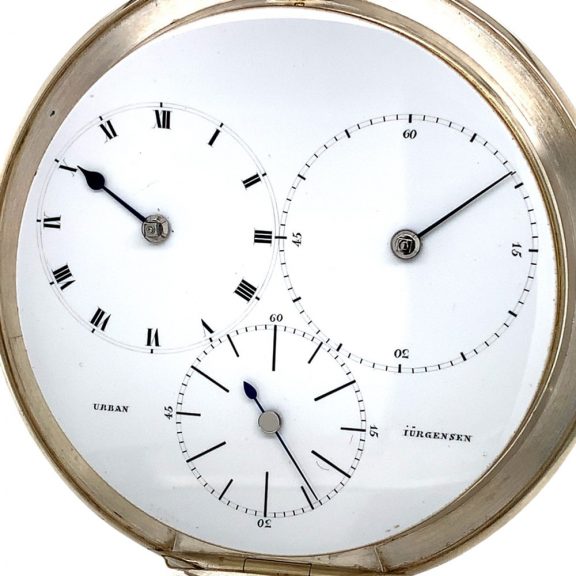
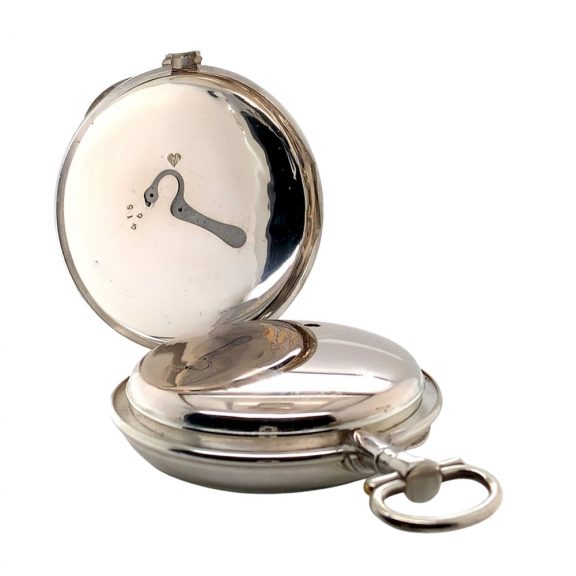
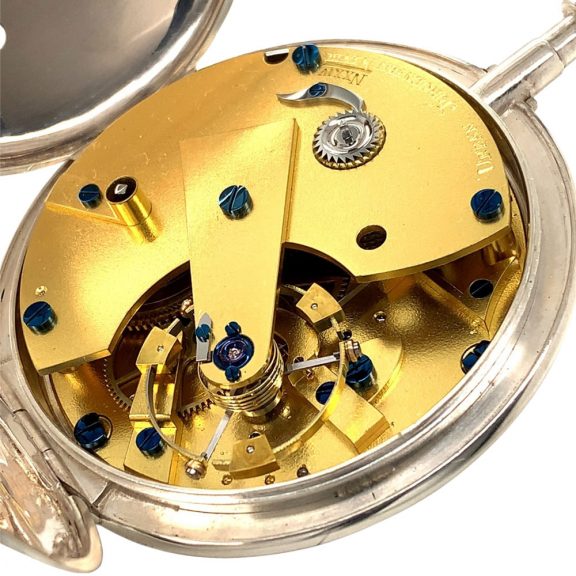
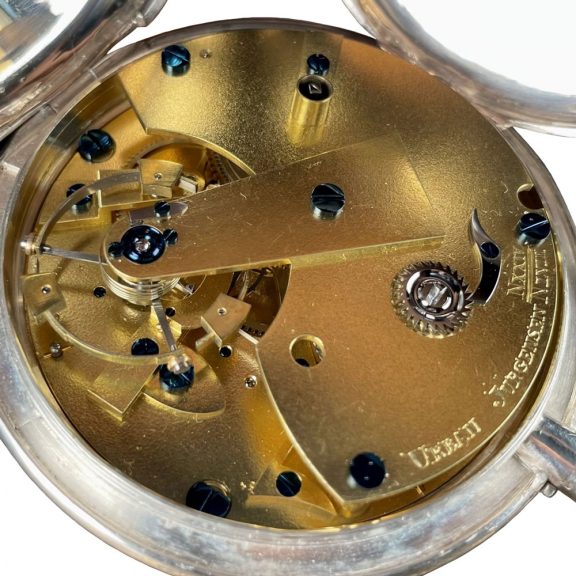
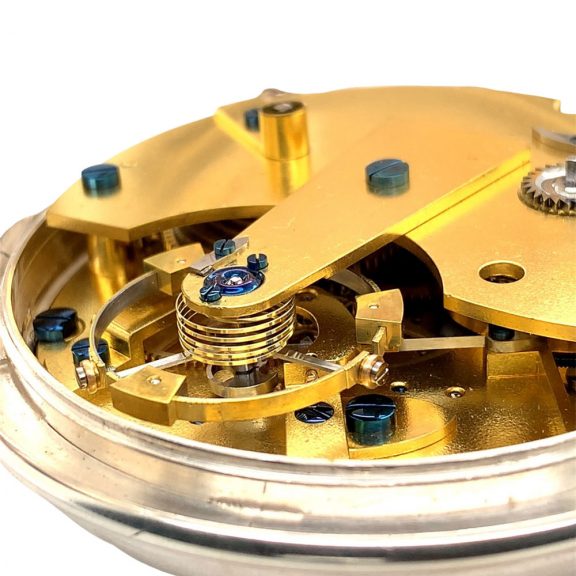
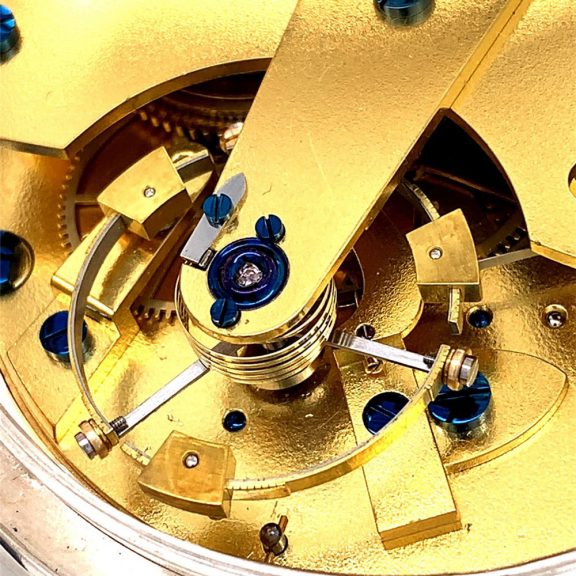
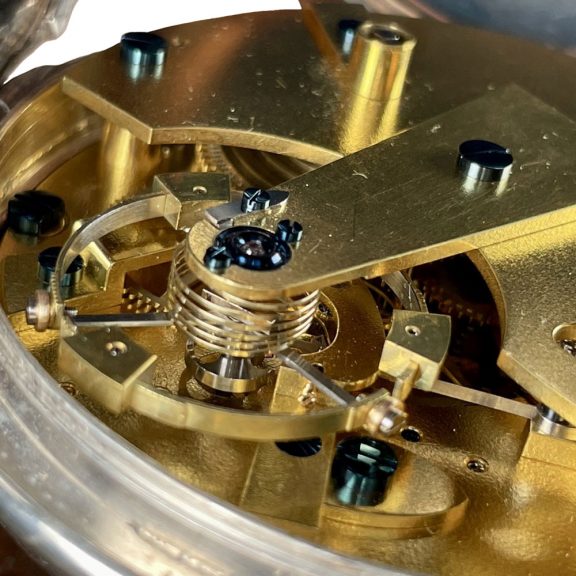
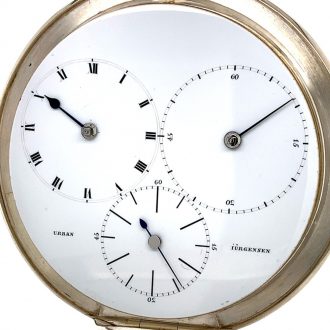
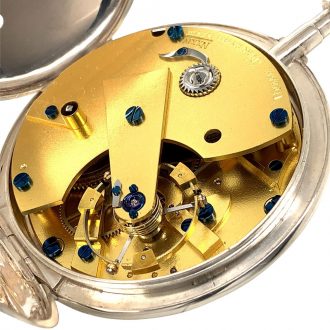
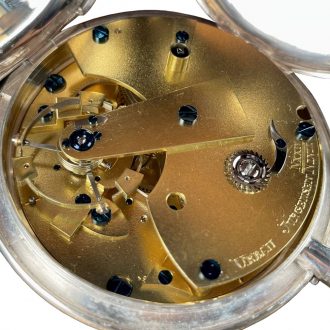
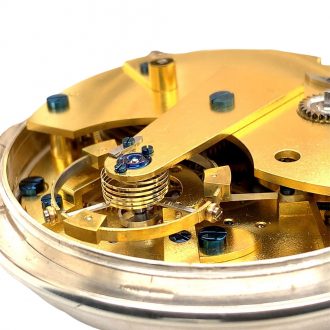
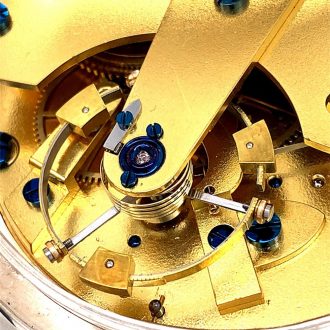
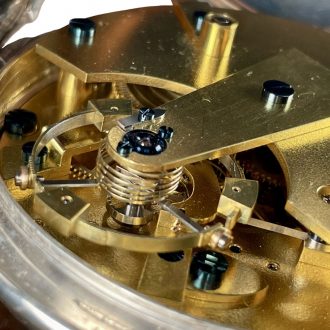
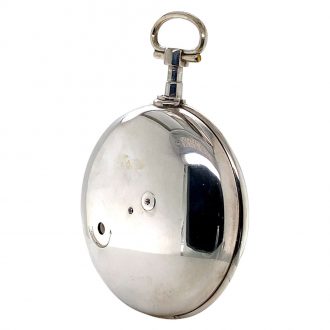
An exceptionally fine, rare and large Danish silver open faced deck chronometer with regulator dial, circa 1810/1811. ½ Plate movement, chain and fusee with Harrisons maintaining power, Arnold‘s spring detent escapement, bimetallic chronometer balance with three screws and three round weights, free-sprung helical gold balance spring with terminal curve. White enamel dial with a Roman hour chapter ring at 10 o’clock, a minute chapter ring with Arabic quarter-hour numerals at 2 o’clock and auxiliary seconds at 6 o’clock. The polished case with maker’s mark IFH for Johann Friedrich Hansemann within a heart-crest, a winding aperture on the back. Dial signed, movement signed and numbered, case numbered.
–
Diameter: 69 mm
–
Weight: 212 g
–
Signed: Urban Jürgensen
This piece is the 24th chronometer of 58 movements so far produced.
–
An identical deck chronometer is known as the so-called Moltke Chronometer, named after the Danish politician and first democratically elected Prime Minister of Denmark Count Adam Wilhelm Moltke, 1785-1864, who lent these chronometers for scientific expeditions.
–
John Arnold was the first to use balance springs in gold, probably as early as 1779. Both Jürgensen’s teacher and later father-in-law Jacques Frederic Houriet and Abraham-Louis Breguet experimented with gold balance springs, but it was Urban Jürgensen who knew how to perfect them and use them effectively. He used the gold balance spring in his best chronometers, which were intended for seafaring because he knew that neither rust nor magnetism could harm them. This led to his chronometers being taken on various scientific expeditions, initiated by the Danish politician Count Adam Wilhelm Moltke.
Heinrich Christian Schumacher, 1780-1850, German astronomer and mathematician, professor of astronomy in Copenhagen and director of the observatory, was also enthusiastic and remarked: “A considerable number of chronometers has been executed in Mr. Jürgensen’s establishment, which have all proved superiority in their construction. We particularly draw attention to the helical balance springs which are made of gold, and with respect… to alloys, elasticity and dimensions, are based upon the experience of a great many years.”
The spring detent escapement is based on John Arnold’s design. The brass escape wheel has cycloidal impulse faces. The detent is mounted to a gilded brass arm, which has micrometric adjustment, allowing for precision adjustment of the locking stone. Many were later converted to the Earnshaw-type and it is rare to find one which has survived in original condition. In his early years, Urban Jürgensen used cases made by Johann Friedrich Hansemann, 1787-1843, a Danish goldsmith of German origin who became a master in 1810. He made the cases for some of Jürgensen’s best chronometers.
Urban Jürgensen was the son of Jürgen Jürgensen (watchmaker to the Danish court). He was born on August 5th, 1776 in Copenhagen. He went to a business school which he left at the age of 15 to train with his father. At the same time, he took private math lessons and studied foreign languages with Professor Woolf, who later became minister of state. When he was 20, Urban’s father sent him to Switzerland to further his education. He spent 18 months in Neuchâtel and 6 months in Geneva. In 1797, Urban went to Le Locle to work for Jacques-Frédéric Houriet. From Le Locle, he travelled to Paris. Since he came highly recommended, Jürgensen was able to work in the workshops of Abraham Louis Breguet and Ferdinand Berthoud. At the time he received an annual grant of 800 thalers from the Danish government. Jürgensen later went to work with John Arnold in London to perfect his knowledge of the design of marine chronometers. From London, he travelled back to Switzerland via Paris and married one of the daughters of Jacques-Frédéric Houriet.
In 1801, Jürgensen returned to Copenhagen and founded a company for the production of marine chronometers with Etienne Magnin. Magnin went to St. Petersburg shortly afterwards. In 1806, his eldest son Louis Urban was born and on 27 July 1808 his son Jules Frederik. Urban Jürgensen was the first watchmaker to become a member of the Royal Danish Academy of Sciences. King Frederick VI granted him a Royal Appointment to supply the court with watches and the Danish Admiralty with chronometers. Urban Jürgensen died on May 14th, 1830. After his death his sons Louis Urban and Jules continued the business.
Signed: Urban Jürgensen
Share this page: