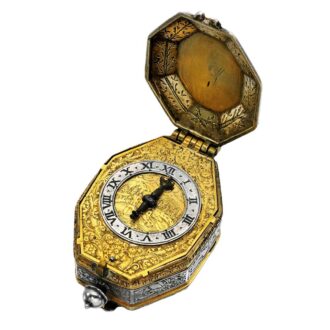
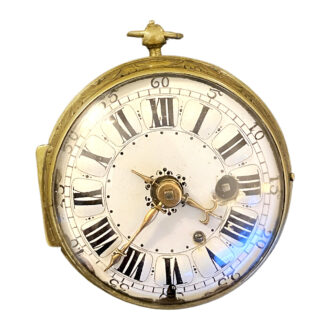
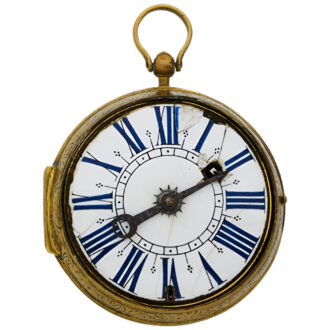
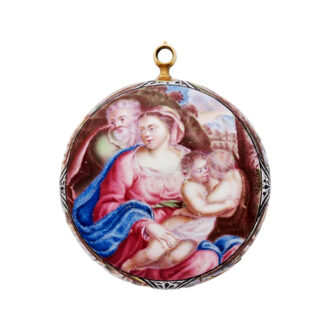
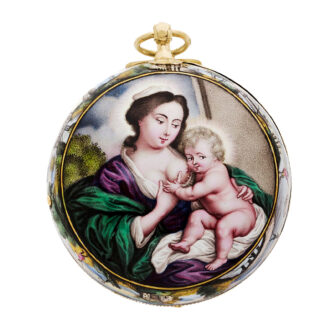
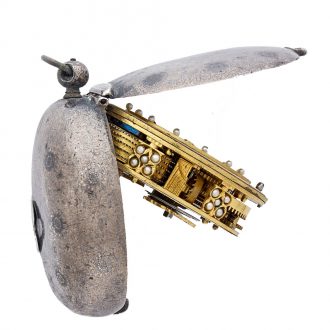
Early Turkish silver egg shape pre balance spring watch Circa 1650
- Kenmerk
- FF0020
- Diameter
- 51 mm
- Estimate
- € 40.000 - 80.000
- Price sold
- € 53.150
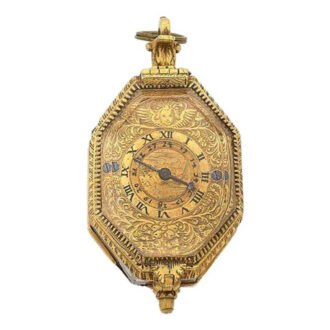
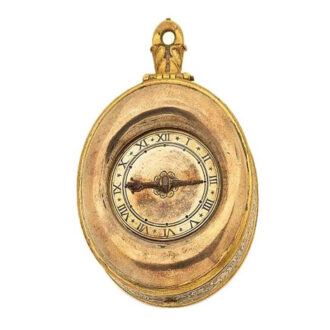
Silver single hand oval watch
–
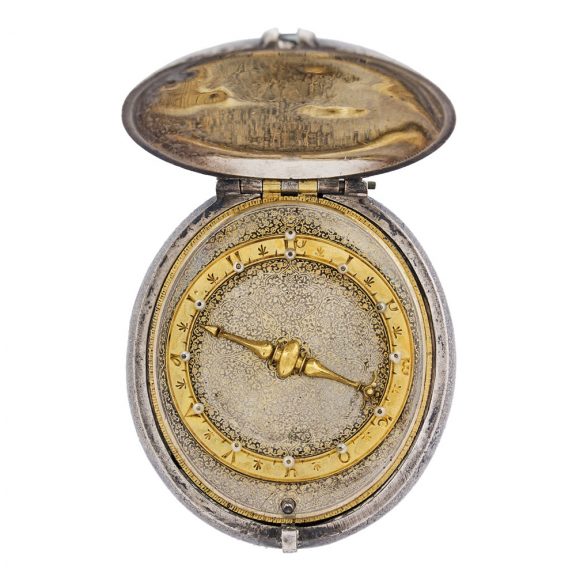
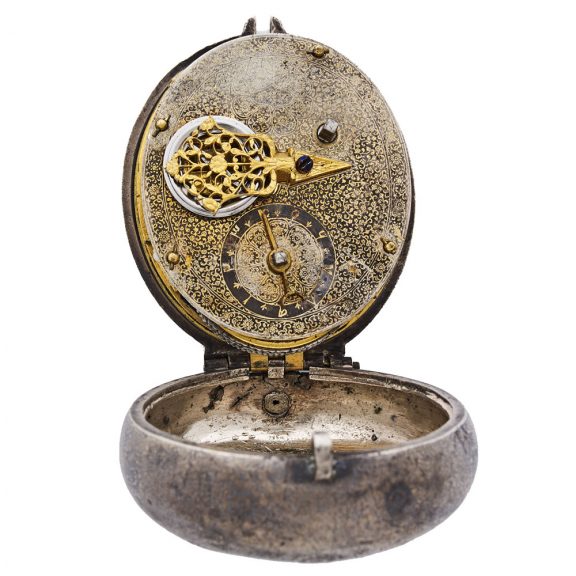
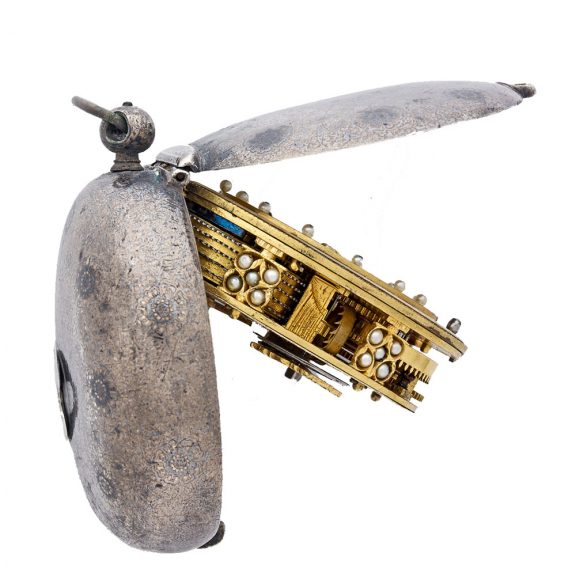
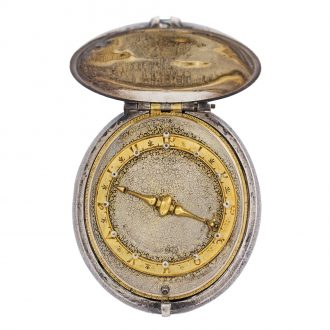
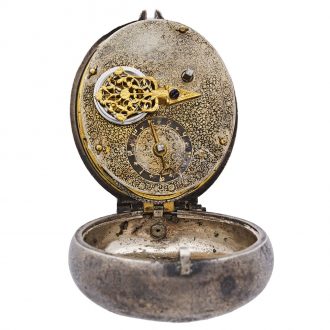
A Turkish silver single hand oval watch in nielloed and silver, set with pearls, pre balance spring, made for the Ottoman Empire market, circa 1660. Full plate fire gilt movement with key winding, the plate entirely nielloed and engraved with scrolling foliage, verge escapement, gilded plate with pillars set with cock pearls chased and pierced fixed on a foot, fusee and chain, simple steel balance, adjustment disc with Turkish numerals, Islamic inscription in a lobed cartouche.
–
Single hand dial with Turkish numerals, stylized baluster shaped hand, stylized indications for the quarter and half hours, the back decorated with damascened arabesques, the circle for the hour indication with raised pearl settings.
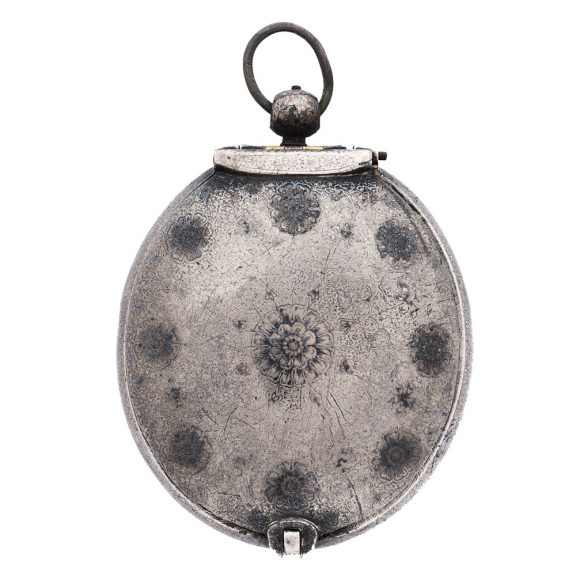
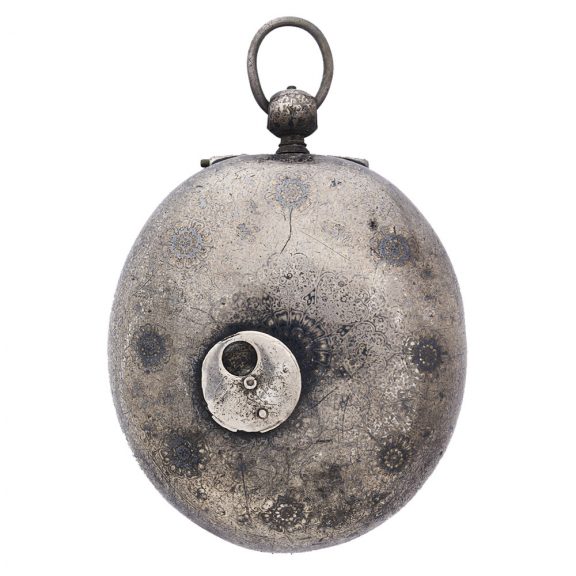
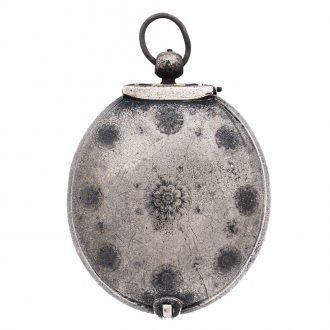
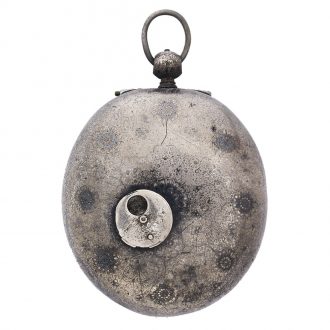
Western-shaped oval silver case with hinged cover over the dial, entirely nielloed with stylized geometric flowers and foliage, pendant with ring.
–
Demensions: 44 x 51 mm
–
Weight. 105.2 gr.
–
Name watchmaker: Amali Sahibi Bulugat a Galata Constantinople
–
This eample is among the first known watches of local manufacture for the court of the sultans of the Ottoman Empire in Constantinople, a rare example of a pre-balance spiral watch that is typical of the manufactures of the half of the 17th century.
With this large niello and damascene decoration, this intriguing oval watch with a pearl setting on the dial and movement is built in the manner of a Western watch, but is of local manufacture in the city of Galata.
The shape of the case, dial and movement have been given an oriental touch that is distinguished by this decoration of arabesques, leaving no doubt that the maker must have been one of the best Turkish watchmakers native to Galata.
The close similarity between the movement of this watch and the movement of a wall clock in the Topkapi Museum by Bulugat shows that it was made by the same hand.
Although it is known that clocks and watches existed at the court of the sultans of the Ottoman Empire, in and around the Ottoman capital as early as the 16th century, very few are known to have survived to the present day, such as our example.
The Ottoman Fascination with the Great European Powers
As the Habsburg ambassador to Constantinople wrote in 1555: “There is no city more magnificent or better adapted to trade than Constantinople.”
The Ottoman Empire had been in contact with European powers for centuries, and in the late 17th and 18th centuries, Western innovations in horology, particularly from France, Switzerland and England, began to make their way into Ottoman society.
The sultan and the elite classes were fascinated by mechanical watches, and watches quickly became both functional tools and luxury items within the empire.
While trade was flourishing at the time, it was through the French embassy that the first Swiss timepieces would appear on the Ottoman market. The Swiss having obtained special privileges following the treaty signed by Francis I in Fribourg in 1516, they settled very quickly to make the art of watchmaking prosper.
Indeed, the city of Constantinople has fascinated the West for centuries, but while we know of a few rare examples of watches made in Europe for the market of the Ottoman Empire, notably with Islamic calendars, few are known to this day to be from the hands of local watchmakers.
The first colonies of European watchmakers in the service of the Seraglio.
The first Western clockmakers who settled in Galata at the end of the 16th century were sent to maintain and repair the clocks that had been offered as diplomatic gifts to Sultan Murad III (1546-1595), who was particularly fascinated by mechanical clocks.
The famous diamond merchant Jean Baptiste Tavernier, who visited Constantinople in 1630, reported the existence of clockmakers working in the palace treasury, which indicates the importance of this community to the sultans and the court of the time.
At the end of the 17th century, there were already nearly a hundred members of the clockmakers’ guild on site, including the ancestor of the famous philosopher of the Age of Enlightenment, Jean Rousseau, a specialist in repairs who would be appointed Time Adjuster at the Topkapi Palace.
The first colony of Genevan clockmakers settled in Galata.
Galata watches refer to watches produced during the Ottoman Empire, this historic district located on the northern bank of the Golden Horn, was a center of commercial activity, attracting European merchants, artisans and craftsmen.
Galata, a historic district located on the northern bank of the Golden Horn, was a center of commercial activity, attracting European merchants and artisans. During the Ottoman period
Share this page: