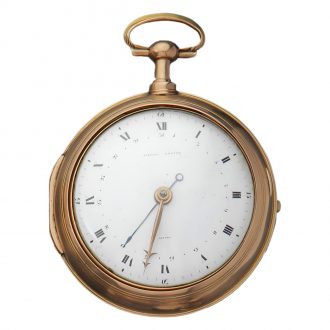
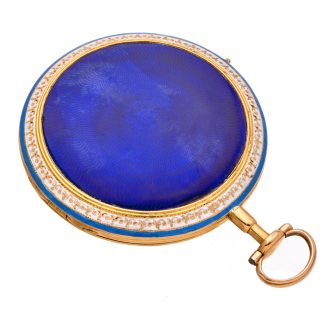
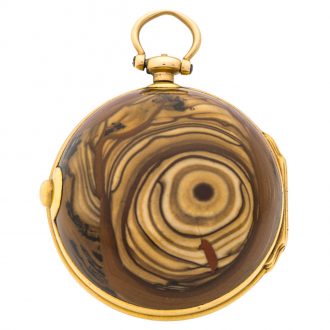
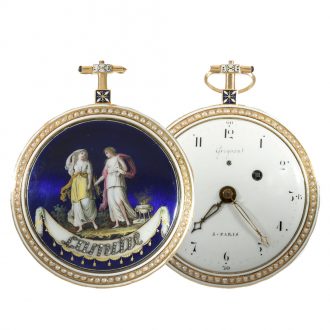
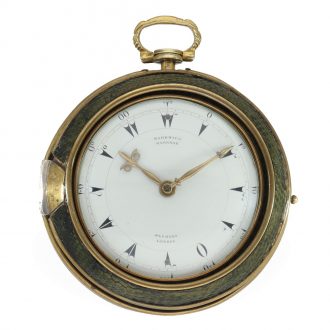
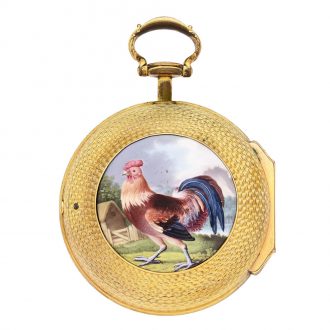
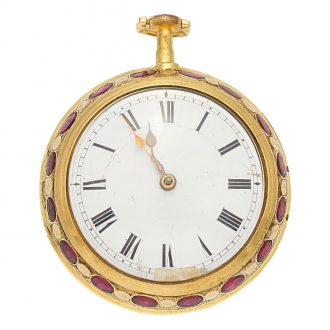
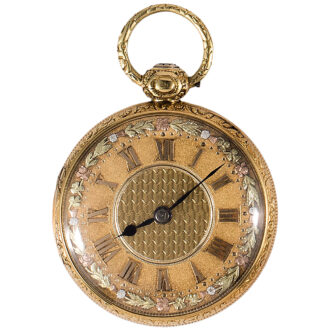
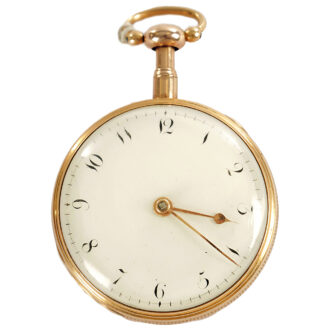
English 18 carat gold and pearl set lever watch Circa 1790
- Kenmerk
- FF0041
- Diameter
- 48 mm
- Estimate
- € 6.500 - 11.000
- Price sold
- -
Pocket watch with pearls and beautiful monogram
–
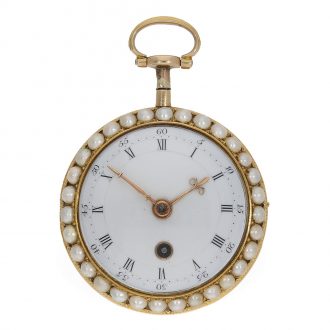
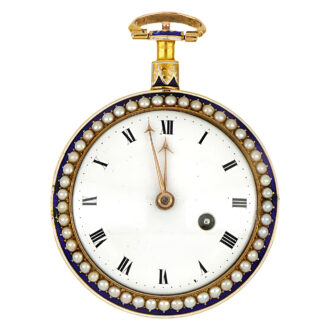
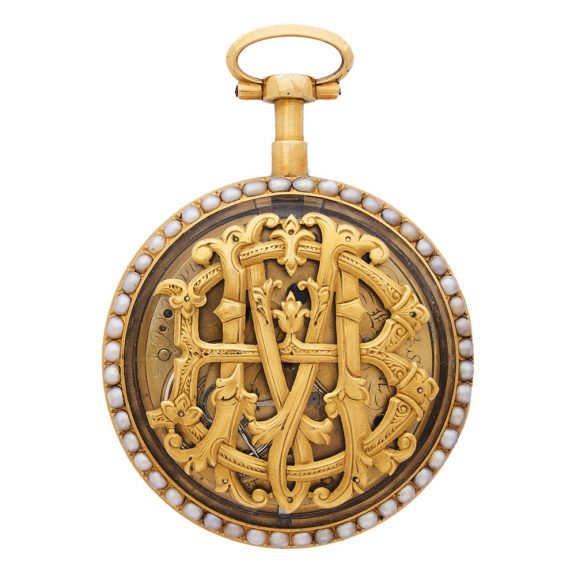
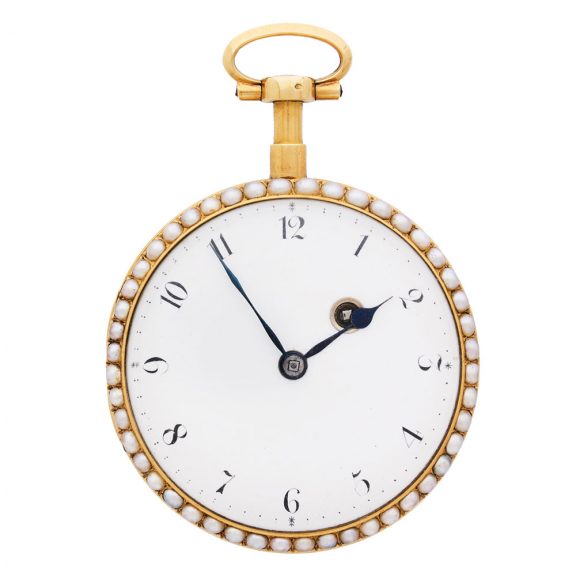
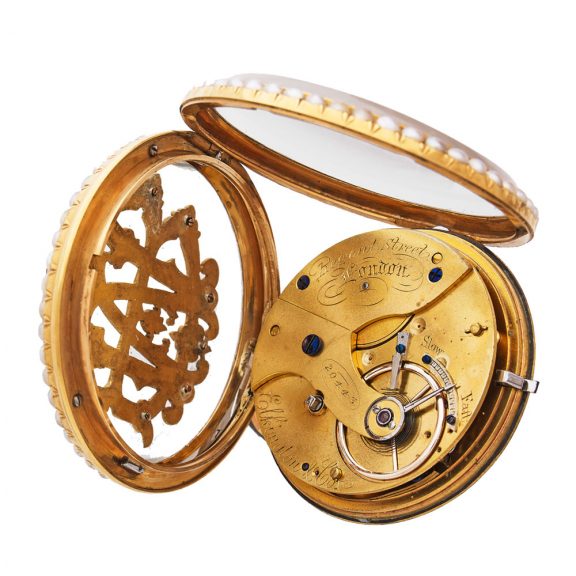
An English 18 carat gold open faced pocket watch with pearl set bezel decoration and monogram, circa 1790. Full plate gilt movement with key winding, lever escapement, plain balance cock, silver index for advance and delay adjustment, blued balance spring, fusee and chain, signature on the plate Elkington, Regent Street, London.
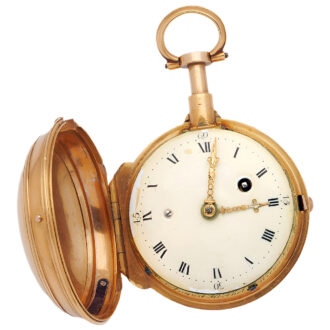
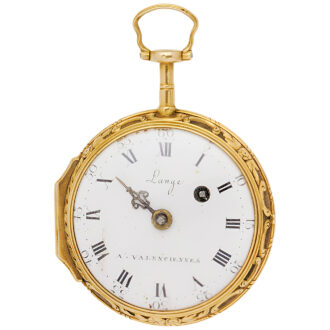
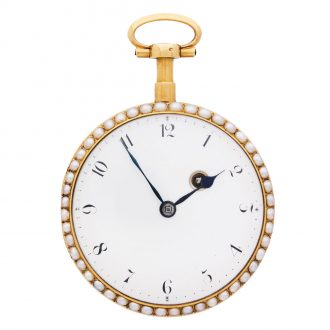
White enamel dial with Arabic numerals, external pearled minute track, steel blued spade hands, opening for the winding square.
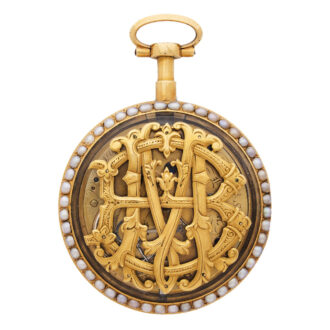
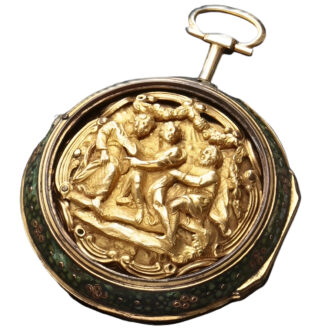
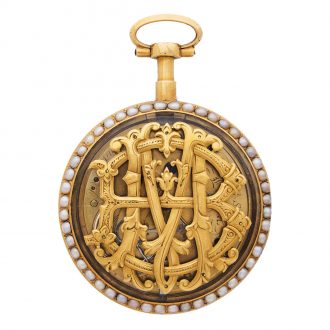
Round case on hinge, bezel set with half-pearls, glazed on both sides, the back glazed with raised gold initials, the rim set with half-pearls, the entire movement visible through the gold initials.
–
Diameter: 48 mm
–
Weight: 84.8 g
–
Signed: Elkington & Co., Regent Street, London
–
Elkington and the Beginnings of Electroplating
From relatively humble beginnings as a manufacturer of gilded toys, spectacle cases, and silver mounted perfume bottles, the Elkington Company rose to fame when its founder, George Richards Elkington, perfected and patented the technique of electroplating in 1840.
Electroplating, or electrolysis, is a technique for depositing a thin layer of metal, such as gold or silver, onto a metal object. This process is commonly used in watchmaking to improve the aesthetics and durability of watches.
Henry and George Richard Elkington, two British inventors, played a crucial role in the development of electroplating in the 19th century.
In 1840, they patented an innovative process for electrolytically depositing precious metals, revolutionising plating methods.
–
Although the Elkingtons are primarily known for their contributions to goldsmithing and the production of plated metal objects, there is no documentation that they applied their techniques specifically to the manufacture of watches.
However, Elkingtons continued to demonstrate an artistic commitment by producing exact copies in electroplating, with silver, gold or bronze finishes, of some of the greatest historical vases and vessels of ancient and medieval art. In doing so, they responded to this particular form of Victorian historical kleptomania and the bourgeoisie’s desire to possess objects that transmitted lineage and knowledge.
–
Reinforcing their reputation as an industrial manufacturer and ensuring that their output reflected the latest fashions, Elkington employed the best artists of the day to produce unique designs, including Benjamin Schlick, Pierre-Emile Jeannest, Léonard Morel-Ladeuil, Auguste Adolphe Willms, Edward Welby Pugin, G. Halliday, and Christopher Dresser.
Therefore, although Elkington produced a vast output of all types of silver and electroplating, the enormous income this generated allowed them to commission artists to make valuable objects, such as our watch for display, demonstrating the supreme capabilities of their workshops, as seen in this richly decorated watch.
Signed: Elkington & Co. Regent Street, London
Share this page: