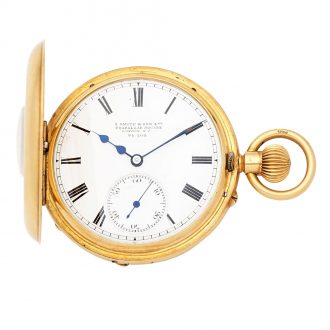
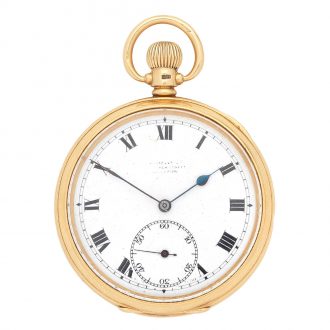
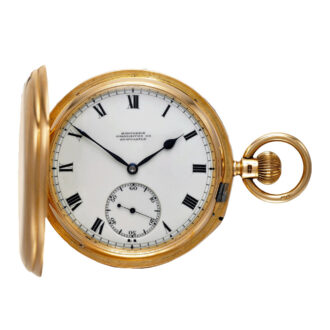
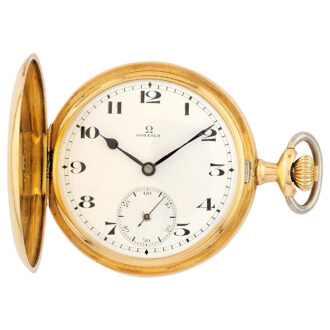
English gold pocket watch with one minute tourbillon Circa 1919
- Kenmerk
- TA2133
- Diameter
- 55 mm
- Estimate
- € 30.000 - 55.000
- Price sold
- € 49.350
Gold keyless lever pocket watch
–
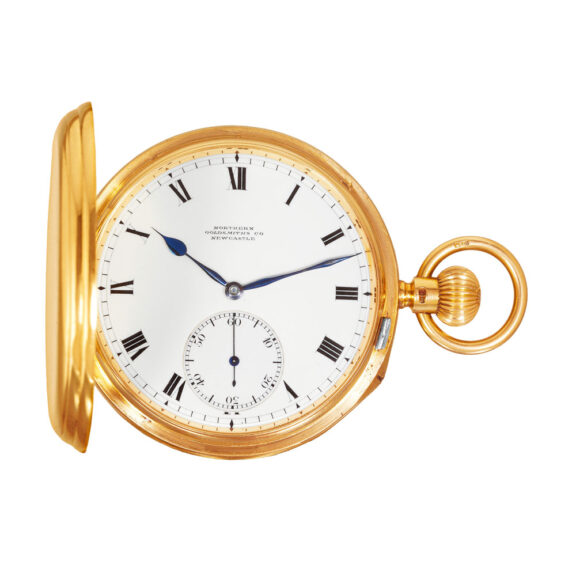
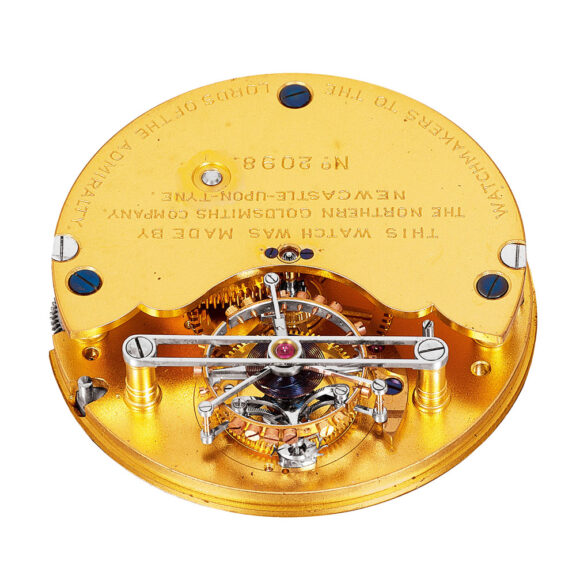
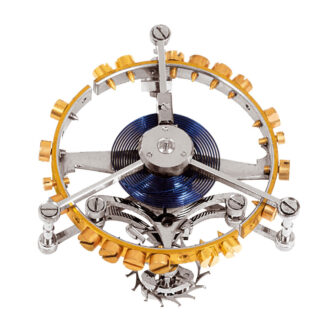
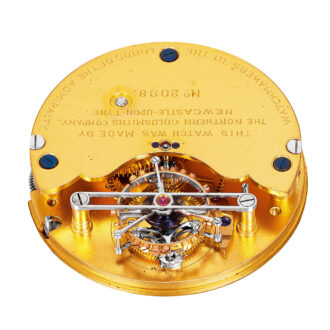
Extremely fine and important English, 18K gold hunting cased keyless pocket watch with a one-minute tourbillon regulator, circa 1919. Made by Sidney Better (type 1) with Guillaume balance. Kew Observatory Rating Marks of 90.3 was achieved in 1920. Made by Northern Goldsmiths Company, Newcastle-Upon-Tyne, watchmakers To the Lords of the Admiralty. The case by Northern Goldsmiths, with London hallmarks for 1919.
–
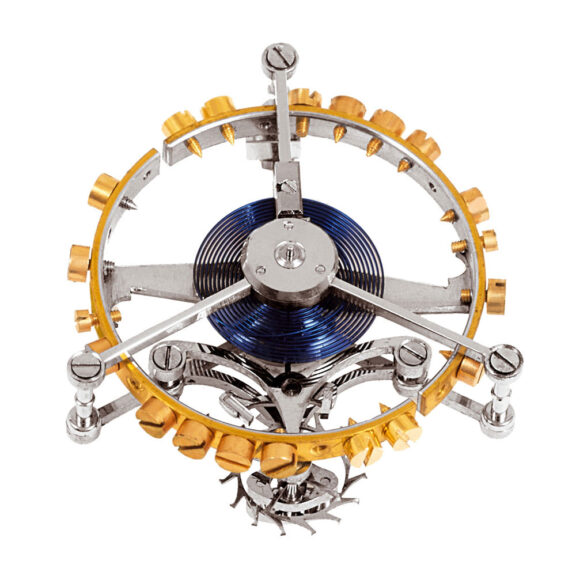
A polished case, the band rising to incorporate the hand-setting button, glazed gold-rimmed cover for viewing the movement. White enamel dial with radial Roman numerals, outer minute track, subsidiary seconds. Blued steel spade hands. A frosted gilt half-plate movement, jewelled to the centre, going barrel, one-minute tourbillon regulator with Sidney Better Type 1 equidistant three-arm polished steel cage and lateral polished steel bridge, straight-line lever escapement, free-sprung cut bimetallic Guillaume Anibal-brass balance with winged arms, peripheral timing and temperature compensation screws, blued steel Breguet balance spring. Dial, case and movement signed.
–
Diameter: 55 mm
–
Signed: The Northern Goldsmiths Co Newcastle
–
Sidney Better One of the great makers of tourbillon carriages. Between 1917 and 1922 he constructed eight tourbillon watches of very high quality for The Northern Goldsmiths Company using two types of carriage: Type 1 – Used in the present watch, with three equidistant arms surmounted by a two-arm bridge. Type 2 – With three arms at 90-degree angles to each other and a de-centralized balance. A watch with this type of carriage was sold by Antiquorum, Geneva, November 11, 2001, Lot 295. Both types used a Swiss straight-line lever escapement. In the 1920s The Northern Goldsmiths Company hit financial difficulties which prematurely ended their association with Better.
–
The result was that only eight tourbillon watches by him for Northern Goldsmiths are known. The present watch attained 90.3 marks in a Kew trial of 1920. Literature: Le Tourbillon, Reinhard Meis, Les Editions de L’amateur, 1990. Anibal (Acier au nickel pour balanciers): An alloy invented by Dr Charles Edouard Guillaume, exhibits unusual properties, both in terms of thermal expansion and in changes in elasticity. These properties are very different from those of two other famous alloys invented by Guillaume, Invar and Elinvar.
–
Around 1900 Guillaume attempted to eliminate the so-called Middle-Temperature Error caused by the fact that the change of rate in a timekeeper with a steel-brass bimetallic balance is approximately a linear function of temperature, while the change of rate caused by the change in the elasticity of a balance spring is approximately a quadratic function. Thus, it equals zero at only two temperatures, causing a secondary error. Countless attempts were made to eliminate Middle-Temperature Error, usually by means of auxiliary compensation devices. In 1899, Guillaume noticed that steel with an addition of 44.4% nickel had a negative square coefficient of thermal expansion. This alloy, combined with brass in the bimetallic lamina, makes its expansion close to quadratic. Balances with bimetallic rims made of Anibal and brass are usually called Guillaume balances, or, as their inventor called them, integral balances. When combined with special balance springs, they exhibit remarkable temperature stability, on occasion not exceeding 1/50 second per day at 1oC.
Signed: The Northern Goldsmiths Co. Newcastle
Share this page: