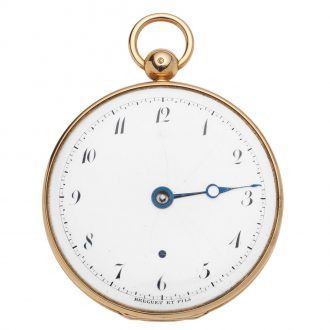
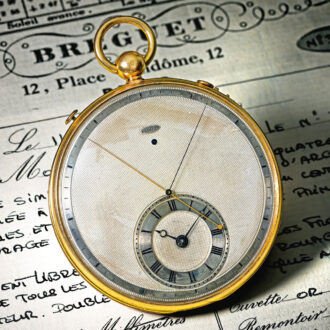
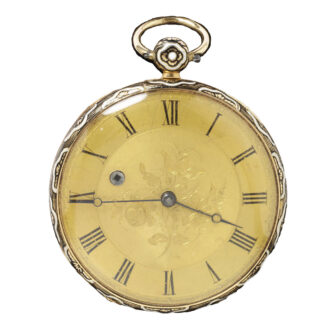
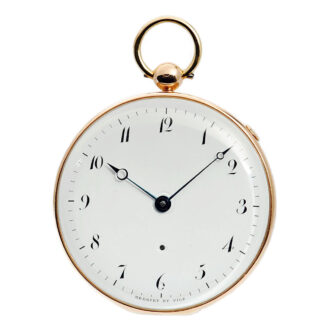
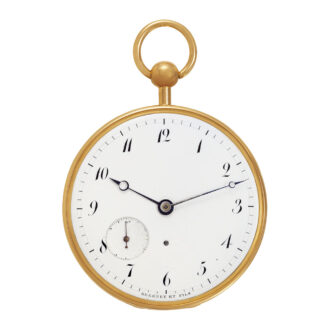
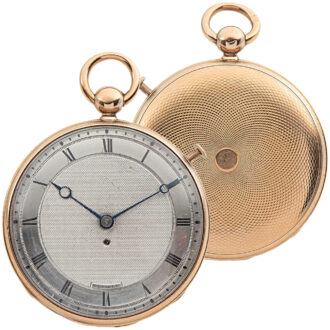
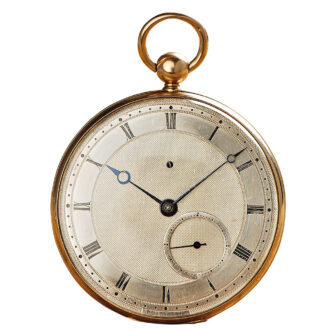
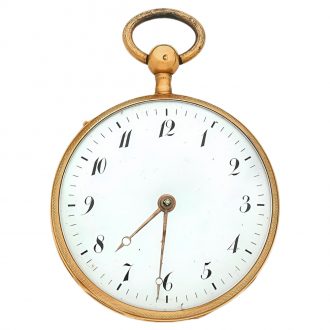
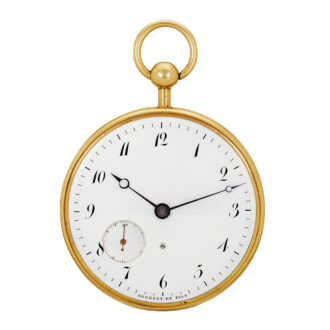
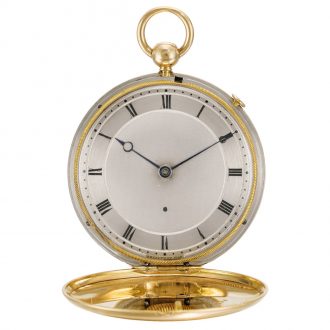
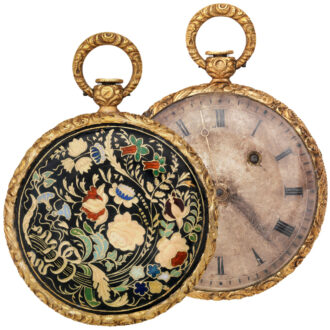
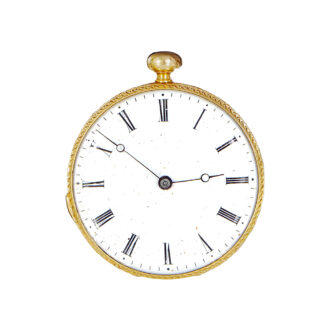
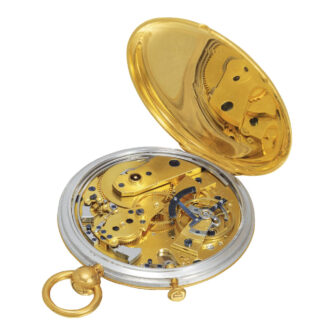
French platinum and 18k gold quarter repeating watch Circa 1822


- Kenmerk
- TA1693
- Diameter
- 52 mm
- Estimate
- € 100.000 - 200.000
- Price sold
- € 253.600
Gold, platinum hunting cased cylinder watch
–
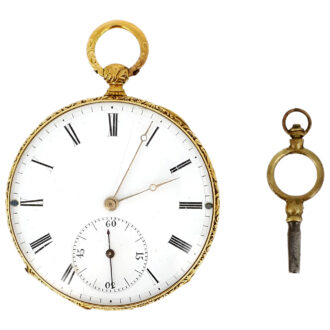
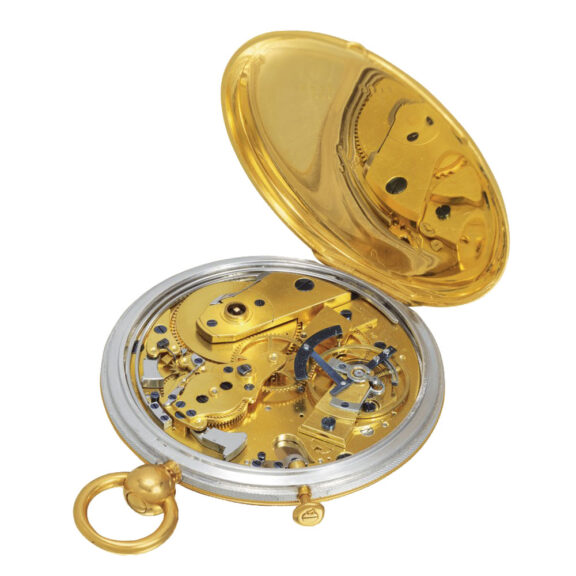
A very fine and extremely rare French, platinum, and yellow 18k gold hunting cased quarter repeating pocket watch, circa 1822. With ruby cylinder escapement. Accompanied by the original fitted box, spare rock crystal, original certificate dated November 3, 1829, and a duplicate certificate dated May 26 1971. This watch was sold to Comte Francois Potocki on March 14, 1822, for 2,400 francs, bought back and resold to Mme Dupaty on November 3 1829, for 2,400 francs.
–
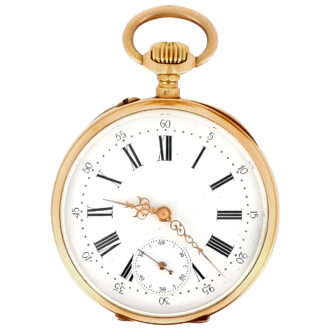
Hunting cased watch with yellow gold engine turned covers, platinum body with an engine-turned band. Gold cuvette. Matte silver dial, engine-turned, brushed chapter ring with radial Roman numerals, outer minute chapter with dot indexes. Blued steel Breguet hands. A frosted gilt movement, overhanging ruby cylinder escapement, plain three-arm balance with parachute on the top pivot, blued steel flat balance spring, index regulator via the cuvette with bimetallic temperature compensation curb repeating on two short circular section gongs with two hammers via plunge on the band. Dial and cuvette signed.
–
Diameter: 52 mm
–
Signed: Breguet et fils
–
This is only the second example of a gold and platinum cased pocket watch with a quarter repeat by Breguet to have passed through these rooms. The first watch was sold to Mademoiselle de Valckiers on October 21 1995. The certificate dated 1829 for the present lot is an interesting historical document in its own right. It has a list of watchmakers around Europe who could be trusted to repair the watch and for instructions on its correct use. The Potocki family is an important aristocratic family that originated in Potok in the Krakow Voivodeship; their family name derives from that place’s name. On May 3 1791, Europe’s first republican constitution was adopted, co-authored by brothers Ignacy and Stanislas Potocki. Stanislas was the subject of J.L. David’s famous portrait and the owner of an art collection unrivalled in Eastern Europe. Perhaps most eminent was his cousin Jan Potocki, traveller, ethnologist, linguist, and legendary author of The Manuscript Found in Saragossa.
–
A philosophical collection of stories within stories, this book, written in French, remains one of the greatest works of the European Enlightenment. François Potocki (1786-1853) The son of Vincent Potocki and Anna Mycielska commanded a squadron in Napoleon’s army and was the personal aide of Marshal Davout. In 1831 he was a Major in the Polish insurrectional army; he was also a Senator and President of the then very important “Heroldyi” organization that verified the origins of Polish nobility. Potocki appeared in the 1824 list of those authorized to bear the title of Count in the Kingdom of Poland; his title was confirmed by Russian Emperor Nicholas I on July 16, 1838. The title became extinct upon his death without issue. Potocki’s first wife was Sidonie, Princesse de Ligne (the daughter of Charles, Prince de Ligne, who was also his stepmother’s first husband). His second marriage was to Karolina, Countess of Koffler.
Signed: Breguet et fils
Share this page: