English astronomical watch with annual calendar Circa 1778
- Kenmerk
- AS1652
- Diameter
- 58 mm
- Estimate
- € 175.000 - 350.000
- Price sold
- € 720.000
Gold and enamel pair cased cylinder watch by George Margetts
–
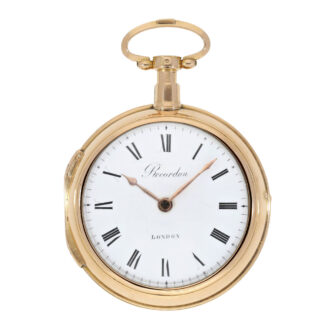
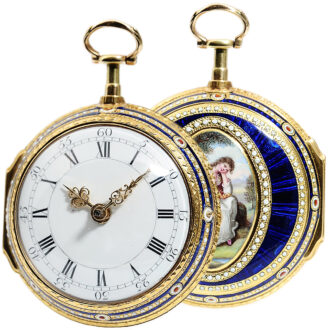
An important English gold and enamel pair-cased cylinder watch with a tidal dial, an annual calendar, and astronomical indications, circa 1778. This rare watch features a gilded full plate movement with a steel cylinder escapement. The balance cock is decoratively pierced and engraved with an eagle at the neck, and it also includes a silver regulator plate, diamond endstone, fusee, and chain. The movement is signed and numbered Geo. Margetts of London.
–
The astronomical dial features a white enamel ground and a 16-gear train for dial indications that advance clockwise, except for a fixed mean time dial with Roman numerals. It also includes a gold north indicator, two gold parallel parabolas, and a tidal dial indicating tides at eight English ports: Portsmouth, London, Hull, Yarmouth, Dover, Downs, Plymouth, and Dublin. Additionally, it has a fixed moon hand indicating the latitude of the planet, its position in the Zodiac, and declination in degrees on the nearest calibration of the main dial. The dial edge features an annual calendar read against the sun’s hand, which also indicates the sun’s declination and position in the Zodiac. The observer’s horizon is indicated by a tangential parabola, and the space between it and the inner parabola represents the astronomical twilight zone. The area of the dial enclosed by them shows the rise, southing, and fall of constellations, with the age of the moon engraved on gold through a circular aperture to the tidal dial.
–
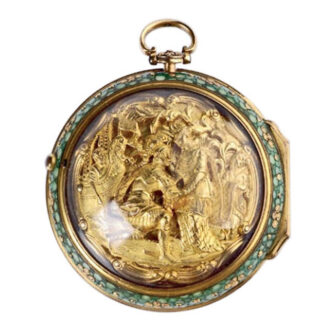
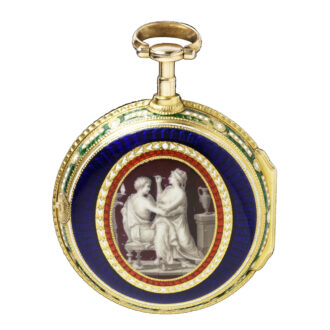
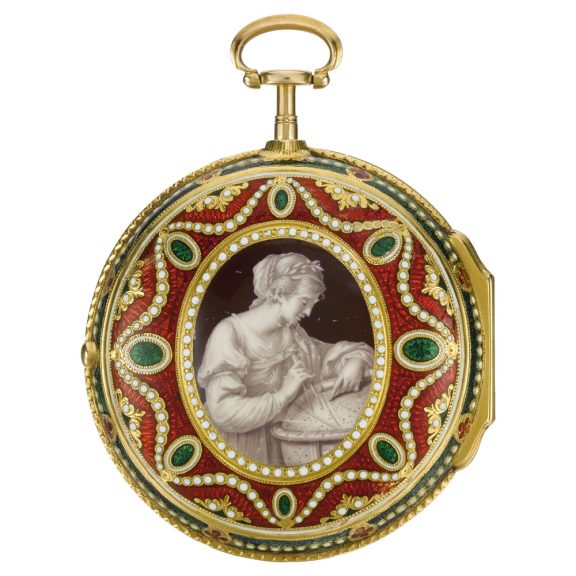
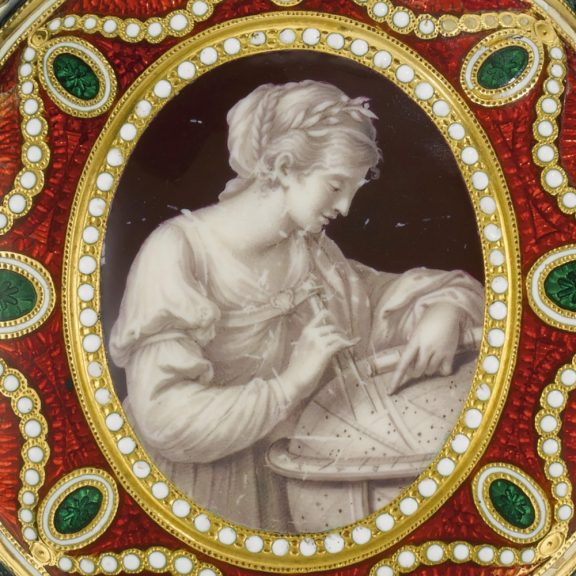
The timepiece consists of two cases. The plain gold inner case features a stirrup pendant and bow, with an aperture for winding on the case back. The gold outer case is centred with a portrait of the muse of Astronomy (Urania) in grisaille, surrounded by translucent red enamel over engine-turning, further adorned with swags of opaque white enamel beads spaced with ovals of green enamel. The bezels are decorated with translucent green enamel over engine-turning, along with opaque enamel beaded stringing. Both cases are hallmarked 1778 and bear the case maker’s mark IW for John Willis.
–
Diameter: 58 mm
–
Signed: George Margetts, London
–
The dial is in good overall condition, with some small and minor nibbles at the edge. The inner case has some light depressions on the band, while the outer case has some repairs or re-enamelling to the green enamel of the bezels and some small areas of repair to the red enamel. The central scene appears to be in good condition. It’s important to note that there has been some loss to the enamel on the case back, as the green enamel medallion at 1 o’clock is no longer present. The movement is running and appears to be in good condition.
–
A handwritten watch paper found within the outer case of the watch indicates that it was previously owned by Baron W. de Rothschild, who passed away in 1923 at over 90 years of age. There are four or five known astronomical watches of this type made by Margetts, along with two large tripod-mounted timepieces (nos. 341 and 342). Dr George Daniels conducted a detailed examination of the Royal Institution’s astronomical watch, Margetts No. 311, and published an illustrated article in Antiquarian Horology (No. 6, Vol. 6, March 1970). In his article, Daniels observed that the astronomical watches reveal an entirely different philosophy compared to Margetts’s marine timepieces. Beautifully made and finished, they are fine examples of the art of the 18th-century English horologist. Two unnumbered examples of these astronomical watches, which are older than the present watch, can be found in the British Museum. One is lacking its case, while the other is in a plain gold case. The fact that the present watch is numbered ‘1’ and has a fine and highly decorated outer case suggests that this was the first watch of this type to be issued and sold by Margetts. The dials of the two examples in the British Museum are slightly different from the present watch, neither having an aperture for moon age to the centre but, instead, the moon age is calibrated to the edge of the tidal dial.
–
It is uncertain for whom these astronomical watches were intended. In his book Old Clocks and Watches and Their Makers, F. J. Britten suggested that they were made as presentation pieces for captains within the East India Company. However, George Daniels wrote: It should be remembered that in the late 18th century, navigation was a hotly discussed and fashionable scientific subject. The motions of the heavenly bodies are basic to the subject, and Margetts was, no doubt, astute enough to realise that watches would appeal to those gentlemen of scientific bent who could afford to indulge their fancy with an expensive oracle (Antiquarian Horology, No. 6, Vol. 6, March 1970, p. 351).
–
An obituary from 1806, written a year after Margetts’s death and featured in Jonathan Betts’s new book, Marine Chronometers at Greenwich, provides a detailed account of the watchmaker’s life.
–
Margetts, born in 1748 in the parish of Old Woodstock, Oxfordshire, was the son of John Margetts, a wheelwright who passed away in 1763. At the age of 14, George was apprenticed to his brother, also a wheelwright. Before this, he displayed exceptional mathematical skills while attending school. At 18, Margetts claimed to have created a machine demonstrating the various motions of the earth, followed by a clock illustrating the diurnal motion of the earth, the progress of the zodiac, the spring and neap tides, and the revolution of the seasons.
–
According to the obituary, it was this clock that caught the attention of the Duke of Marlborough, who seemingly sponsored his relocation to London and admission to the watchmaking profession at the age of 23, possibly as an apprentice or journeyman. Margetts became a member of the Clockmakers’ Company in 1779. He petitioned the Board of Longitude multiple times in pursuit of funding for his projects related to finding longitude and improving astronomy, receiving some support from both the Board and the East India Company. His contributions to the East India Company included providing tables to aid navigators. Margetts is most renowned for his astronomical watches and eight-day chronometers. In late June 1804, Margetts began experiencing a breakdown and subsequently passed away at home the same year after spending some time in St. Luke’s lunatic asylum. For further details on Margetts, refer to Jonathan Betts’s Marine Chronometers at Greenwich, OUP, 2017, pp. 230–23.
Signed: Geo. Margetts, London
Share this page: