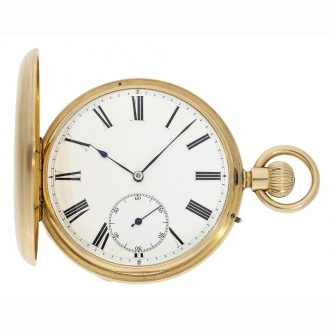
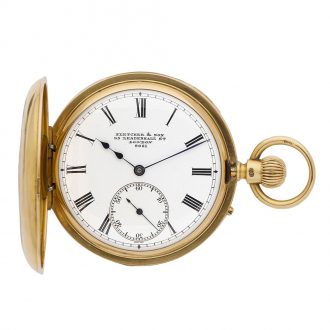
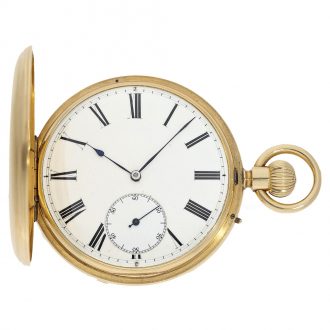
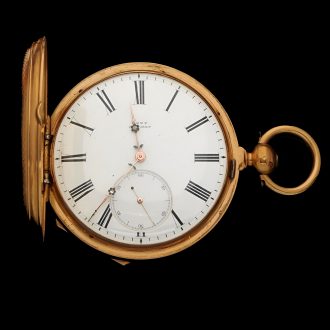
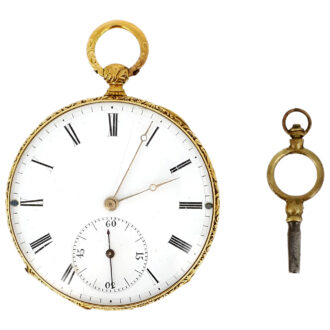
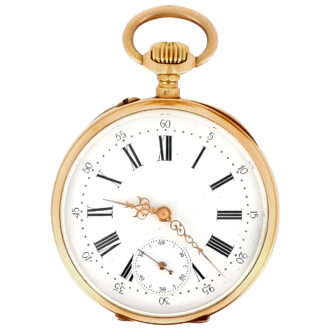
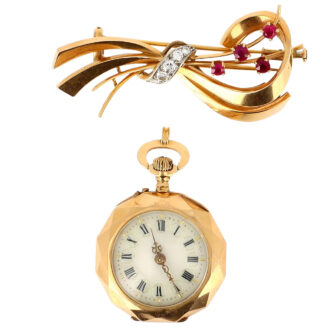
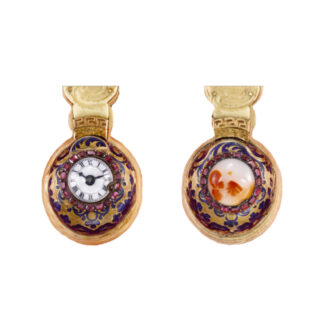
English 20K gold fan watch for the Chinese market Circa 1875
- Kenmerk
- TA2973
- Diameter
- 21 mm
- Estimate
- € 125.000 - 250.000
- Price sold
- € 541.800
Attributed to James Cox, London
–
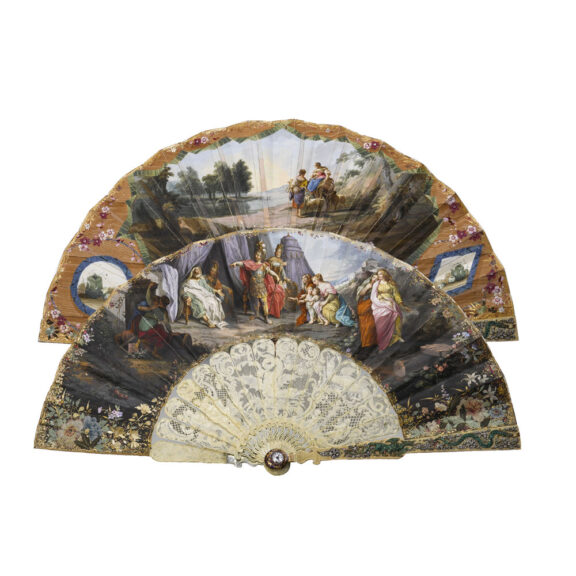
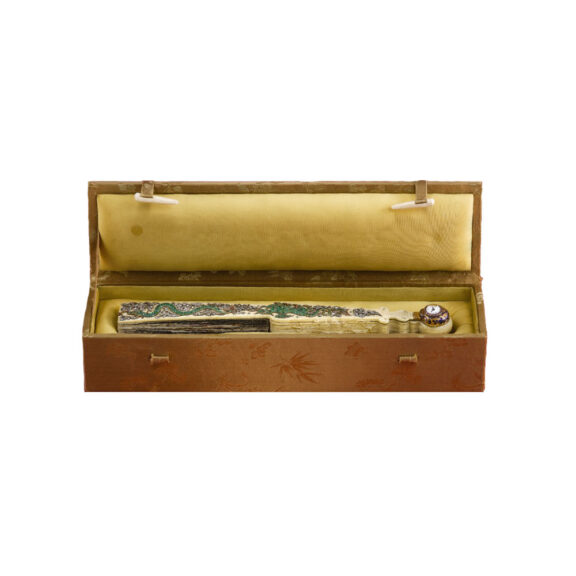
Magnificent and extremely rare English 20K gold, silver, ivory, enamel, diamond, ruby, emerald and agate-set fan with a watch, circa 1875. And a compartment containing a small mirror and the winding key, made for the Chien Lung Imperial family (1711-1799), of the Ching Dynasty. In a Chinese fitted box.
–
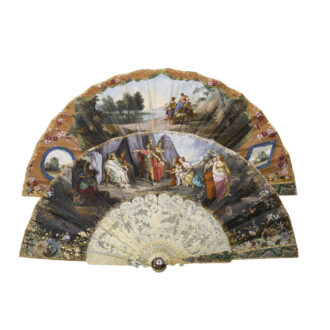
Fan: frame with 16 ivory sticks. Down the length of each of the guard sticks is, within a diamond foliate design, a dragon chasing a snake made up entirely of emeralds and rubies. The edges of the sixteen closed sticks are jointly carved with two dragons, one on each side of the fan; when the fan is open, their pierced and carved floral and lattice decoration is dominated by three winged dragons. These have five claws on each foot, a decorative privilege restricted to the Chinese Imperial family. The paper leaf is painted with a scene adapted from a painting by Antoine Coypel (1661-1722) of a quarrel between Achilles and Agamemnon, which was engraved by Nicolas Tardieu with the title Colère d’Achille. The central figure is Agamemnon, who had won a priest’s daughter as a prize of war and then given her up, following the advice of the seer Calchas, who foresaw disaster. There was trouble anyway, as Agamemnon, to compensate for the loss, seized the slave girl Briseis who belonged to Achilles. Here, Agamemnon is shown pointing imperiously outside Achilles’ tent.
–
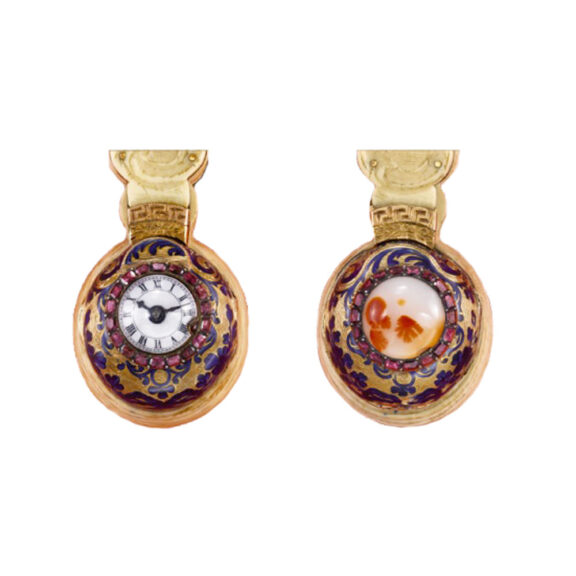
The reverse is also painted and has a landscape with a shepherdess on a donkey and a companion beside her. The fan pivot: with ruby-set bezels, in gold and Imperial blue translucent champlevé enamel. The front contains the watch and the matching back has a moss agate in the centre covering a compartment containing a small mirror and the winding key. The watch: White enamel dial, Roman chapters, outer minute ring. Blued steel heart and poker hands. Oval movement, gilt brass full plate, cylindrical pillars, fusee and chain, verge escapement, plain brass three-arm balance, single-footed cock, pierced and engraved with asymmetrical foliage. Totally height 530 x 280 mm.
–
Diameter: 21 mm
–
Signed: No Name
–
James Cox (circa 1723 – 1800) Was the son of Henry Cox, a tailor. He became Free in 1745. In June 1745 he set up shop in Racquet Court, where he remained until 1756. In 1756 Cox entered into a partnership with Edward Grace, moving to larger premises in Shoe Lane. However, Cox & Grace declared bankruptcy in November 1758. During the 1760s and early 1770s, Cox became famous for luxurious musical and automaton clocks and watches, made of precious metals and studded with precious stones, destined particularly for the court of the Chinese Emperor James Cox died in Watford in early 1800 and was buried in the family vault in London’s Bunhill Fields on February 26 of that year. We are indebted to Roger Smith for the information contained in his article “James Cox (c.1723-1800): a revised biography”, Burlington Magazine, June 2000.
–
Also see Clare Le Corbeiller, James Cox: A biographical Review, Burlington Magazine, June 1970, v. 112 (May-Aug. 1970), p. 351-358.
Published in the Sandberg book, pages 378-379. The case of the watch, together with the movement and the richness of the object, are consistent with the work of James Cox. Judging from its magnificence, this fan was probably ordered by King George III (1738-1820) of England and given as a present by Lord MacCartney, who led the Macartney Embassy to Beijing in 1792 with a large British delegation on board to celebrate King Chien Lung’s (1711-1799) 80th birthday. It was customary for European ambassadors to present sumptuous gifts to the Emperor or the Imperial family in pursuit of commercial privileges and favours.
Share this page: