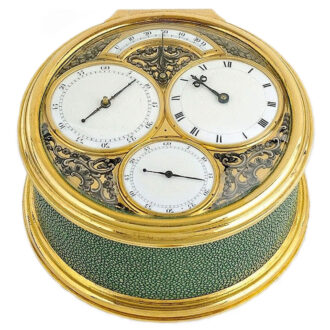
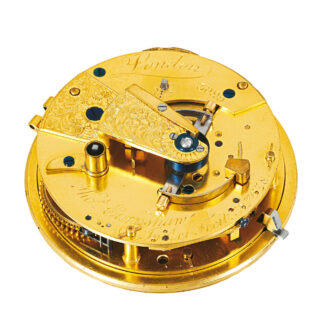
English chronometer with spring detent escapement Circa 1802
- Kenmerk
- TA1315
- Diameter
- 65 mm
- Estimate
- € 4.500 - 9.000
- Price sold
- € 8.900
Silver-Gilt open faced watch by Thomas Earnshaw
–
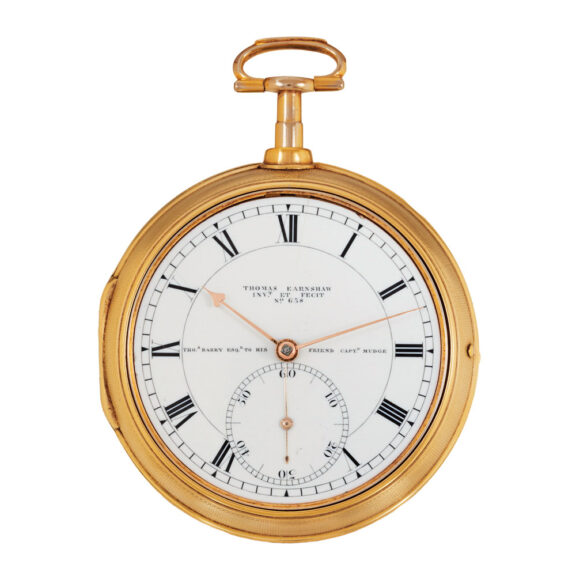
A very fine and rare English, silver gilt, pair-cased pocket chronometer with “Z” balance, circa 1802. The cases with London hallmarks for 1802-1804. Privateer Chronometer, Thomas Barry Esq. to his friend Capt. Mudge Thomas Earnshaw, Invt. Et Fecit, London 1802. The outer case by Richard Grove (master mark RG), 1804, engine-turned, the centre engraved around a crest with three fleurs-de-lys: GUGLIELMO SUO DE MALO LACU D D MORIENS ZACH MUDGE AD MDCCCLXVII, inner case is polished, master mark “TH” 1802.
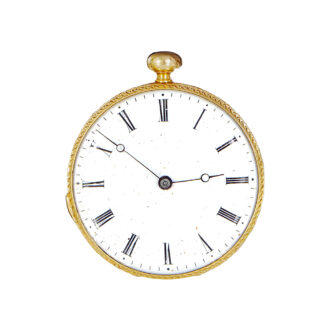
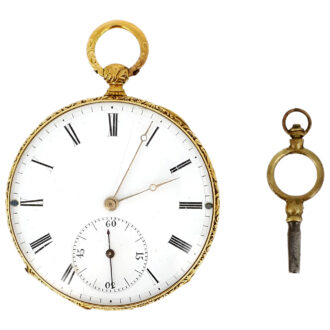
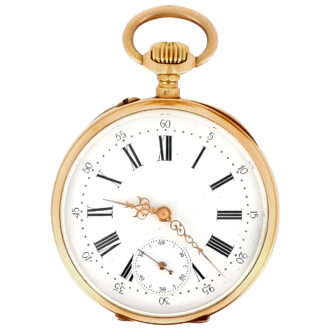
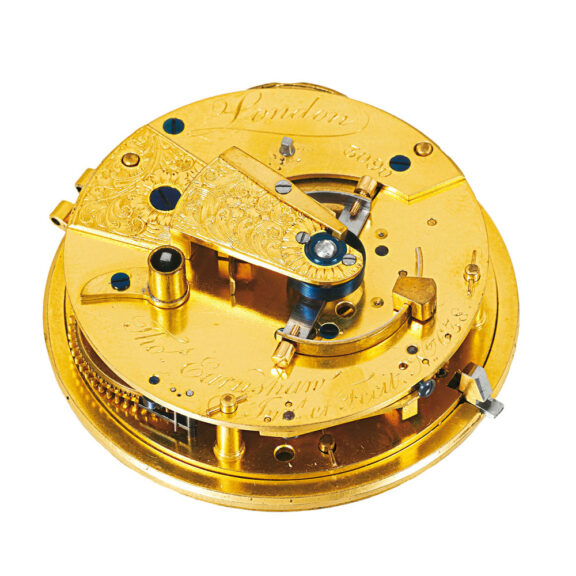
White enamel dial with radial Roman numerals, outer minute track, large subsidiary seconds, centre inscribed Thos. Barry Esqr. To his friend Captn. Mudge. Gold heart and poker hands. A frosted gilt full plate movement with cylindrical pillars, fusee and chain with Harrison’s maintaining power, Earnshaw spring detent escapement, bimetallic “Z” balance with wedge-shaped sliding temperature weights and two gold meantime screws, single footed cock with diamond endstone, escapement jewelled, blued steel free-sprung helical balance spring with outer terminal curves. Dial and movement signed. Dial signed on the reverse before firing “Earn Invt 638 Old Komn”.
–
Diameter: 65 mm
–
Signed: Thomas Earnshaw, London
–
Thomas Earnshaw Was instrumental in the development of the modern chronometer. For 200 years afterwards the vast majority of marine chronometers have been constructed after the principles introduced by Earnshaw in the late 18th century and implemented in this watch. A privateer vessel was a privately financed and owned warship, which had been granted a government license to attack enemy vessels. Privateering was a form of legitimate piracy. During the war of 1812, New York had 26 privateer ships on the seas, Baltimore as many as 18, while Newport, Charleston, Boston, Newburyport, Bristol, New London, Salem, Portsmouth, etc., all had their share. Privateersmen, being authorized to keep all or a part of their booty, often became extremely wealthy. Captain Mudge was the commander of Gov Plumer, a privateer ship that took part in the War of 1812. Zachary Mudge (1770-1852) began his naval career in 1780 at the age of ten; by 1849 he had attained the rank of admiral. He was first lieutenant on H.M.S. Discovery, serving under Captain Vancouver, who in 1792 named Cape Mudge after him. Thomas Barry is recorded as having been a gunner in 1812 on the privateer ship the Macedonian, which also took part in the War of 1812.
Signed: Thomas Earnshaw, London
Share this page: