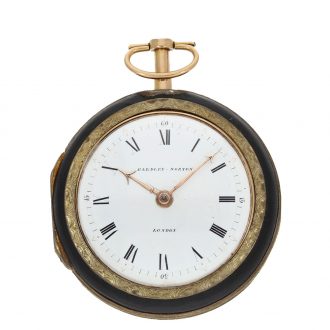
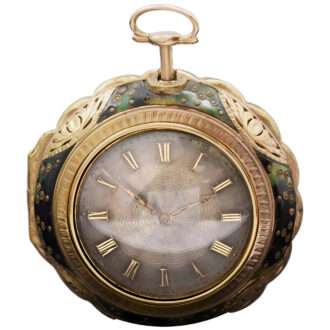
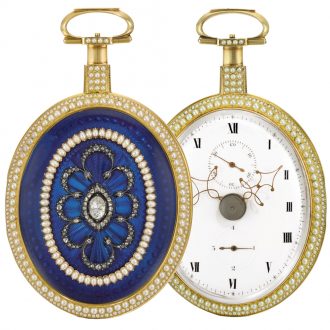
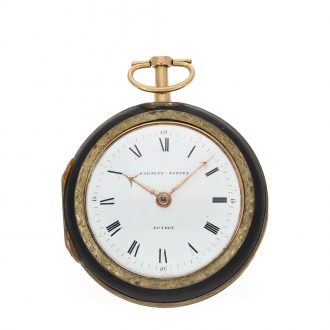
English 18K gold quarter repeater for the Turkish market Circa 1800
- Kenmerk
- FF0022
- Diameter
- 60 mm
- Estimate
- € 9.000 - 16.000
- Price sold
- -
Multi coloured gold quarter repeater
–
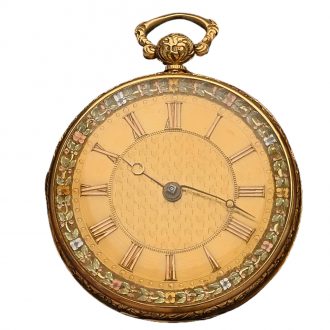
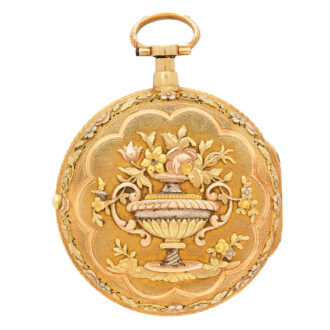
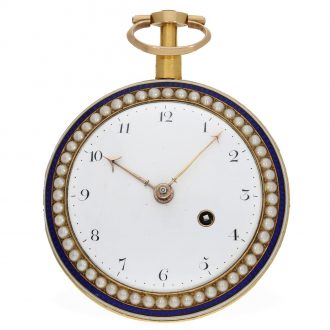
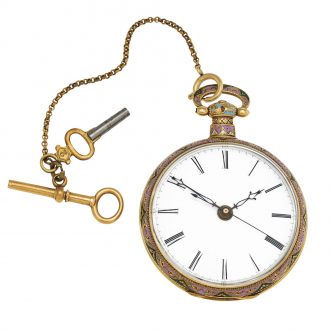
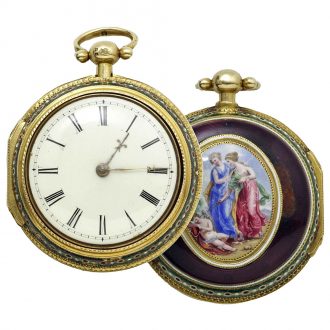
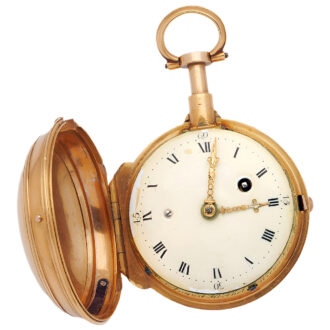
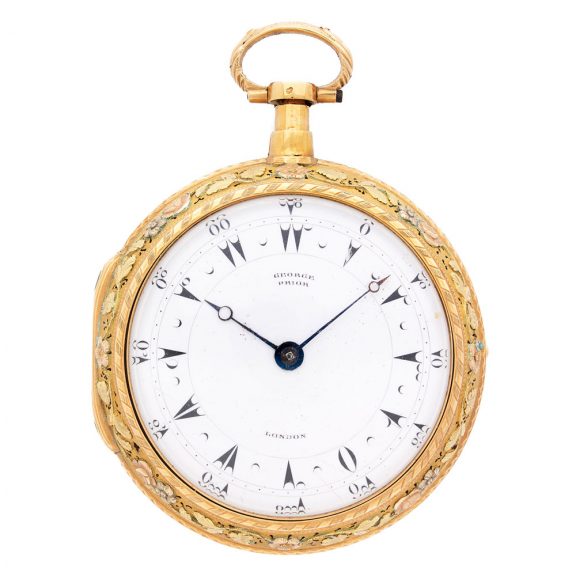
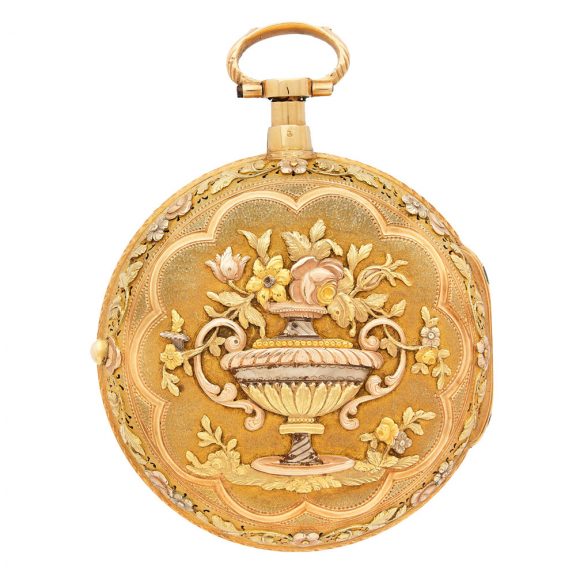
An English 18 carat gold large multi coloured gold open faced quarter repeater watch made for the Ottoman market, depicting The Flower Vase on the back, circa 1800. Full plate movement with key winding, the plate with a large foliate and chased decoration, verge escapement, chased and pierced cock of English manufacture with a single foot, ruby counter pivot, adjustment disc for gain/retardation, repeater with hammers on a bell at the bottom of the case pressure activated pendant.
–
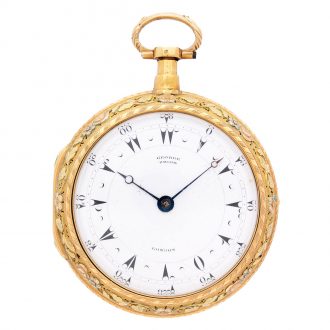
White enamel dial with Turkish numerals for the hours and minutes, railway minute track, , half hour markings, steel Breguet hands, signed George Prior London.
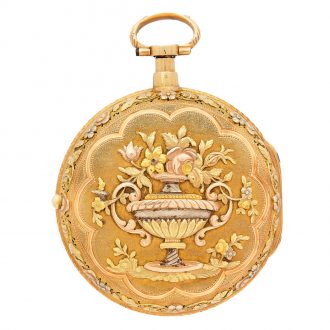
Round hinged case, the back with raised floral decoration in four colour gold depicting The Flower Vase, the case richly engraved with floral motifs and pierced for the sound emission on the case band, the pendant for the chime.
–
Diameter: 60 mm
–
Weight 162.5 g
–
Signed: George Prior, London
–
In the watches manufactured by George Prior for the Ottoman market in the 18th century, the vases of flowers decorating the dials or cases have a rich symbolism adapted to the cultural tastes of the Ottoman Empire. These flower motifs are not only ornamental elements; they also carry a deep meaning linked to Islamic culture, Ottoman traditions, and the universal symbolic values of nature and beauty.
Symbol of ephemeral beauty and the passage of time
The vase of flowers is a classic symbol of ephemeral beauty. In Ottoman culture, the flower is often associated with the fragility and transitory nature of life. By incorporating flower motifs into watches, George Prior recalls
not only the passage of time, but also the brevity of life. This symbolism resonates deeply with Ottoman art, which values the aesthetics of the present moment, while recognizing the ephemeral nature of beauty.
Influence of Ottoman Culture and Islamic Art
In Ottoman art, floral motifs (such as tulips, roses, and carnations) are prevalent and symbolize divine creation, purity, and perfection. Flowers are central elements in Islamic decorative arts, as they are seen as perfect creations of God. In George Prior’s watches, the flower vase becomes a bridge between European watchmaking and Ottoman aesthetics, reflecting an understanding and respect for local traditions.
The vase as a symbol of abundance and prosperity
The flower vase can also be interpreted as a symbol of abundance and prosperity. In the Ottoman Empire, a vase filled with flowers evokes the idea of wealth and fertility, values highly valued in Ottoman arts and culture.
By incorporating this imagery into his watches, George Prior offers an object that is not only functional, but also a lucky charm, believed to attract fortune and prosperity to its owner.
Spirituality and the Divine Nature
In Islamic culture, flowers also symbolize the perfection of creation and the power of God. Flowers, which bloom, fade, and renew themselves, are a metaphor for the cycle of life and resurrection, spiritual themes present in the Islamic faith.
The vase of flowers on George Prior’s watches allows us to see the timepiece as a reminder of spirituality and divine beauty, a profound symbolism that could attract Ottoman customers looking for an object that would recall their faith.
A fusion of European and Ottoman styles
George Prior, by incorporating flower vase motifs into his watches for the Ottoman market, demonstrates a sensitivity to local aesthetic tastes.
This fusion of European and Ottoman decorative traditions is evidence of the cultural adaptation of products to appeal to foreign markets. The vase of flowers thus became a symbol of the exchange between Europe and the Ottoman Empire, where European watchmaking adopted Ottoman visual codes to better meet the expectations of buyers.
The vase of flowers in George Prior’s watches intended for the Ottoman market is not a simple ornament. It embodies a complex symbolism combining ephemeral beauty, prosperity, spirituality and respect for Ottoman traditions. By integrating this motif, George Prior was able to create watches that spoke not only of the passage of time, but also of the deep values of Ottoman culture, making each watch a unique object of art and a testimony to an era when cultural exchange was at the heart of luxury trade.
Signed: George Prior, London
Share this page: