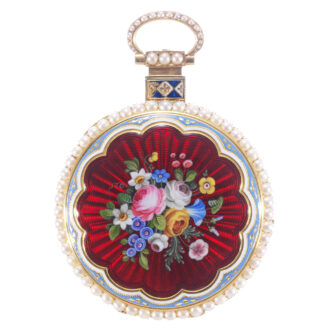
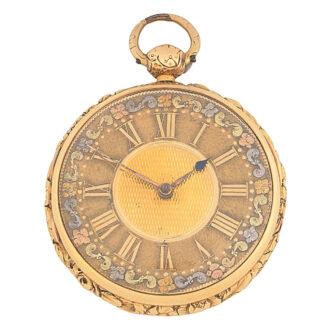
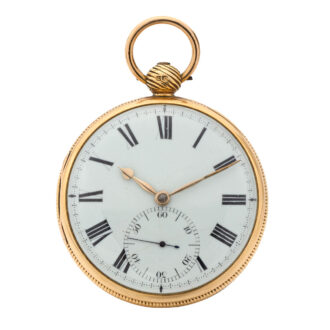
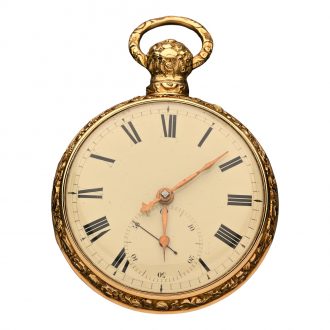
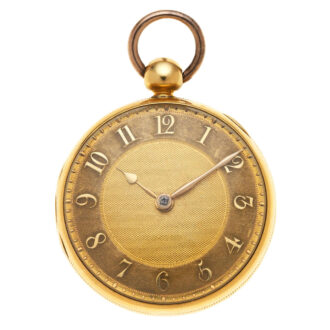
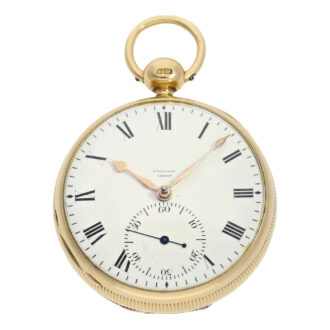
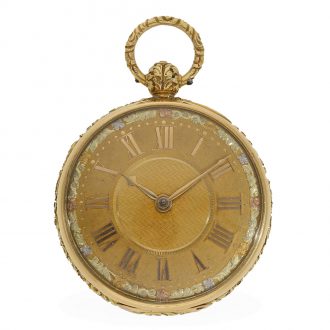
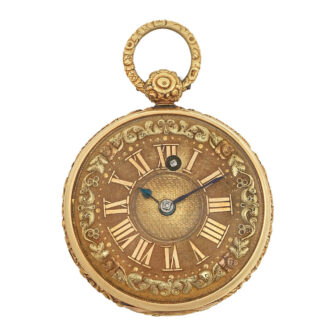
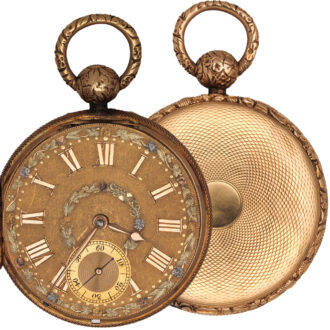
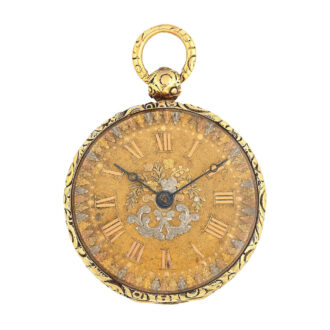
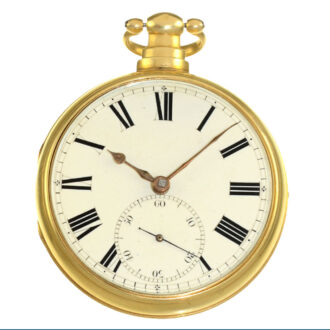
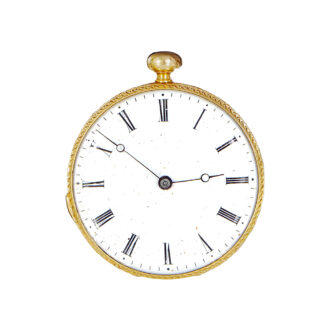
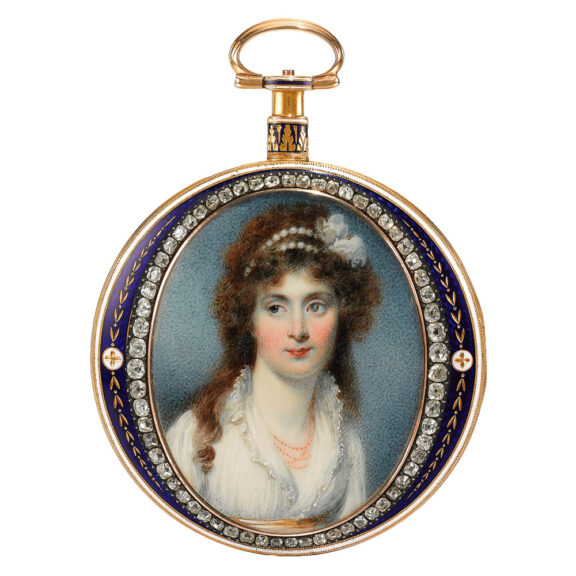
English enamel diamond set watch with portrait Circa 1821
- Kenmerk
- SA0078
- Diameter
- 62 mm
- Estimate
- € 9.000 - 17.500
- Price sold
- -
Enamel ivory and diamond set watch with portrait
–
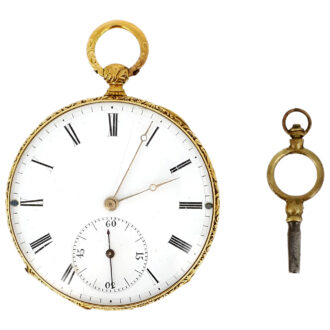
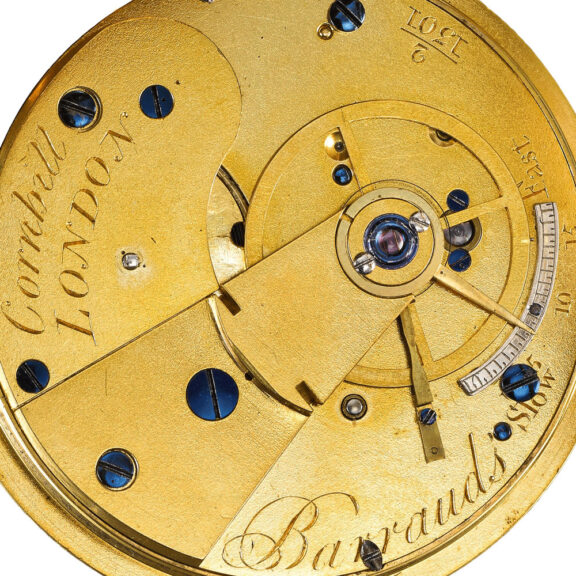
An English rare gold, enamel ivory and diamond-set watch with portrait miniature attributed to Simon Rochard, circa 1821, unusually slim cylinder escapement, brass three-arm balance, regulator with applied silver scale, plain balance cock, ruby endstone, dust cap, white enamel dial with Arabic numerals, gold arrow hands, winding square situated above 6 o’clock, champlevé enamel decoration on both front and rear bezels, case back features a fine stipple-work portrait miniature of a young lady painted on ivory possibly by Simon Rochard 1788-1872, framed by graduated diamonds, case marked IM for John Marsh, movement signed Barrauds, Cornhill London.
–
Diameter: 62 mm
–
Signed: Barrauds Cornhill London
–
Paul Philip Barraud. Apart from the finely painted miniature, one should also note the slimness of the watch, which was just coming into fashion during this period. Simon Rochard, (1788-1872) was a well known miniature portrait artist. Rochard was born in Paris and schooled at the Ecole des Beaux-Arts where he studied under J.B.J Augustin. Among Rochard’s most famous commissions is the portrait miniature of the Duke of Wellington for the King of Spain prior to the Battle of Waterloo in 1815. Following this, he moved to London and established himself as the favourite miniature portraitist of the Aristocracy. He remained in London from 1814-1845 where he exhibited at the Royal Academy, Society of British Artists and the New Watercolour Society. He moved to Brussels in 1846.
Paul Philip Barraud was born in London, December 5th, 1752 of Huguenot lineage. He was admitted to the Clockmakers’ Company in 1796 and elected master in 1810 and 1811. According to Tony Mercer, Chronometer Makers of the World, he and his sons made over one thousand chronometers before his death in 1820. He used Arnold and Earnshaw type detent escapements and Pennington type balances, once they were introduced. With the help of William Howells and George Jamison, he was able to offer a simplified version of the Mudge chronometers, Green and Blue, to the Admiralty at a price of 90 guineas. His firm was supplied by outside specialists such as Thomas Earnshaw.
Signed: Barrauds Cornhill London
Share this page: