Exceptional English gold and enamel verge watch Circa 1650
- Kenmerk
- SA0106
- Diameter
- 29 mm
- Estimate
- € 30.000 - 60.000
- Price sold
- -
Gold and enamel verge pocket watch by Edward East
–
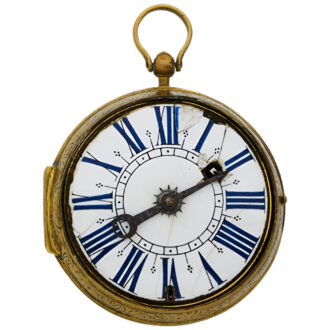
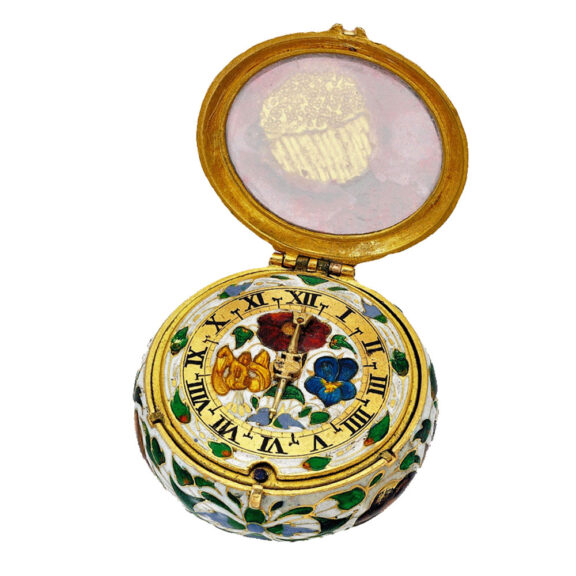
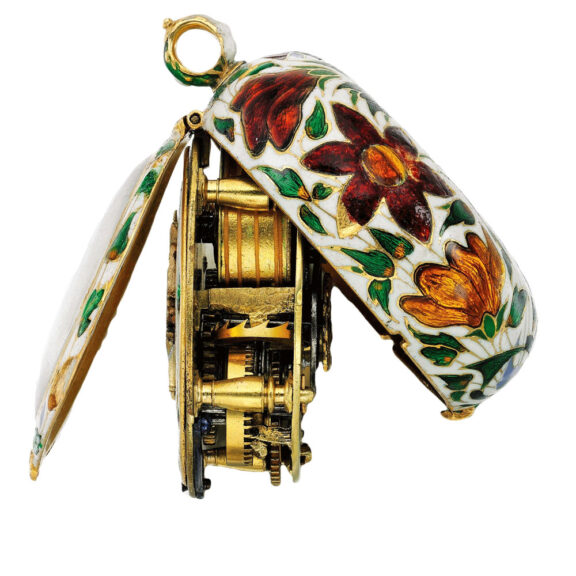
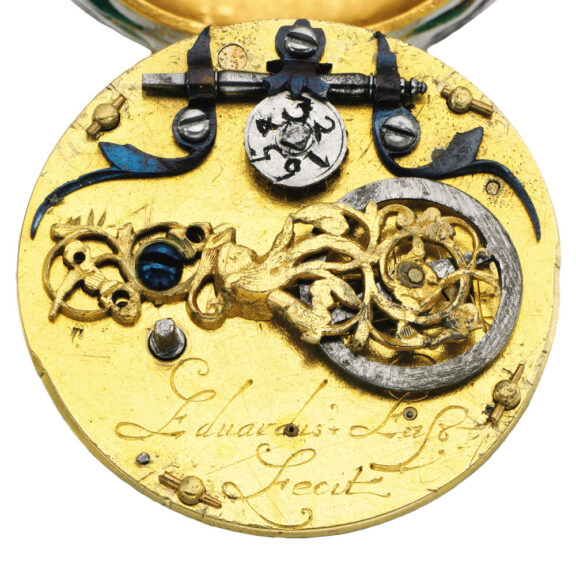
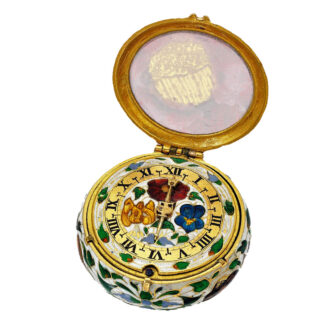
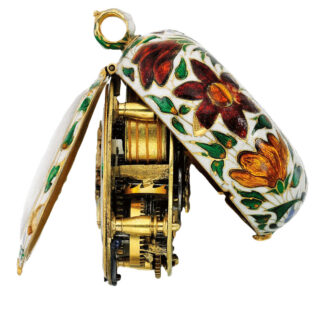
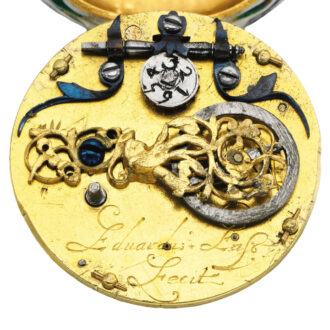
An exceptional English gold and enamel verge pocket watch, circa 1650. Gilded full plate movement, verge escapement, decoratively pierced and engraved screwed-on balance cock depicting a dolphin and scrolling foliage, flat steel balance, worm and later wheel set-up, fusee and gut line, baluster pillars.
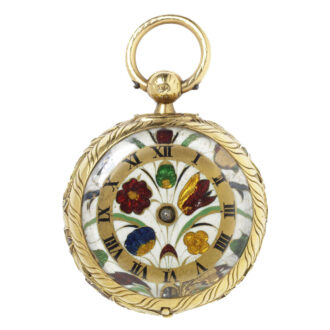
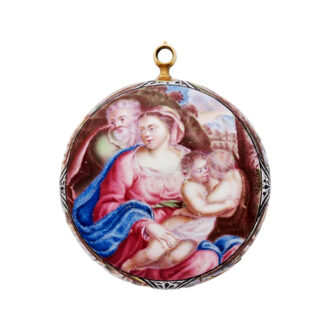
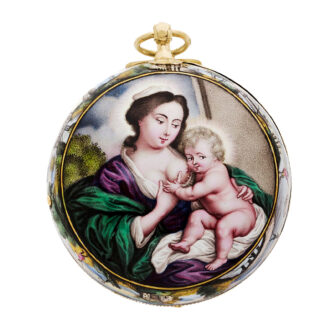
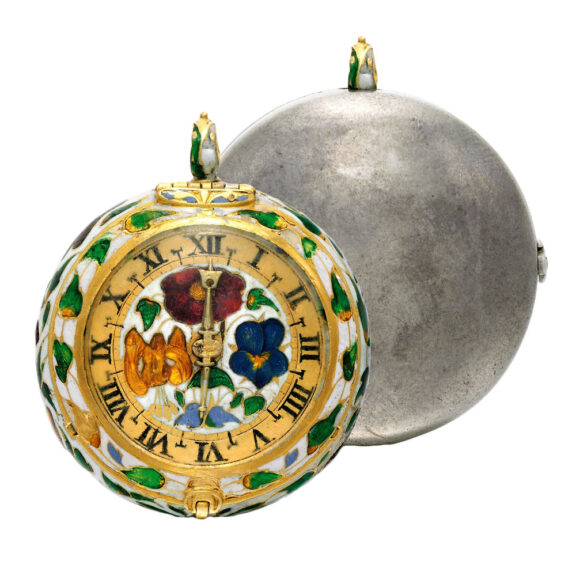
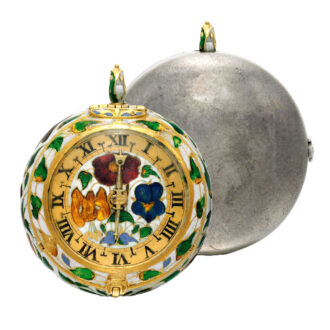
Gold cloisonné and champlevé enamel dial with translucent polychrome enamel flowers against a white enamel ground, chapter ring with Roman numerals and half hour divisions, double ended tulip hand, the case and bezel similarly decorated, pendant with green and white enamel highlights. Comes with a plain silver outer protective case.
Movement signed.
–
Diameter: 29 mm
–
Signed: Edwardus East Fecit
–
This superb watch, by one of England’s finest early watchmakers, is richly decorated with cloisonné and champlevé enamel, lending the watch a jewel-like quality. When the Time Museum purchased this watch from Christie’s in June 1981, the catalogue stated: “By descent through a family of title in Ireland. According to family tradition, given by King Charles I on the scaffold to Bishop Juxon.” Despite a 1905 book by Allan Fea and an exhibition catalogue of 1911 each supporting the view that the watch had belonged to the King, as Cedric Jagger has pointed out in his own book, Royal Clocks: “While this beautiful watch could certainly be described as of ‘royal’ quality, there is sadly no proof whatever of such antecedents.” Indeed, the style of the watch would suggest a date a few years after the King’s execution in 1649. Nevertheless, as family traditions often have some truth to them, it is still of course possible that the watch originally belonged to Bishop Juxon.
–
Bishop Juxon, 1582-1663, rose to prominence during the early seventeenth century. He studied law at Oxford but chose instead to have an ecclesiastical career, becoming the vicar of St. Giles’ Church in Oxford in 1609. He held several prestigious positions at Oxford until he eventually served as the chaplain-in-ordinary to King Charles I. In October of 1633, he was consecrated as the Bishop of London, and by 1636, King Charles I bequeathed several secular responsibilities to him, such as the High Treasurer of England, and First Lord of the Admiralty. King Charles I held Juxon in very high esteem and frequently sought his advice on important issues. He requested that Juxon stand with him on the scaffold and offer him his last rites during his execution. After the Restoration of the Monarchy, Charles II named Juxon the Archbishop of Canterbury, which he remained until his death in 1663.
–
Without question one of the most important early English watchmakers, Edward East was born in Southill, Bedfordshire in 1602. In 1632, he was made one of the first assistants of the Clockmakers’ Company, was Warden in 1638 and Master in both 1645 and 1653. In 1660 he was appointed chief clockmaker to King Charles II. In October 1692, East gave £100 to the Clockmakers’ Company with the interest to be used to support poor members. Edward East lived through almost the entire 17th century and died in 1697 leaving an extraordinary legacy of exceptional watches and clocks.
–
Cloisonné is an ancient technique for decorating metalwork objects with coloured material held in place or separated by metal strips or wire, normally of gold. In recent centuries, vitreous enamel has been used, but inlays of cut gemstones, glass and other materials were also used during older periods, indeed, cloisonné enamel very probably began as an easier imitation of cloisonné work using gems. The resulting objects can also be called cloisonné.
Signed: Edwardus East Fecit
Share this page: