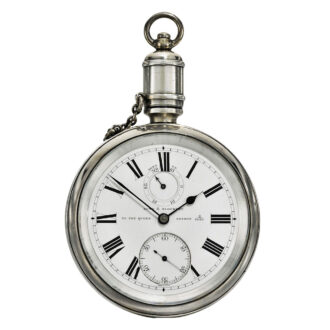
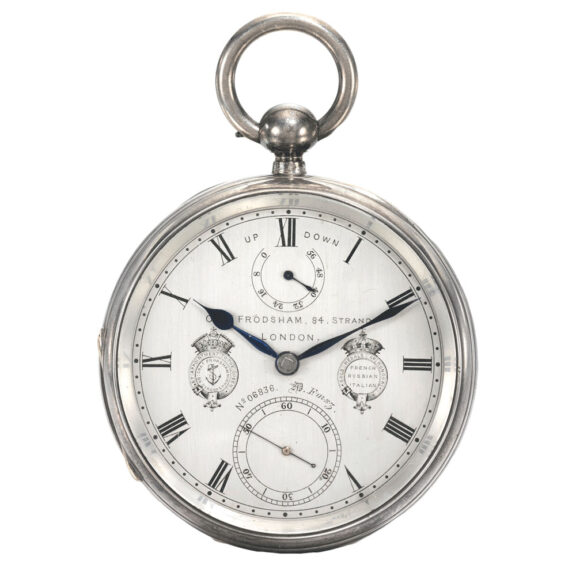
English chronometer deck watch with power reserve Circa 1884
- Kenmerk
- SA0095
- Diameter
- 68 mm
- Estimate
- € 10.000 - 30.000
- Price sold
- -
Large silver two day chronometer deck watch with power reserve
–
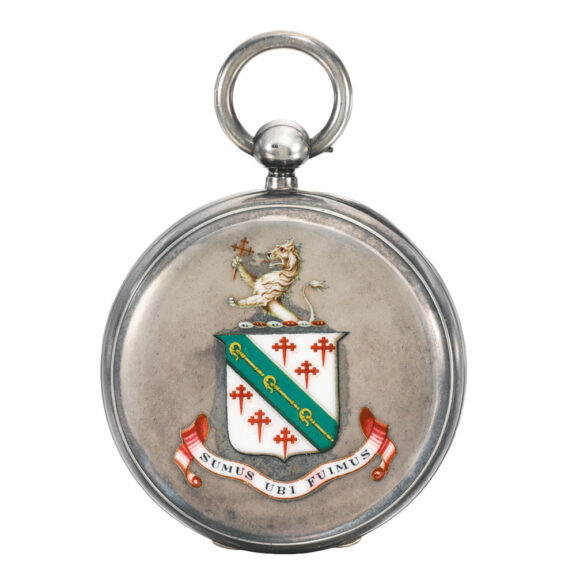
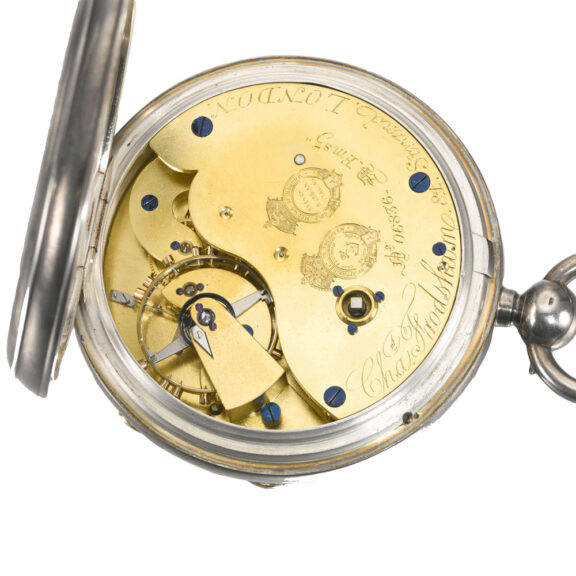
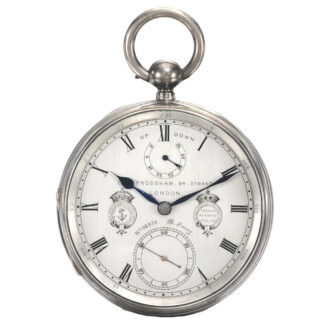
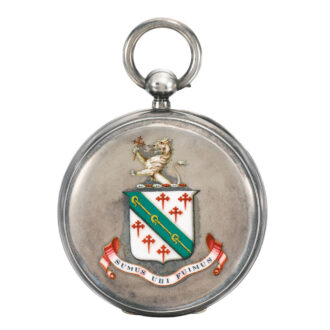
An English exceptional and large silver open face two day chronometer deck watch with power reserve indicator and duo in uno hairspring, circa 1884, 32 Lancashire size 3/4 plated gilt movement with spring detent escapement, duo in uno hairspring, diamond end stone, free sprung, bi metallic screw balance. Silvered dial, blued steel spade hands, Roman numerals, subsidiary seconds dial and sector with an up and down indication from 0 to 56, the dial further engraved with Royal warrant and a medal of honour for France, Russia, and Italy. The case bearing the arms of the Weare Family of Devonshire, enamelled in white, green and red, with the motto SUMUS UBI FUIMUS, with gold hinges, case and cuvette hallmarked, with case maker’s stamp GJT incuse of George James Thickbroom, case and movement signed.
–
Diameter: 68 mm
–
Signed: Charles Frodsham 81 Strand London
–
This watch belongs to a series of approximately twenty-two pieces produced over a period of forty years. Today eleven pieces are known to have survived. The first two pieces made were sold sometime around 1856-7. This watch was finished twenty-five years later and was sold with a group of four pieces.
The Arms finely executed on the case back are for Lieutenant General Sir Henry Edwin Weare. The arms were identified by T. Woodcock at the College of Arms in the 1980s.
The Latin motto SUMUS UBI FUIMUS translates as: “We are where we were”.
In 1843 Charles Frodsham bought the firm J.R. Arnold and became Arnold and Frodsham. This was a bold move as it set him up at 84 Strand. He retained the double name until 1858 when the firm Charles Frodsham, 84 Strand, was officially established. Through his many publications and timepieces, Frodsham dedicated himself to the exploration and education of time and its many forms. He continued to achieve acclaim for his work from chronometers to barometers, reversed fusee and both lever and double rotary escapements. The Frodsham balance, which was designed for astronomical accuracy can be found in carriage clocks and some mantel clocks dating to as early as 1851.
Frodsham became free of the Clockmakers’ Company in 1845 and Master of the Company in 1855. He served as Master of the Company for the second time in 1862, that same year he was elected Vice-President of the British Horological Institute, of which he was one of the original members.
In 1855 he won the Gold Medal of Honour at the Paris Exhibition. In 1862 he was awarded the Medal of Honour for his service as a juror at the Great International Exhibition in South Kensington. He continued to achieve recognition at exhibitions from Russia to Paris. Charles Frodsham excelled at his art until his death in January 1871, at the age of 60.
Upon Charles’s death, his son, Harrison Mill Frodsham, took charge of the firm and incorporated it in 1893 as Charles Frodsham and Co. Ltd. Harrison Mill Frodsham proved to be an able horologist and businessman and the firm continued to flourish as a maker of fine timepieces, as the present lot exemplifies.
Signed: Charles Frodsham 81 Strand, London
Share this page: