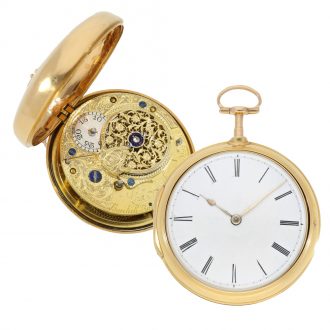
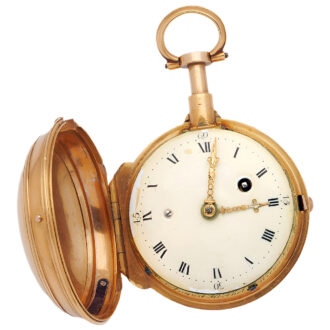
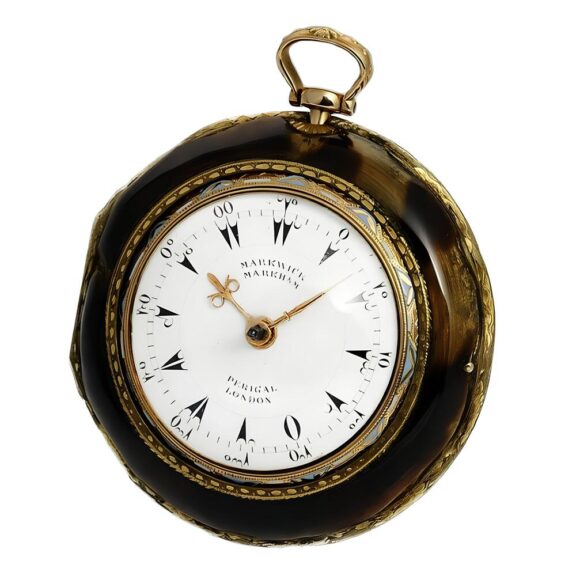
English gold enamel verge for the Ottoman market Circa 1793
- Kenmerk
- AD4070
- Diameter
- 51 mm
- Estimate
- € 10.000 - 15.000
- Price sold
- € 13.750
Open faced pocket watch by Markwick Markham & Perigal
–
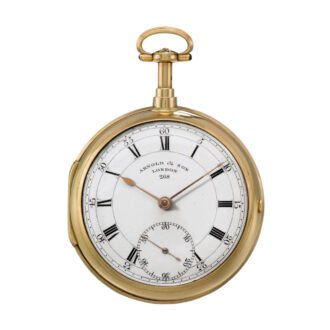
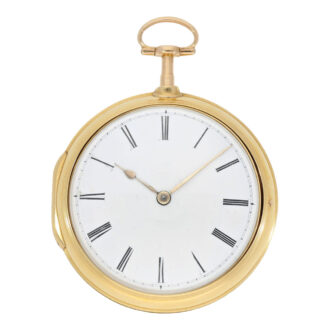
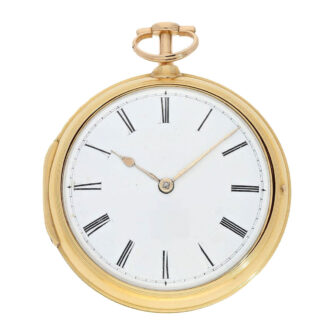
A very fine English gold enamel verge pocket watch in a triple case for the Ottoman market, circa 1793. Three cases: Outer case – brass/gilt, tortoiseshell with stud decoration, large lateral hinge; Inner case – 18-carat gold, polished, florally engraved pendant, case maker’s punch mark AN; Middle case – 18-carat gold and polychrome enamel, waved inner edge with floral engraving and translucid taille d’epargne flowers and tendrils. The outer edge is decorated with flowers, and the back has an exquisite polychrome miniature painting: military instruments on a hexagonal engine-turned translucid red background, a large outer hinge, and a case maker’s punch mark AN. Signed enamel dial with radial Ottoman numerals and gold Poker and beetle hands. Full plate movement, keywind, applied florally engraved ornaments, fire gilt, signed, chain/fusee, Egyptian movement pillars, verge escapement, three-arm steel balance, very finely engraved pierced balance cock, large set diamond endstone on balance.
–
Diameter: 51 mm
–
Weight: 95 g
–
Signed: Markwick Markham & Perigal, London
–
James Markwick, Markwick Markham & Perigal
James Markwick and his son James were fine watchmakers working in London. The elder was apprenticed on 25 June 1656 to Richard Taylor and subsequently to Edward Gilpin. He became free of the Clockmakers’ Company on 6 August 1666. Six apprentices were bound to him between 1674 and 1699. In 1673, he succeeded Samuel Betts’s business behind the Royal Exchange. Although he held office in the Clockmakers’ Company, he was irregular in attendance, ceasing to tend to its affairs after 1700. He worked until at least 1706. His son, James Markwick Jr., became free of the Company in 1692 by patrimony. The younger James Markwick was an eminent maker, Master of the Clockmakers’ Company in 1720, and a very early user of jewelled bearings. In later years, he partnered with his son-in-law Robert Markham, who succeeded him using the trading name of Markwick Markham, which became famous for watches destined for the Turkish market. Not only did this notoriety encourage the appearance of spuriously signed watches, but at the end of the century, Markham, or his successor, associated the names of other watchmakers with their products intended for the East. Thus, the makers associated Francis Perigal, Peter Upjohn, H. Story, Borrell, John Johnson, Louis Recordon, and Dupont. All were reputable watchmakers in their own right, selling other products under their names. Francis Perigal (also Perrigal) was active from about 1770 to his death in 1794. He was admitted as an honorary freeman of the Clockmakers’ Company in 1781. A maker of fine and interesting watches, he made a very early lever watch which, having been recased, can only be dated by the signature: “Watchmaker to the King”. This appointment was conferred upon him in 1784. Little is known of Perigal, but the few surviving watches bearing his name are of considerable mechanical interest and fine quality. He was succeeded in business by his son.
Signed: Markwick Markham & Perigal, London
Share this page: