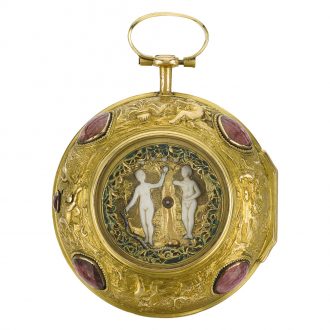
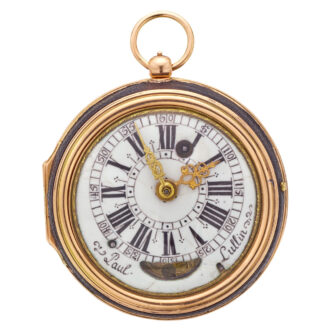
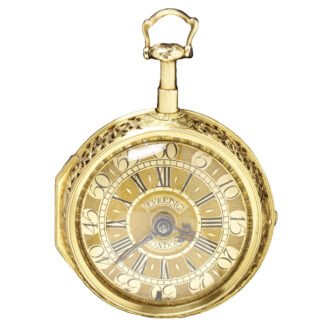
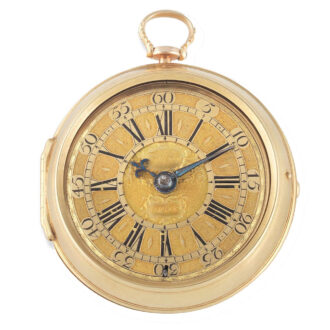
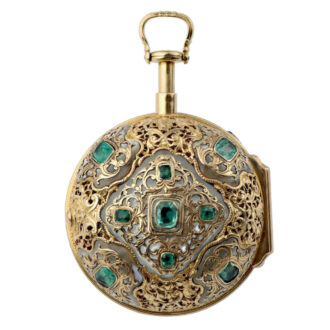
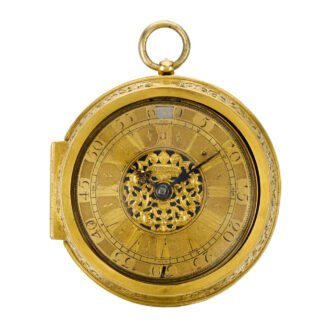
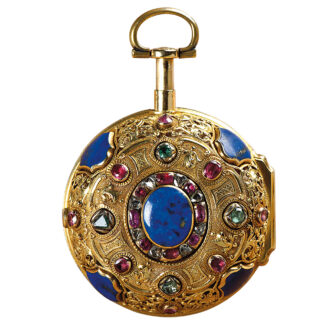
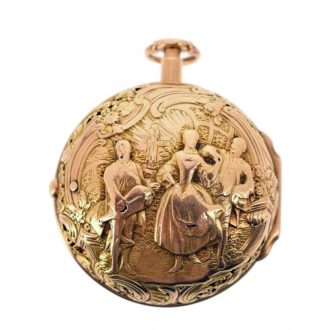
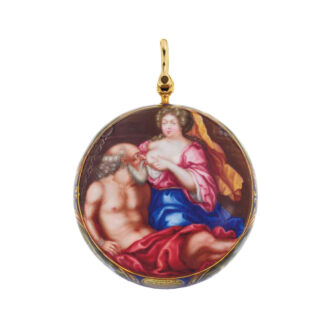
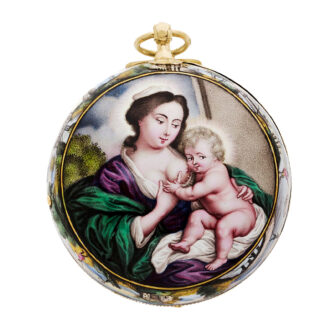
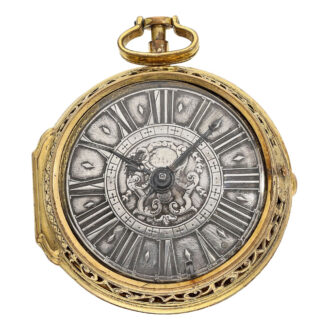
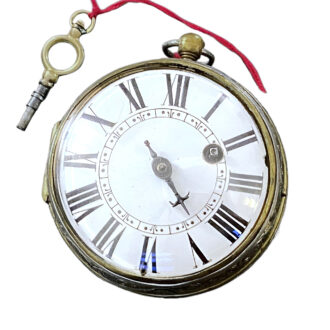
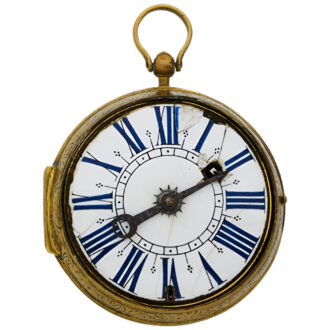
English gold and enamel watch, protective case Circa 1700
- Kenmerk
- SA0406
- Diameter
- 48 mm
- Estimate
- € 10.000 - 20.000
- Price sold
- -
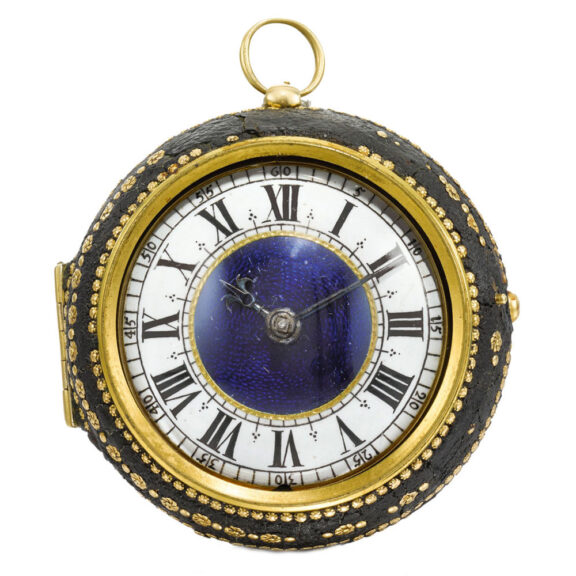
Rare gold and enamel watch with a leather outer protective case
–
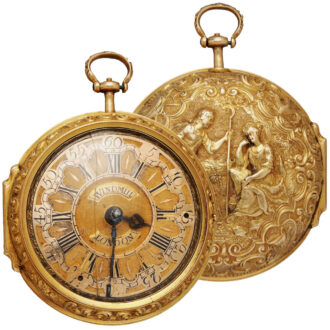
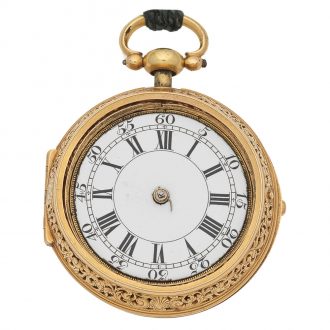
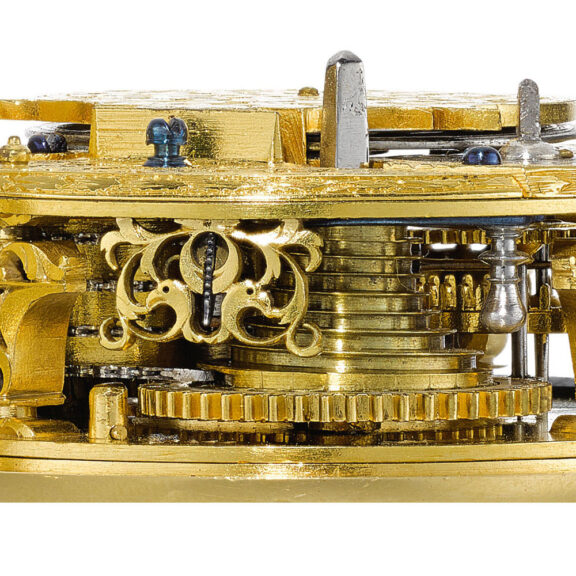
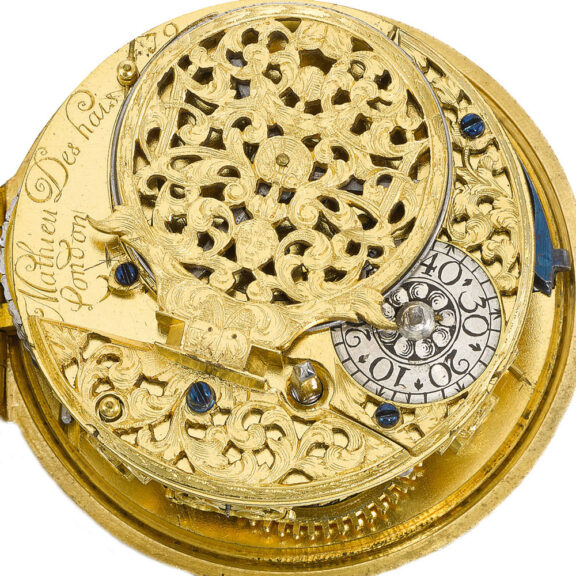
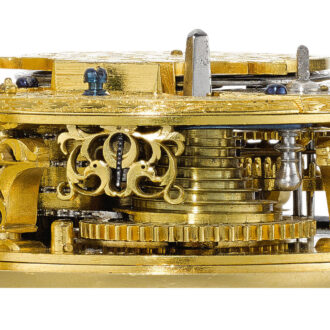
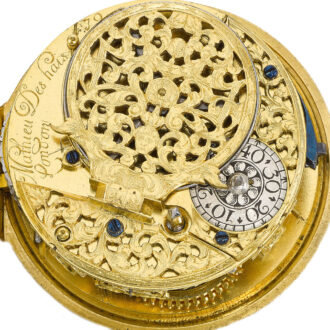
An English rare gold and enamel watch with leather and pique decorated outer protective case and later verge movement, cases circa 1675-1680, movement circa 1700, later gilded full plate movement, decoratively pierced balance cock engraved with foliage and a head above the neck, flat three-arm balance with spring, both ends of the spring secured by square tapered pins in square holes, fusee and chain, crested Egyptian pillars, signed Mathieu Des hais.
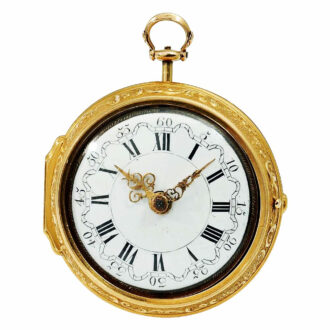
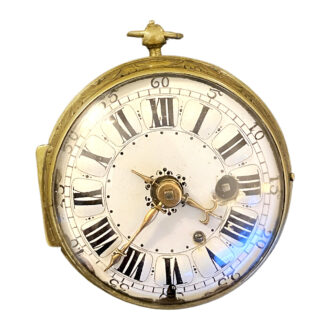
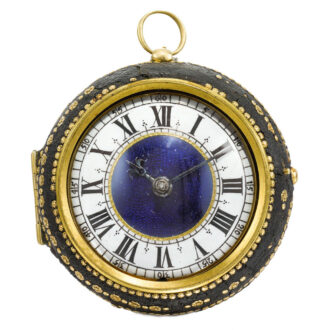
White enamel dial, chapter ring with Roman numerals, outer Arabic minute ring, inner quarter-hour divisions, the center with translucent blue enamel over circular engraving, blued steel tulip and poker hands.
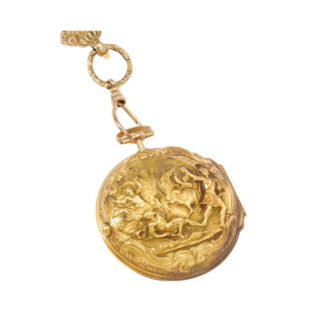
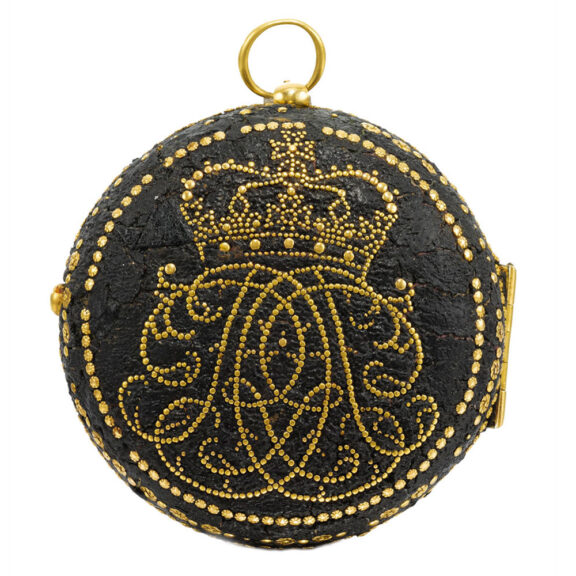
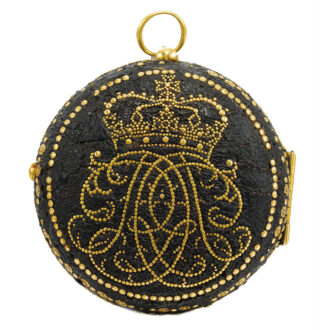
Plain gold inner case, the back with shuttered winding aperture, split bezel for glass retention, case maker’s mark a stylized fleur-de-lis above broad ‘I’ or pedestal, outer leather protective case with decorative gold piqué work, the back centered with a Royal coronet and cipher, Charles Rexconjoined and reversed.
–
Diameter: 48 mm
–
Signed: Mathieu Des hais
–
A fascinating watch of exceptional quality and character, the outer case back is tantalizingly decorated with a Royal Coronet and Cipher suggesting Charles Rex, conjoined and reversed in particularly fine gold pin work. The gold dial has a white enamel chapter ring with translucent Royal blue enamel over the gold to the center.
In his book, The English Watch 1585-1970, Terence Camerer Cuss notes that whilst conclusive evidence is lacking, this watch was found some years ago “wrapped, together with some mourning rings, in a newspaper dated 1822 in a house which had belonged to the same extended family since the 16th century. By a process of deduction, it was very clear the rings belonged to Richard Benyon de Beauvoir, one of whose forebears married a Mary Tyssen, widow of one Paulet Wrighte. On the eighteenth-century watch-paper is written ‘Dr. Wright £-4s 6d’. Mary Tyssen was the daughter of Francis Tyssen of Sacklewell (1690-1717) and Rachel, daughter of Richard de Beauvoir – whose name Benyon assumed the same year as the wrapping paper. Richard de Beauvoir provided not only the Coronation rings for James II and Mary but also designed her Coronation Crown. The Tyssen and de Beauvoir families were goldsmiths and bankers; the royal family often turned to these when it was in need of money. The watch could have been sold to either the Tyssens or the de Beauvoirs, maybe after the king died in 1685.”
It may be that the movement originally fitted to this watch was not a success, however, it does seem certain that the original would also have had a balance spring as the dial has provision for minutes. The present movement by Des hais is of very fine quality and appears to have been specially fitted. Little is known of Mathieu Des hais of London, Baillie records a watch made by him, whilst Britten records a bracket clock. Indeed, Des hais is noted as a “shadowy character” by E. F. Bunt in an article for Antiquarian Horology, in which the writer notes a daybook believed to have belonged to Benjamin Gray that shows Des hais to be the former’s best customer, purchasing 38 movements, the majority between 1704 & 1710. Movements signed by Des hais are of the highest order. A special feature of the movement of this watch and another by Des hais, numbered 254 & 57 is that both ends of the balance spring are secured, not by the normal circular pin and hole, but the superior method of square tapered pins in square holes. Interestingly, Jeremy Evans writes of the Des hais watch no.79 in his book Thomas Tompion at the Dial and Three Crowns, noting “it displays workmanship closely comparable to Tompion’s style.”
Signed: Mathieu Des hais
Share this page: