Impressive Swiss musical watch for the Chinese market Circa 1820
- Kenmerk
- TA4413
- Diameter
- 62 mm
- Estimate
- € 40.000 - 80.000
- Price sold
- -
Gold, enamel and pearl watch
–
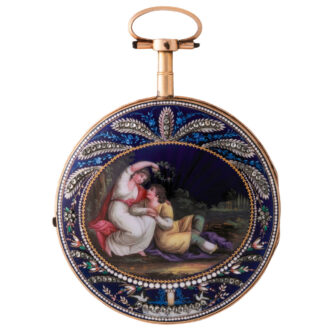
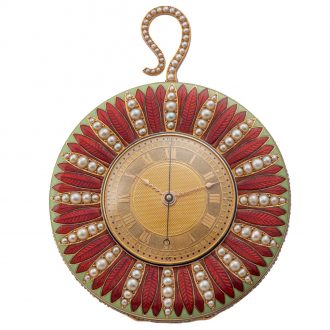
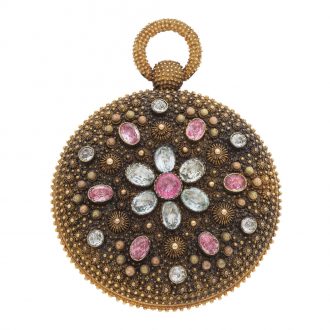
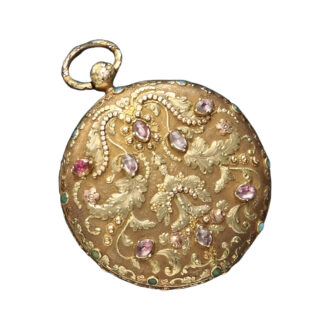
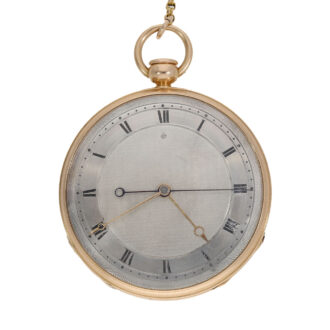
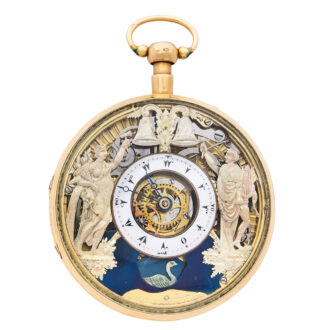
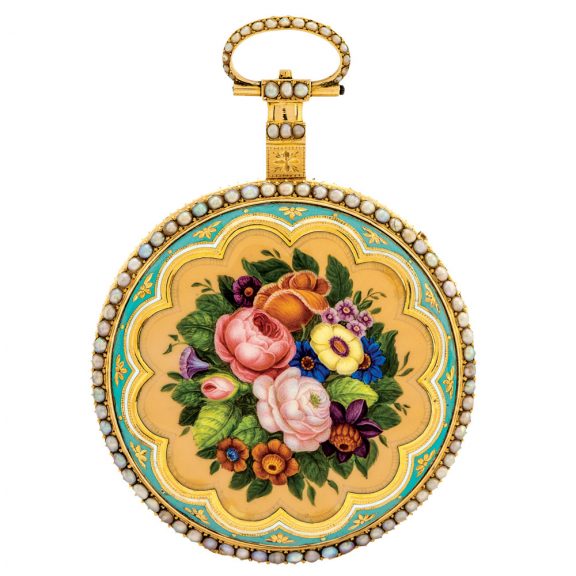
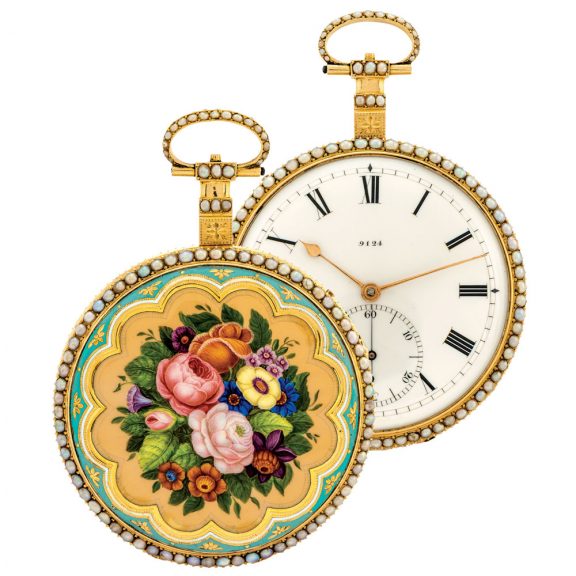
Impressive Swiss 18 carat gold, painted on enamel and pearl musical pocket watch, circa 1820. Made for the Chinese market. With sure plateau musical movement playing music on the hour or at will. English style movement, attributed to Piguet et Meylan, perhaps supplied to Ilbery or Charman, London. An Empire case, hinged pearl set bezel, pendant and bow, coin-edge band with a lever at 11 for activating the music. The hinged and sprung back cover is decorated with a very finely painted enamel bouquet on an opalescent guilloche enamel ground. Scallop edged gold border within an enamel white line and pale green enamel outer border, pearl set edge to match the bezel. Hinged gold cuvette with winding apertures and lever for music/silence protruding from the edge.
–
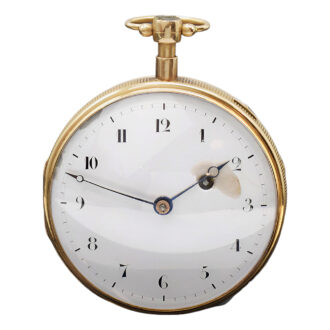
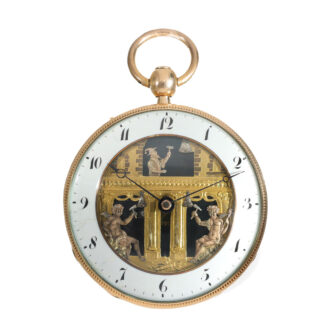
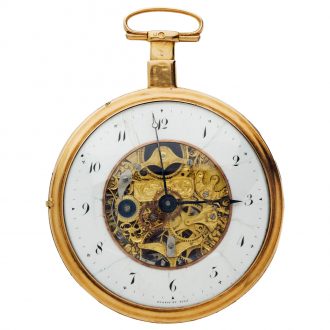
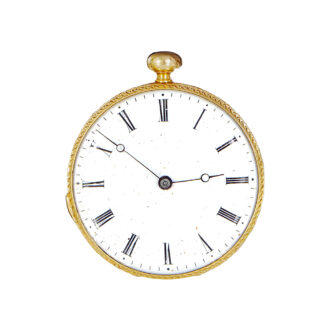
White enamel dial with radial Roman numerals, outer minute track, large subsidiary seconds and gold poire hands. Matte gilt movement, standing barrel, jewelled cylinder escapement with steel escape wheel, four-arm brass balance, flat balance spring, finely pierced and engraved English style single footed balance cock, index regulator with an engraved scale on the backplate. Sur-plateau musical train with large fixed barrel, flat pinned disc with 25 tuned steel vibrating blades playing on both sides of the pinned disc, polished steel activation levers. Dial numbered 9124, case numbered 24/33, movement punch numbered 32 on the musical disc.
–
Diameter: 62 mm
–
Signed: No Name
–
This large and heavy, beautifully decorated musical watch has a very high quality movement almost certainly made by Piguet & Meylan, the main exponents of this particular type of sur-plateau movement. Despite being entire of Swiss craftsmanship, this watch is very much made in the English style in particular the single footed balance cock. It was likely ordered by either Ilbery or Charman in London to export it to China. Because English made goods were regarded by the Chinese as of superior quality at the time, when the London watchmakers ordered watches from Switzerland, their movements were made to appear English-made, although, at the same time, the cases were decorated with enamel very much to appeal to the Chinese taste. William Ilbery was Active in London from 1780.
–
Following James Cox in London and Jaquet Droz in Switzerland, he specialized in luxury watches made for the Chinese market. He set a new standard for watches made for the Asian market. Ilbery can therefore be considered the father of Chinese watches as they are known today. Ilbery’s watch cases were decorated by Geneva’s best enamelers, such as Jean-Francois-Victor Dupont and Jean-Louis Richter. He seems to have maintained close contact with the continental trade since a watch signed by Ilbery Paris is known and Ilbery & Son are recorded in London and Fleurier, as well as in Canton. Isaac Daniel Piguet Born in 1775 in Le Chenit in the Vallée de Joux, Isaac Daniel Piguet was the son of Pierre Moïse Piguet and Elisabeth Nicole. He married Jeanne Françoise Capt around 1795, and around 1800 settled in Geneva with his family.
–
Isaac Daniel Piguet went into business with Henry Daniel Capt, his brother in law, on February 10, 1802. The association between Piguet & Meylan came to an end in 1828. Piguet and his son David Auguste established a new company, Piguet père & fils, located at No. 69 rue Jean-Jacques Rousseau. He died in Geneva, on January 20, 1841. Philippe Samuel Meylan Born February 15, 1772, in Bas du Chenit, died in 1845. At 20 years old he came to Geneva where he worked for the Godemar Frères as a Master worker. Afterwards, he went back to Brassus where he founded a little factory in 1811. He then returned to Geneva where he settled. He met another watchmaker from his own village, Isaac Piguet, with whom he entered into partnership, founding the Piguet & Meylan firm, which would last from 1811 to 1828. It specialised in minute quadratures, musical watches, skeleton or automaton watches, mechanical animals and figures, he is also credited with the invention of the bagnolet caliber.
Share this page: