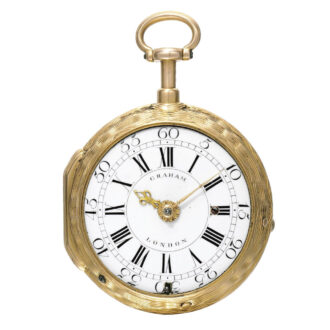
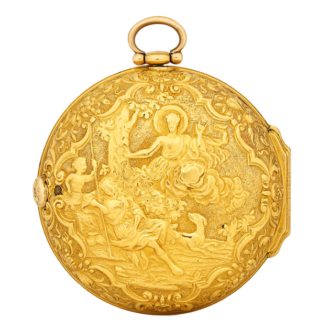
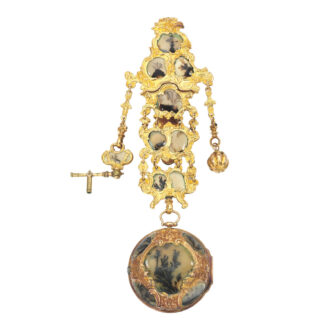
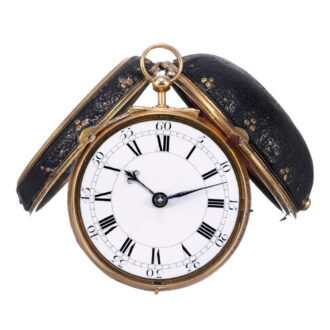
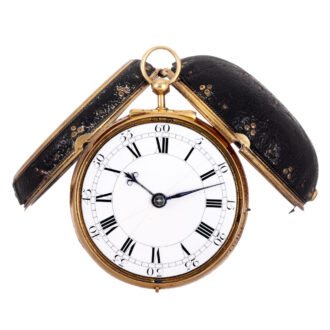
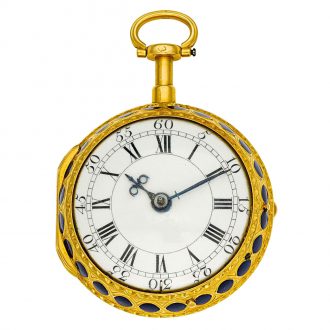
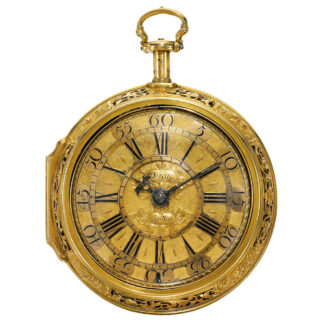
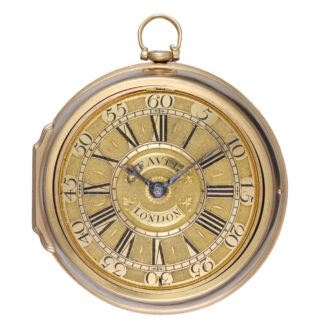
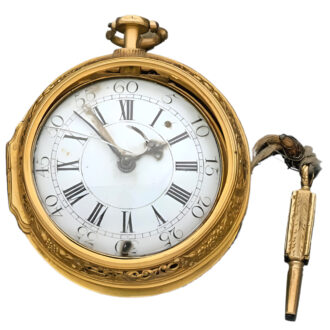
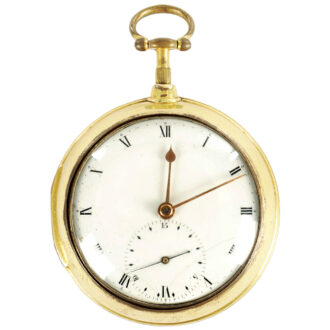
English gold repeating pair cased verge pocket watch Circa 1725
- Kenmerk
- AS1642
- Diameter
- 52 mm
- Estimate
- € 5.500 - 10.000
- Price sold
- € 5.550
Gold repoussé watch with chatelaine by George Etherington
–
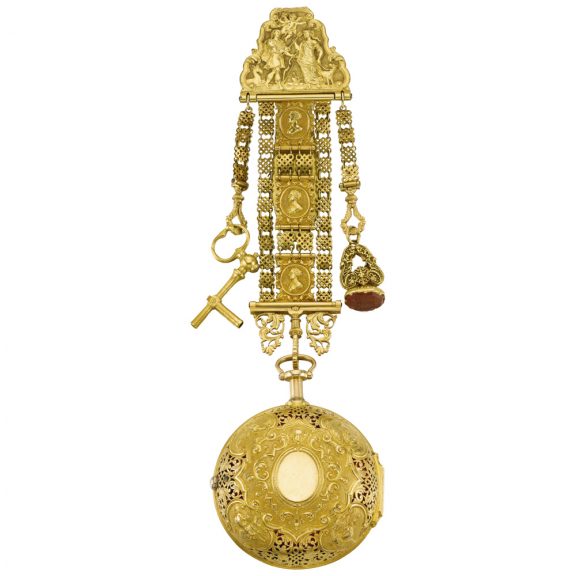
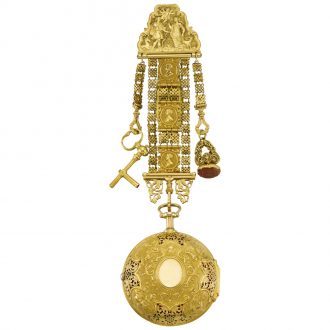
A well-crafted English gold quarter repeating pair cased repoussé verge watch, circa 1725, accompanied by a chatelaine dating back to around 1735. The watch features a gilt full plate movement with a verge escapement, a decoratively pierced winged masked balance cock engraved with scrolling foliage, a plain flat balance, round baluster pillars, fusee and chain, and it repeats on a bell to the inside back. It is signed and numbered by G. Etherington, London with the bell signed by Higgins. The gold champlevé dial features Roman numerals, an Arabic outer minute ring, and blued steel beetle and poker hands.
–
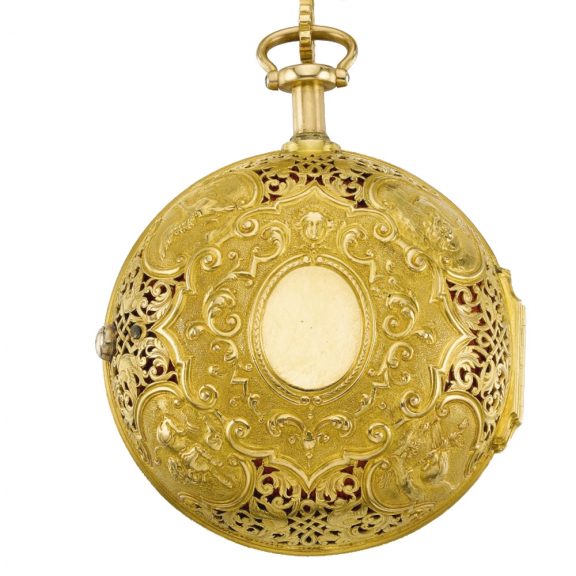
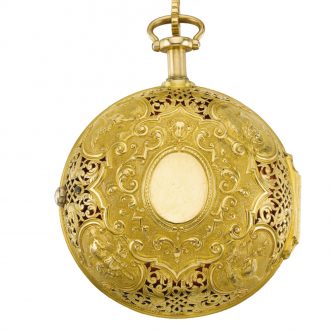
The watch has two cases. The inner case is made of gold and is decoratively pierced and engraved with scrolling foliage and exotic birds. It features a church scene at the base and a village scene beneath the pendant, stirrup plunge pendant, and bow. The maker’s mark is partially obliterated, but the number 1258 is visible beneath the 258. The outer case is also made of gold and has embossed and chased decorations around the central reserve. It features four medallions depicting a lion, an eagle, a peacock, and a dolphin, as well as panels inhabited by birds. The front bezel has pierced panels of scrolling foliage interspersed with baskets of flowers, and there is a pulse piece between 6 and 7 o’clock. The outer case bears the maker’s mark ID, likely belonging to James Delander.
–
The chatelaine features a gilt metal panel on the uppermost part depicting Cephalus and Procris with a stag and a dog, as well as a winged putti in the air. Below are three additional yellow metal panels, each with the bust of a lady in profile, connected by pierced, squared pendant chains. Two side chains terminate in a crank key and a hardstone fob seal with continental arms. The pendant hook is signed Howes for William Howes.
–
Diameter: 52 mm
–
Signed: G. Etherington, London
–
The outer case was embossed and chased in a style that was fashionable by 1720.
–
The dial has light scuffs, and the case’s inside back has two filled winding holes. The filling can be seen from the outside back in a raking light. The bell is scratch marked ‘Huggens[??] London’ and ‘1889 Laxon Coventry’. Additionally, the inside case back is scratch-numbered 477907H. The cases are in good overall condition, retaining clear definition, with some light rubbing to the most exposed areas of the outer case. The movement is running but not currently repeating. The pendant is stiff, and when attempting to plunge, the train begins to engage but resistance is felt almost immediately.
–
George Etherington, an English clockmaker, was acquitted by the Clockmakers Company in 1684 and became a master in 1709. He worked at The Dial in Fleet Street and at the New Church in the Strand in London. George was also known for creating large clocks. He remained a member of the Clockmakers Company until 1729 when his former apprentice Thomas Haydon succeeded him. Another notable figure, case maker James Delander, was acquitted by the Clockmakers Company in 1669.
Etherington’s clocks can be found in The Science Museum in South Kensington, London, where the Guildhall collection is also located. Additionally, a George Etherington clock is part of this collection.
–
William Howes signed the chatelaine. According to Arthur Grimwade’s book “London Goldsmiths 1697-1837” from 1976, William Howes, marked as a small worker, was registered on May 16, 1732, while he was based at Lamb’s Conduit Passage, Red Lyon Square, London.
Signed: G. Etherington, London
Share this page: