English gold tourbillon chronometer escapement Circa 1970
- Kenmerk
- SA0478
- Diameter
- 62 mm
- Estimate
- € 400.000 - 800.000
- Price sold
- € 515.000
Important gold twin barrel one minute tourbillon watch
–
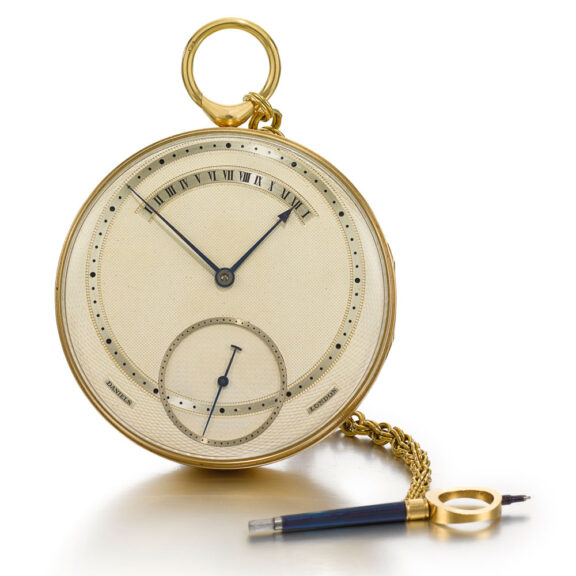
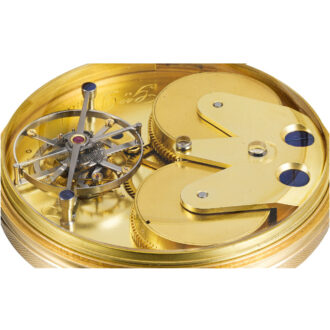
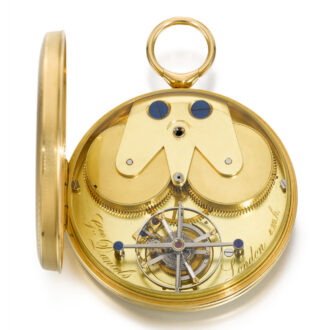
An important English gold watch with a one-minute tourbillon, twin barrels, a spring detent chronometer escapement and a retrograde hour hand. It was made for Edward Hornby around 1970.
–
Movement
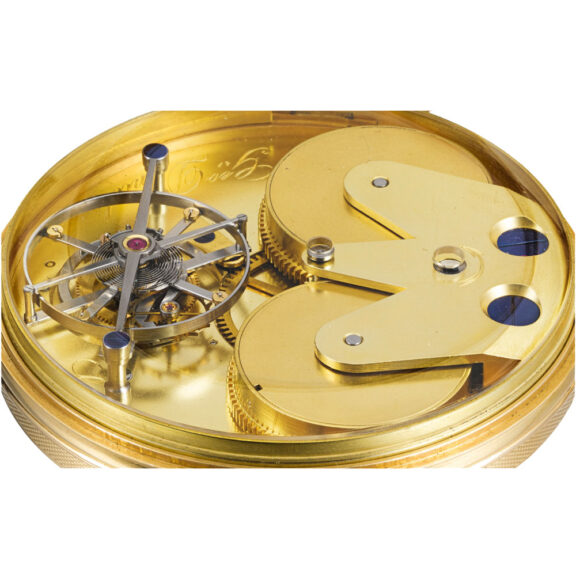
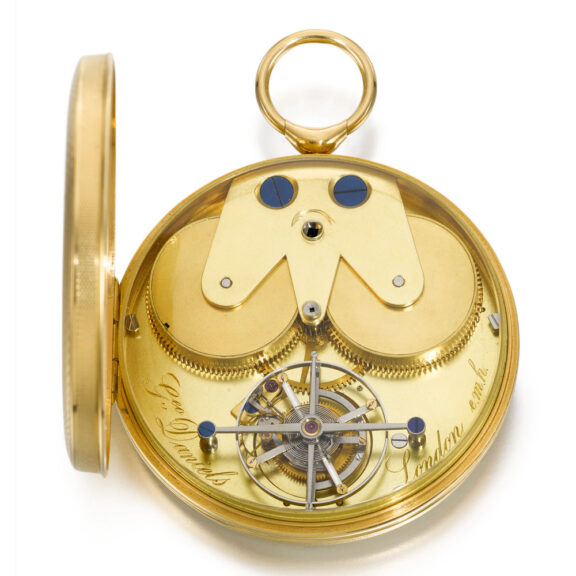
Gilt movement, signed “Geo. Daniels, London, e.m.h.” An Earnshaw-type spring detent chronometer escapement is mounted in a polished steel one-minute tourbillon carriage under a polished steel bridge. Two going barrels sit under a single bridge and both drive a shared offset centre pinion, giving 36 hours of running time. The four-arm balance is monometallic stainless steel with gold adjusting weights. The temperature-compensated overcoil balance spring has an isochronism adjusting screw. There is also a retrograde hour mechanism.
—
Dial
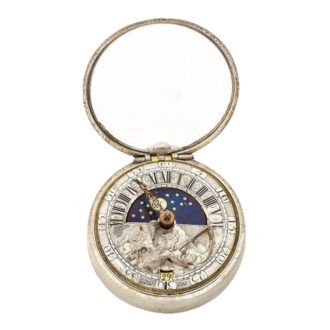
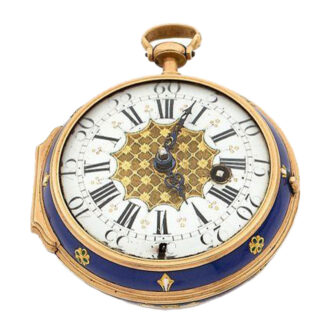
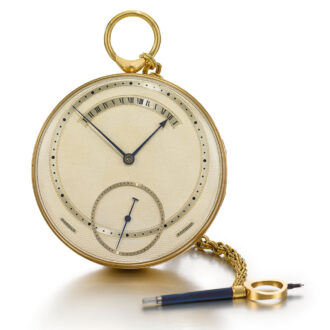
Silver engine-turned dial with three different patterns. It has an off-centre satin-finished minute ring, a satin-finished sector for the retrograde hours with Roman numerals, and a large satin-finished subsidiary seconds ring that interlocks with the minute ring. Matching silver cartouches are signed “Daniels London”. Blued steel Daniels hands.
–
Case
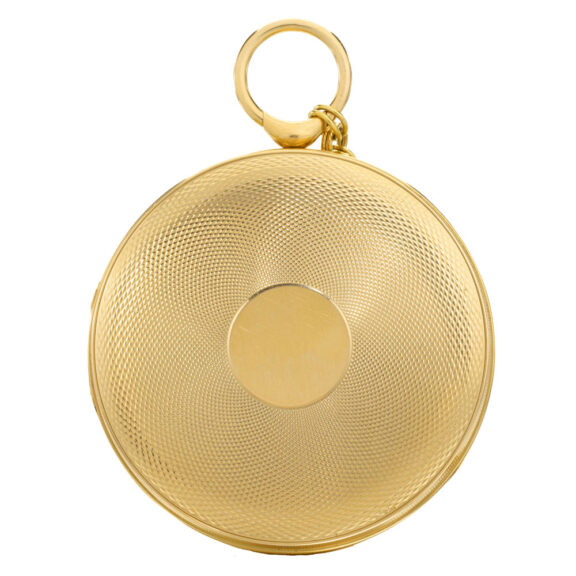
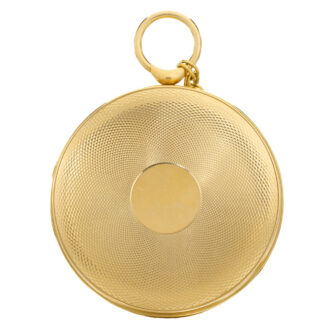
Gold engine-turned case with a Daniels pendant and bow. The back has a plain central panel and opens to show a glazed cuvette with a winding aperture. It is hallmarked for 18-carat gold, with the London date letter for 1970 and the case maker’s mark GD for George Daniels.
–
Extra
A short graduated yellow-gold double-link chain with a gold and blued steel double-ended Daniels key.
–
Diameter: 62 mm
–
Signed: Geo. Daniels London, e.m.h.
–
Provenance
Comes with a handwritten letter from George Daniels and a fitted George Daniels presentation case.
–
Note
This remarkable timepiece is a fine example of Dr. Daniels’s early watches. He made his first watch for Cecil Clutton in 1969 and then made seven more of similarly elegant design, each slightly different. The Clutton watch had a pivoted detent, while the later watches used spring detent chronometer escapements.
–
Dr. Daniels
Dr. Daniels did not simply use the standard spring detent escapement, though. He improved it. As any textbook will tell you, a traditional chronometer escapement does not start by itself. Daniels changed the geometry so that the escape wheel is always unlocked when the balance is at rest. As a result, his chronometer escapement always starts on its own, and the watch simply seems to come to life.
On the first eight watches, the movement signature is followed by the original owner’s initials, like a coded number. This watch, the fourth, carries Edward Hornby’s initials: E.M.H.
–
All eight pocket watches in Daniels’s first series are illustrated and described in two books. One is the catalogue of the George Daniels Retrospective Exhibition, published by Sotheby’s in 2006. The other is Michael Clerizo’s George Daniels: A Master Watchmaker & His Art, published in 2015. A summary of the eight follows.
Early Series George Daniels Watches 1969 – 1974
–
One minute pivoted detent chronometer tourbillon
Cecil Clutton C.B.E., 1969
–
One minute spring detent chronometer tourbillon
Robert Marryat, 1970
–
One minute spring detent chronometer tourbillon
Sam Bloomfield, 1970
–
One minute spring detent chronometer tourbillon
Edward Hornby, 1971
–
One minute spring detent chronometer tourbillon
Cecil Elsom C.B.E., 1970
–
One minute spring detent chronometer tourbillon
Sarah Jane Daniels, 1970
–
One minute spring detent chronometer tourbillon with reserve of winding indication
Professor Thomas Engel, 1974
–
One minute spring detent chronometer tourbillon
Gerald Saunders, 1973
–
In 1999, the present watch was offered for the first time at auction at Sotheby’s London. At the time, George Daniels wrote the following note for the catalogue:
–
“Edward Hornby began collecting watches in the 1930s. His interest centred on the origins of his purchases and their aesthetic qualities. I first met him in 1960 when he began to intensify his interest in horology. We became firm friends and, in 1970, Edward expressed a wish to add a Daniels to his collection. This tourbillon was added to the collection in 1971. It was the fourth example made and can be seen on the bench in the illustration below. When Edward Hornby sold his collection at Sotheby’s in December 1978, he kept the tourbillon and a double wheel chronometer which he purchased in 1975. Concerned that the tourbillon could not equal his new quartz watch, he ran the two together. The test lasted 8 months before the battery went flat and he cheerfully awarded the honour to the tourbillon. Its daily variation rate at room temperature averaged 0-3 seconds per day.”
Signed: John McLennan London
Share this page: