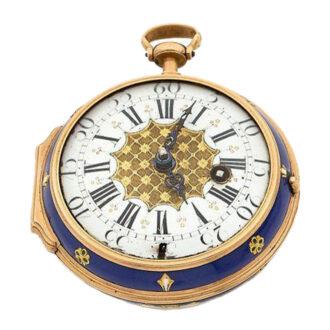
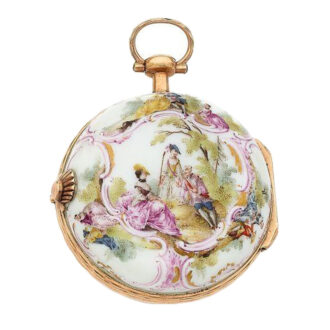
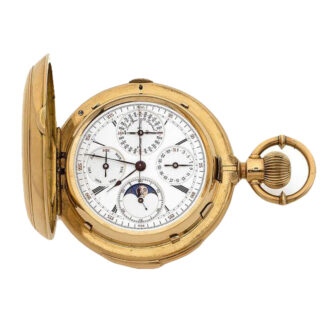
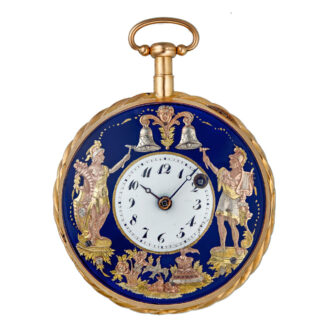
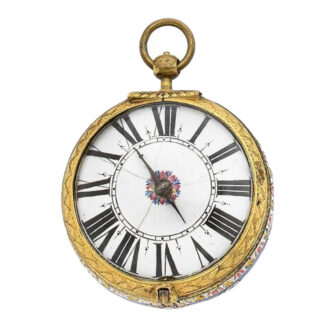
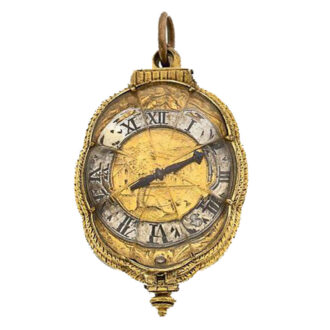
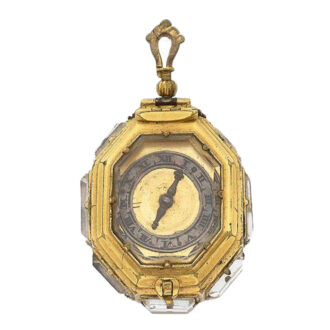
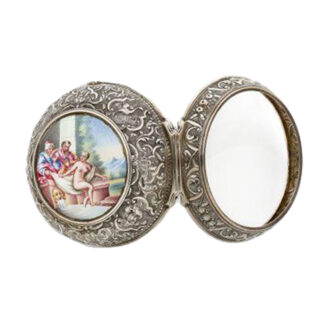
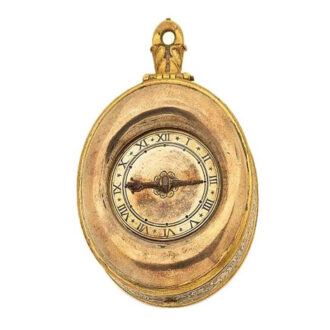
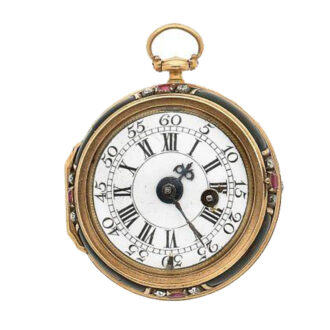
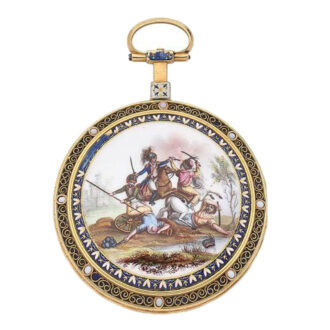
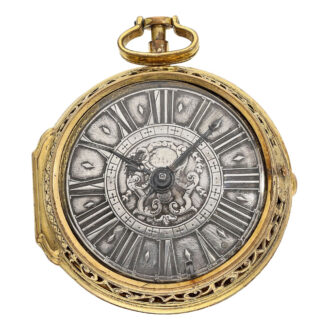
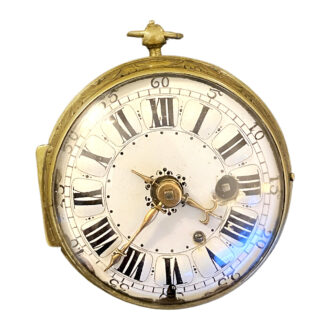
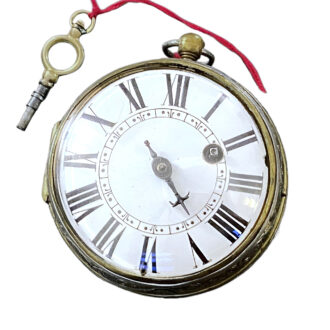
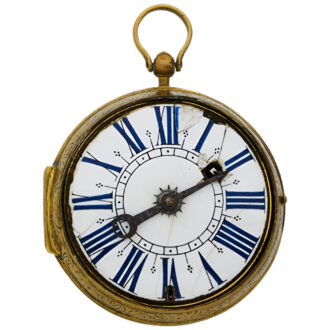
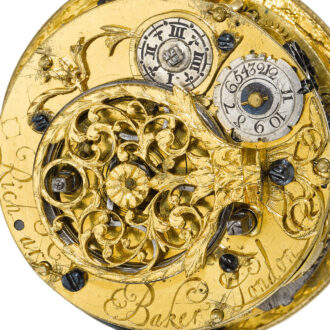
English hour striking two train verge clock watch Circa 1695
- Kenmerk
- SA0308
- Diameter
- 52 mm
- Estimate
- € 4.000 - 8.000
- Price sold
- -
Hour striking two train verge clock watch
–
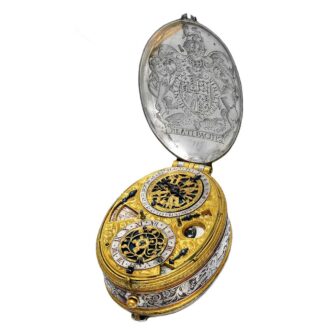
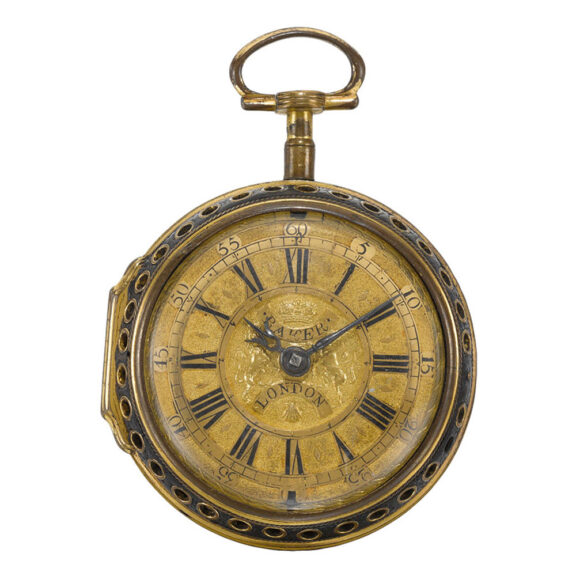
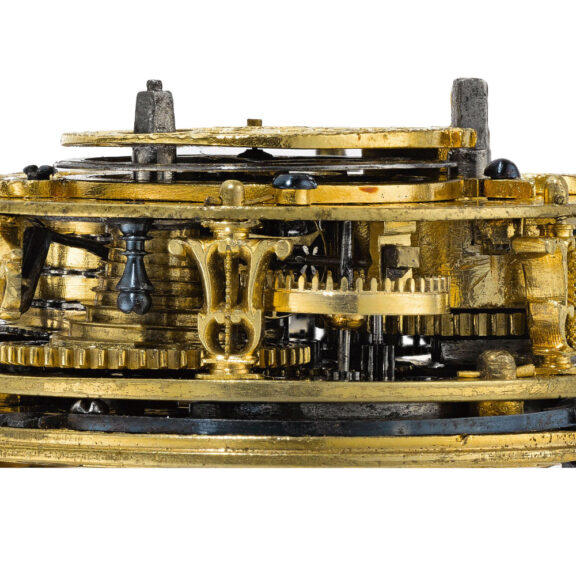
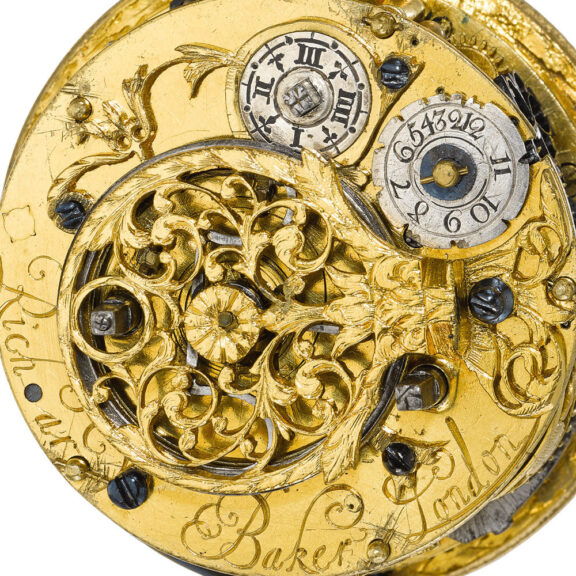
An English hour striking two train verge clock watch in later gilt metal and leather-covered single case movement, circa 1695, gilded full plate movement, verge escapement, balance arms shaped to accommodate going train’s winding square to extend through the decoratively pierced and engraved balance cock, balance spring, silver regulation disc, and locking plate, fusee and chain, tulip and baluster pillars, pierced and engraved striking barrel and blued steel gate, striking the hours on a bell to the inside case back, signed Richard Baker, London,
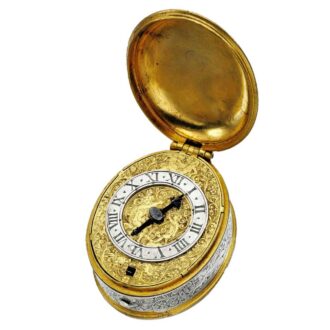
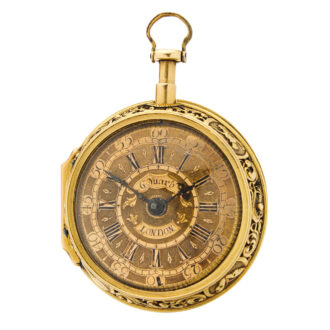
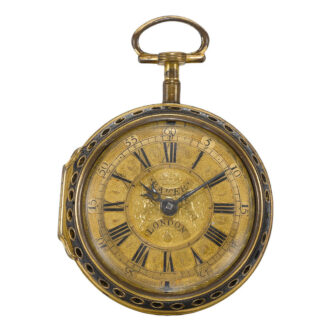
Gold champlevé dial, Roman numerals, inner half hour divisions, outer Arabic minute ring, centre with crown, lion and unicorn taken from the Royal Arms, two semi circular banners signed Baker, London, tulip and poker blued steel hands
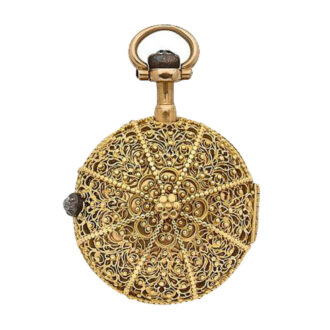
Later single leather covered gilt metal case, bezels front and back with decorative roundels to allow sound emission, shuttered winding apertures to back for going and striking trains,
–
Diameter: 52 mm
–
Signed: Richard Baker, London
By the early 1690s, clockmakers were making a small number of well finished and compact clock watch mechanisms. The watch marks the passing of time by striking the hour on a bell in the same way as a clock. The crown to the dial is of the form used by William and Mary, rather than Queen Anne, which, together with the style of movement, would suggest a date of the 1690s.
Richard Baker was originally apprenticed to John Chatfield through the Blacksmiths’ Company before transferring, in June 1683, to the clockmaker Richard Browne. By redemption, Baker was made a Freeman of the Clockmakers’ in June 1685, on the order of the Lord Mayor. Richard Baker died in c. 1700, but his business was carried on by his widow until at least 1710.
Howard Marryat (1871-1944), a Liveryman of The Worshipful Company of Clockmakers, developed an extensive watch collection throughout his lifetime. He worked as an electrical engineer and eventually became a prominent figure in the electrical and manufacturing industries. He partially owned a company called Marryat and Scott that produced lifts and other electrical equipment and headed the company for a little over 50 years. Marryat also wrote several books, most notably, Watches, From Henlein to Tompion, published in 1938. He developed a great interest in historic watches and the craftsmanship of their movements. His collection included pieces from John Arnold, Robert Pennington, and Jeremy East, along with many others. He completed the revision of the catalogue of watches in the Guildhall Museum, after which he became a Freeman of the City of London. His son Robert
(1910-1996) inherited his collection and eventually became acquainted with the famed watchmaker, George Daniels. Daniels later married Robert’s daughter, Juliet in 1964.
Signed: Richard Baker, London
Share this page: