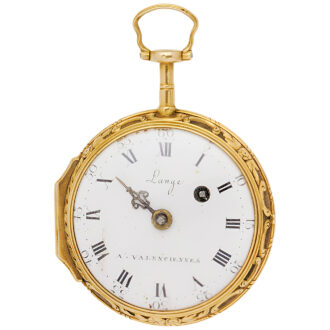
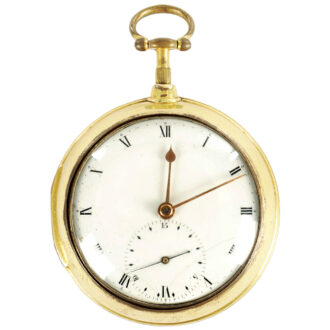
English gold watch with á toc striking mechanism Circa 1773
- Kenmerk
- AD4291
- Diameter
- 55 mm
- Estimate
- € 15.000 - 26.000
- Price sold
- € 23.750
Gold open faced pocket watch by John Arnold
–
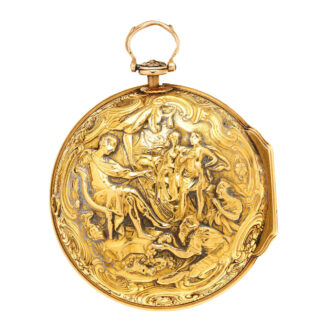
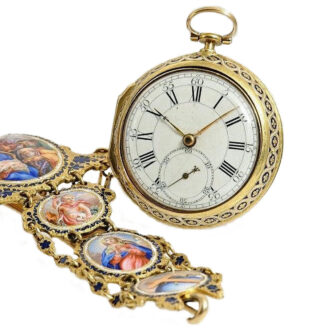
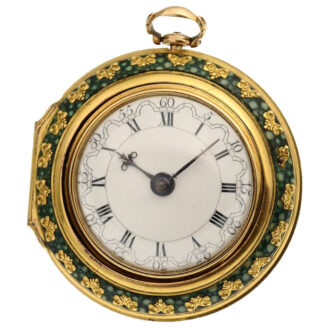
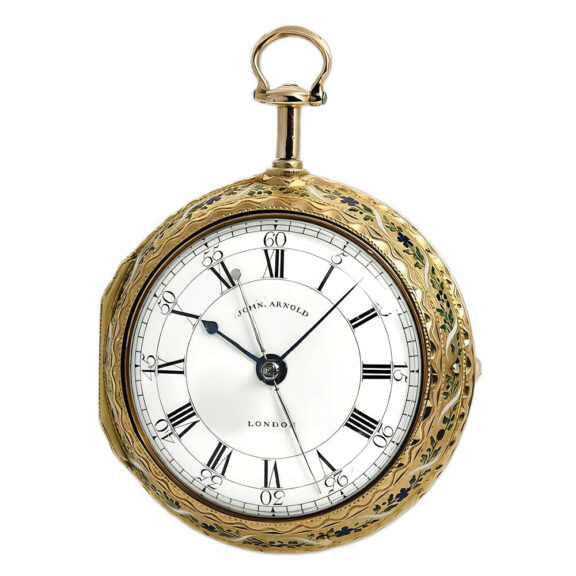
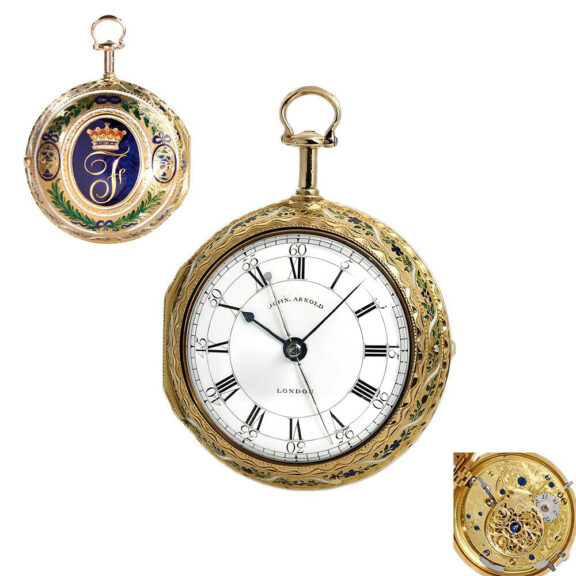
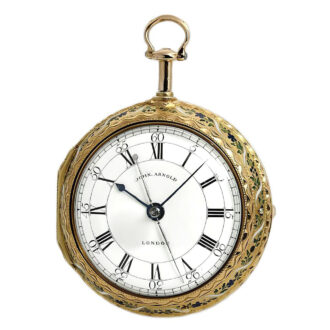
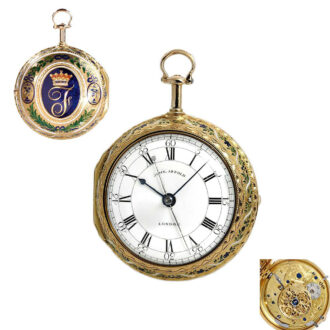
An important gold enamel English pair cased pocket watch with Arnold’s spring detent escapement and half quarter striking mechanism á toc, circa 1773. This timepiece is believed to have belonged to Frederick, Duke of York. It consists of two cases: the outer case is made of 22K gold with a glass rim, featuring a beautifully engraved bezel adorned with blue, white, and green enamel. The back side of the outer case showcases floral engravings with blue, white, and green enamel accents, along with a translucent cobalt blue enamelled medallion at the centre, displaying a duke’s crown and the initial F. Surrounding the medallion are enamelled garlands, vases, and a large lateral hinge. The inner case is also made of 22K gold and includes a signed protective cap.
–
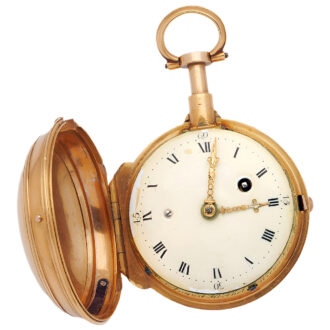
The watch features a signed enamel dial with radial Roman hours, Arabic minutes, blued hands, and a centre-second steel hand. The movement is a full plate type with fire gilt finishing, moulded pillars, a chain/fusee mechanism, two hammers, Arnold’s spring detent escapement, a steel escape wheel, an engraved barrel bridge with a silver regulator disc, an engraved pierced balance cock, a steel balance, and a diamond endstone on the balance.
–
Diameter: 55 mm
–
Weight: 157 g
–
Signed: John Arnold, London
–
This is the second known pocket watch by Arnold, which was changed to the so-called Arnold spring chronometer escapement. The first one is the number 155. Lit.: Illustrated and described in 100 Years of Precision Timekeepers from John Arnold to Arnold & Frodsham 1763-1862 by Hans Staeger Frederick Augustus, Duke of York and Albany (1763-1827) Was a member of the British Royal Family, second eldest son of King George III. From 1820 until his death in 1827, he was the heir presumptive to his elder brother, King George IV, both to the United Kingdom and the Kingdom of Hanover. He served as the commander in chief of the British Army, presiding over the unsuccessful 1793-98 Flanders campaigns during the French Revolutionary Wars. He is now mainly remembered as the inspiration for the nursery rhyme The Grand Old Duke of York”. From 1763-1784, he was Prince Frederick, and from 1784 on, he was The Duke of York and Albany and the “Earl of Ulster; his honours were the Order of the Garter, Order of the Bath, the Royal Guelphic Order, and member of the Privy Council.
Signed: John Arnold, London
Share this page: