English interesting pocket chronometer Circa 1809-1810
- Kenmerk
- SA0157
- Diameter
- 52 mm
- Estimate
- € 5.000 - 10.000
- Price sold
- € 9.800
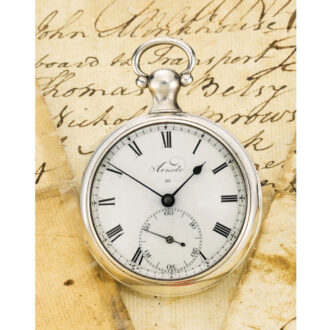
Interesting pocket chronometer in a later case
–
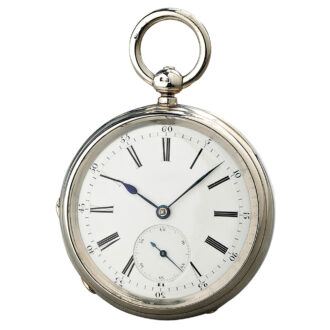
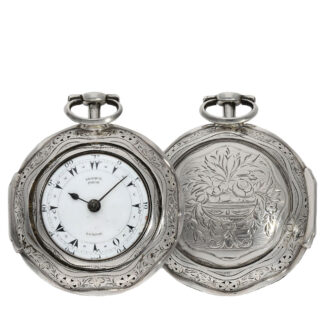
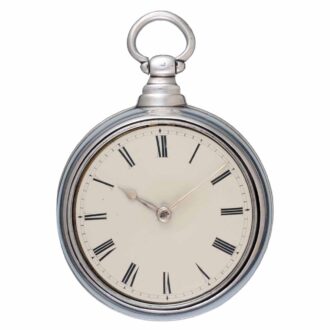
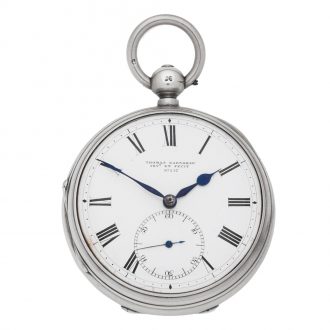
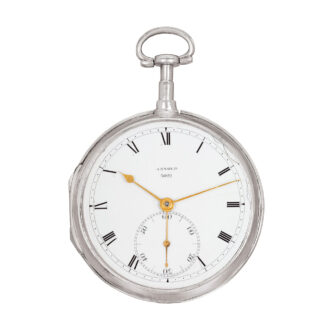
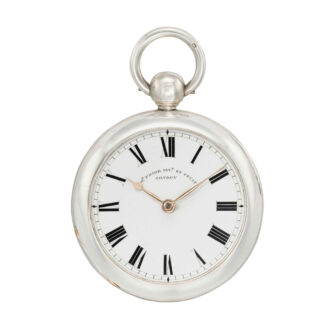
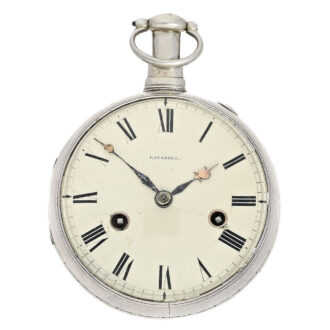
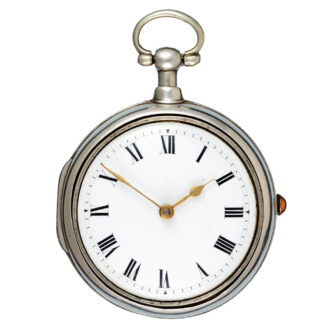
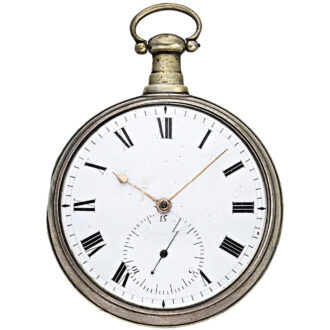
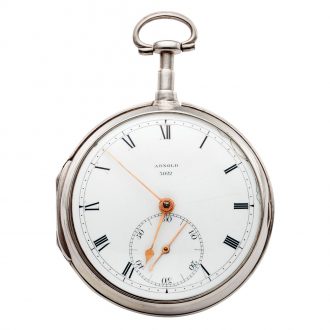
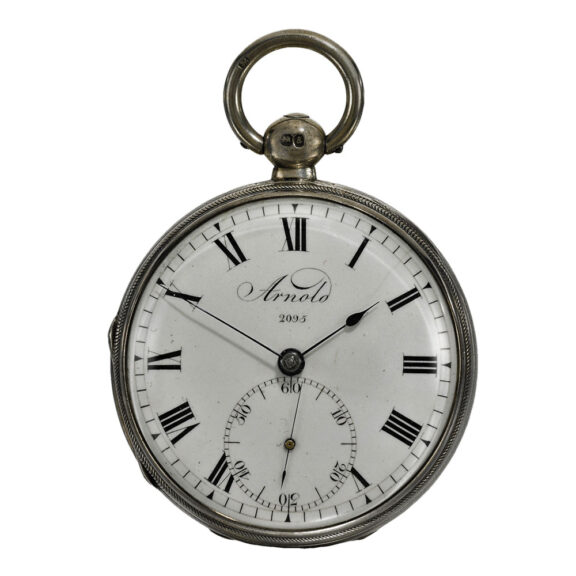
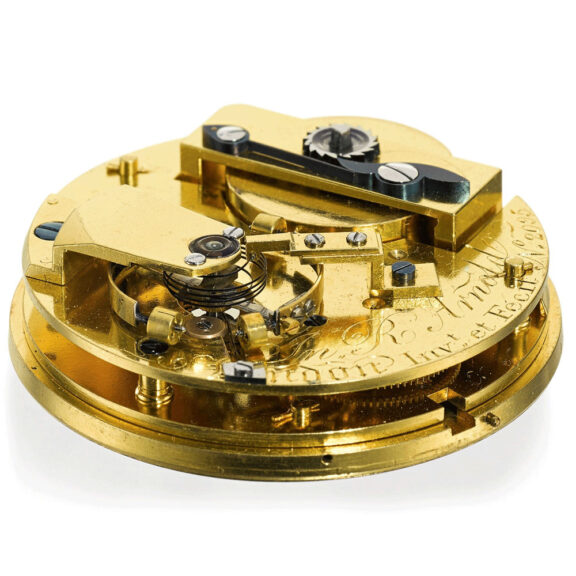
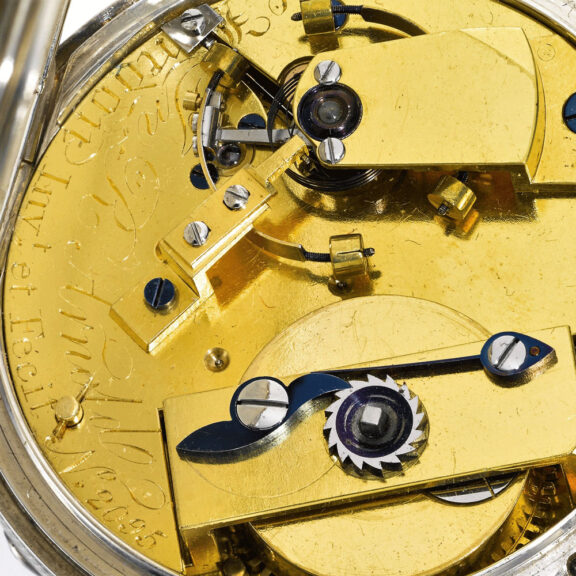
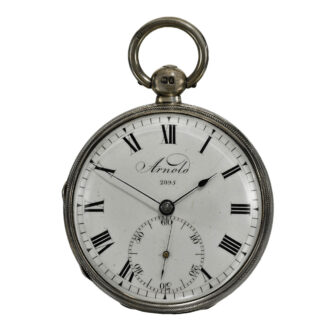
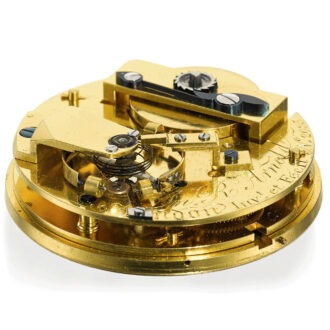
An English rare and interesting pocket chronometer in later purpose made case, circa 1809-1810, gilded full plate movement, Arnold spring detent escapement, ‘Z’ balance, blued steel helical spring, diamond end stone, standing barrel, unusual 21,600 train, signed Jn R Arnold, London Invt et Fecit. White enamel dial, Roman numerals, large subsidiary seconds, blued steel spade hands, subsidiary seconds hand with a gold boss, signed Arnold 2095. Later custom made case, engine turned back, band and bezel, plain hinged silver cuvette with winding aperture, case and cuvette hallmarked 1856 and with maker’s mark HWG in cameo for Henry William Griffin.
–
Diameter: 52 mm
–
Signed: Jn R Arnold, London Invt et Fecit
–
This watch, is one of two very interesting watches by John-Roger Arnold to survive from circa 1809 – 1810. The second watch, which is also in a later case and is successively numbered 2096, is illustrated in Vaudrey Mercer, Arnold and Son, 1972. Like no. 2095, no. 2096 also has a going barrel and both 2095 and 2096 have trains with 21,600 BPH. As early as 1767, John Harrison suggested in his ‘Principles’, when discussing his timepiece H4, that a fast 21,600 train could be used to advantage in smaller timepieces. Clearly, the heavier the balance, and the slower moving it is, the more it can be affected by any sharp rotational movement. The detent escapement is especially susceptible, particularly if a twisting motion coincides with the speed and rotation of the balance. Here Arnold has employed an unusually strong balance spring and a powerful mainspring to drive it. The detent is of sufficient strength to avoid mis locking, in order that, after unlocking, it is fast enough to return to its position of rest before the next tooth of the fast-moving escape wheel arrives. Were the movement to use a fusee and chain in place of the going barrel, they would have to be of such large size as to greatly increase the size of the movement and so defeat much of the object of the exercise.
In Vaudrey Mercer’s book, John Arnold and Son, the author notes that John-Roger Arnold’s pocket chronometer series appears to have started around no. 1600 in the year 1800 (see op. cit. p. 157). Mercer goes on to write that the going barrel in the present watch distinguishes this chronometer from John-Roger Arnold’s earlier pieces, noting that Arnold had begun.
Signed: Jn R Arnold, London Invt et Fecit
Share this page: