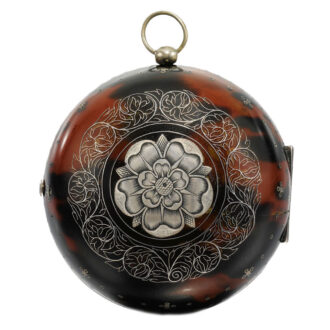
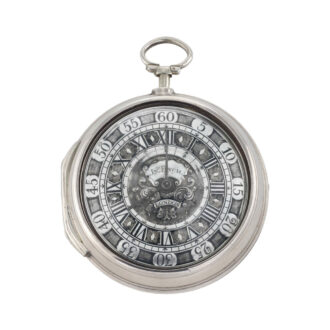
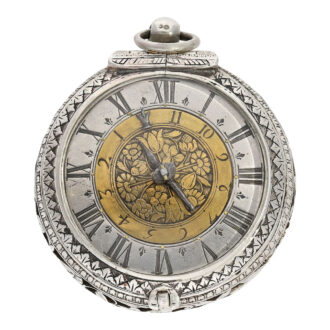
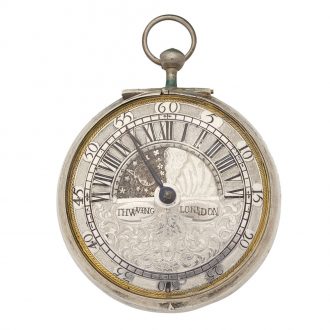
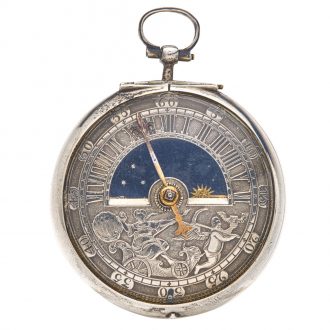
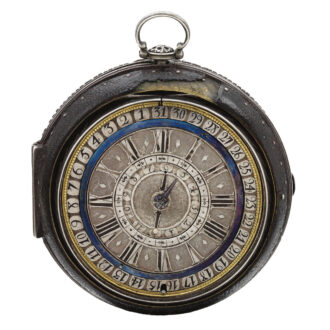
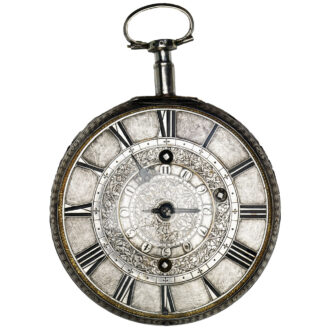
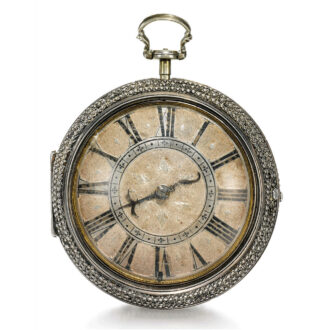
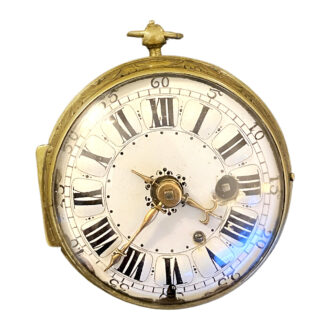
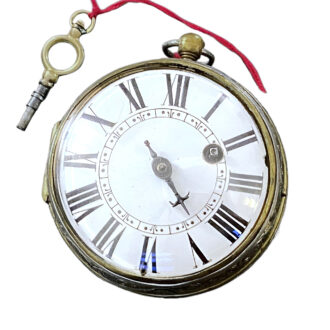
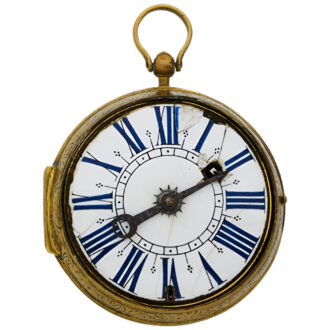
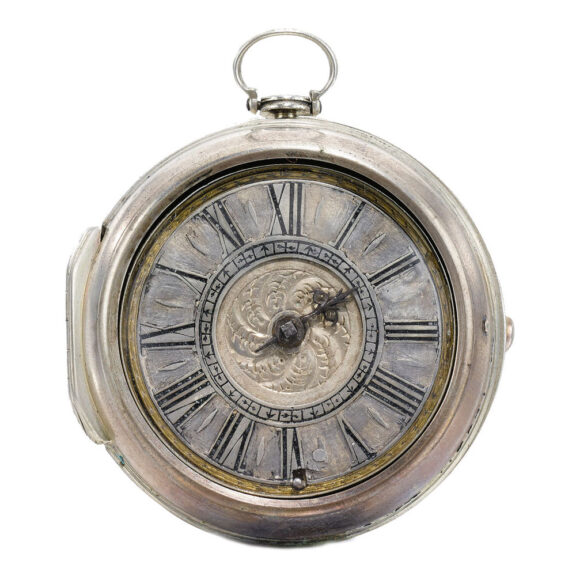
English rare silver verge with barrow regulator Circa 1680
- Kenmerk
- SA0407
- Diameter
- 46 mm
- Estimate
- € 4.500 - 9.000
- Price sold
- -
Rare silver pair cased verge watch with barrow regulator
–
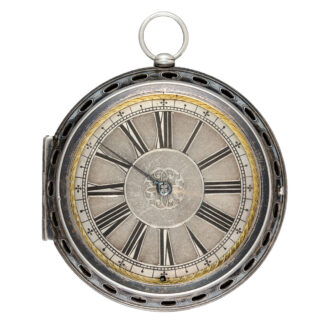
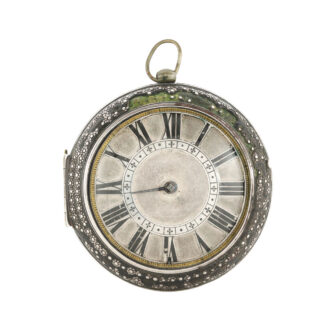
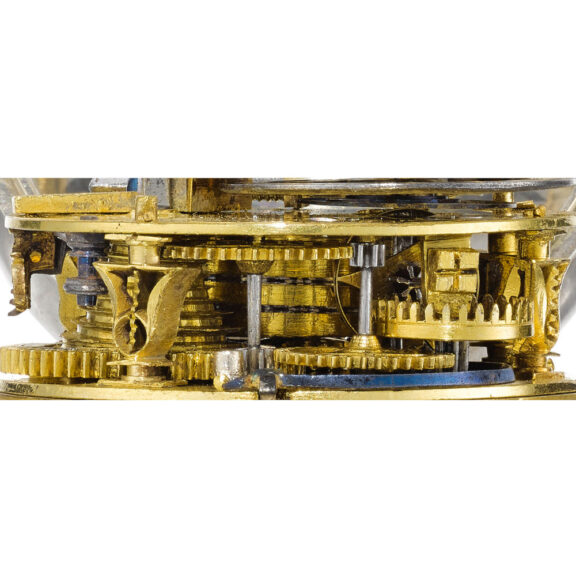
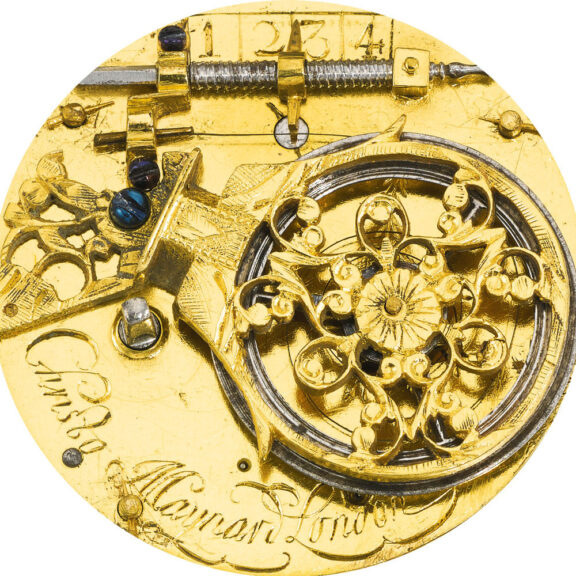
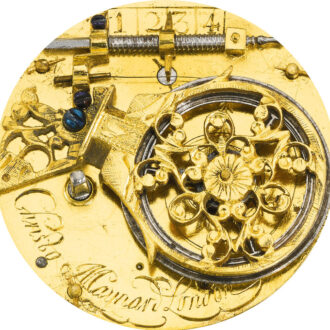
An English rare silver pair cased verge watch with barrow regulator, circa 1680, gilded full plate movement, verge escapement, decoratively pierced and florally engraved screwed-on balance cock, flat balance with spring, barrow regulator, fusee and chain, tulip pillars, signed Christo Maynard, London.
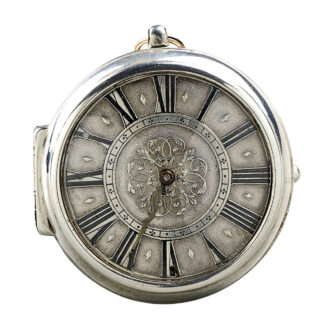
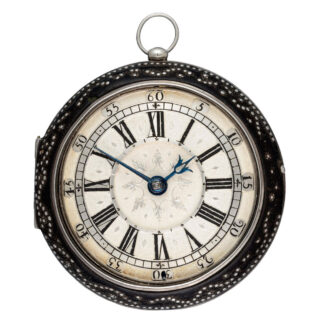
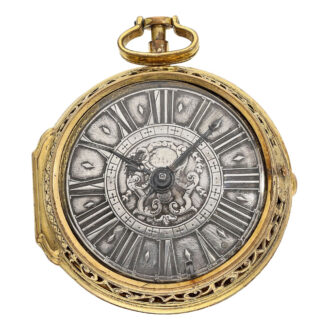
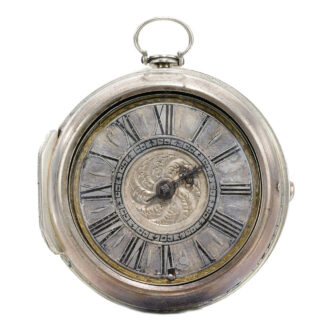
Silver champlevé dial, Roman numerals with half-hour divisions between, inner ring with quarter-hour divisions, central rosette motif, outer gilded ring, single blued steel beetle hand.
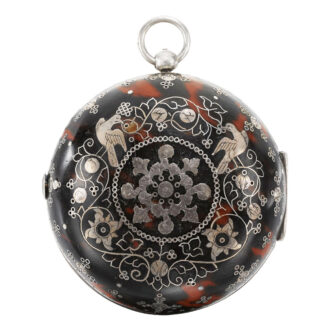
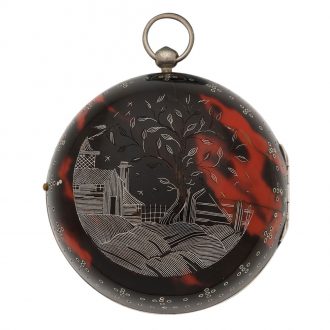
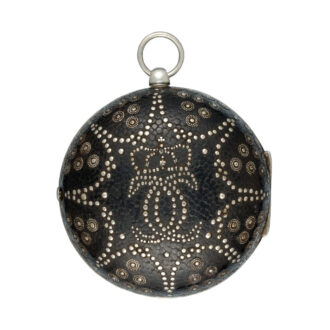
Plain silver inner case, case back with an aperture for winding, later stirrup pendant and bow, case maker’s mark possibly CH, later plain silver outer case.
–
Diameter: 46 mm
–
Signed: Christo Maynard London
–
Despite the fact that this watch has a balance spring, the dial still retains only one hand. This allowed the owner the benefit of dramatically improved timekeeping, without the confusion that an extra hand may have entailed to one used to the traditional ways of reading time.
An early form of regulation for balance spring watches, the Barrow regulator consists of two curb pins held upright in a slide, these embrace the end section of the balance spring which is straight, not coiled. The length of the spring is altered by moving the slide along with a worm (endless screw) which has a squared end to take a key. An index engraved on the movement plate beside the worm indicates the amount the slide may be moved, as the effective length of the spring is altered for regulation. It was F.J. Britten who first coined the term ‘Barrow’ regulator, naming it after Nathaniel Barrow. However, there does not appear to be any evidence to prove this, indeed, the late Cecil Clutton noted that this form of regulation may have originated in Rouen. Only a small number of English watches survive with the Barrow form of regulation and it would appear that none date much beyond the first few years of the 1680s. Those that do survive are signed by a number of different makers which suggests that it may have been quite widely taken up before being superseded by the rack and wheel method attributed to Thomas Tompion.
Christopher Maynard (c. 1646-c.1698) was apprenticed in May 1660 to Simon Hackett. He was freed in 1667 and made an Assistant in the Clockmakers’ Company in 1682.
Signed: Christo Maynard London
Share this page: