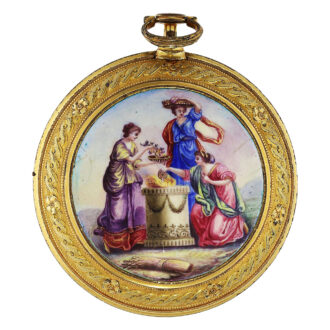
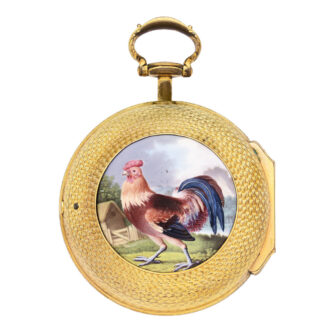
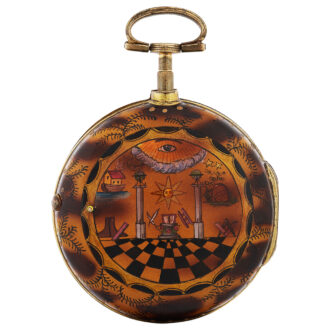
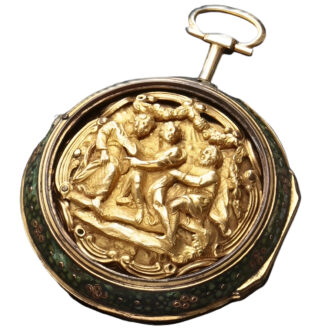
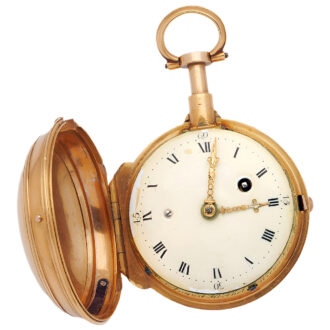
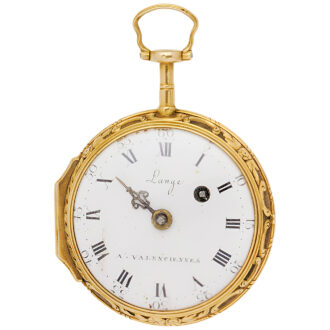
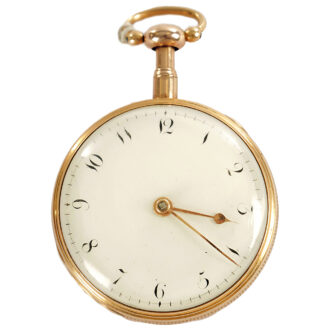
English astronomical double cased verge pocket watch Circa 1790
- Kenmerk
- AD9653
- Diameter
- 65 mm
- Estimate
- € 20.000 - 50.000
- Price sold
- € 14.300
Brass-gilt double cased pocket watch by James Edwards
–
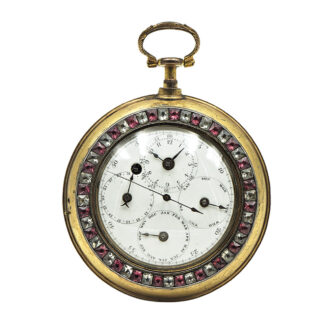
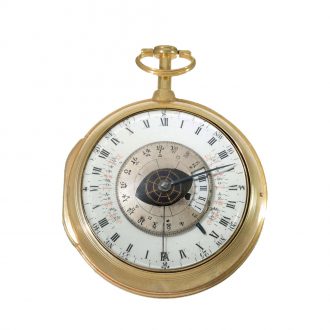
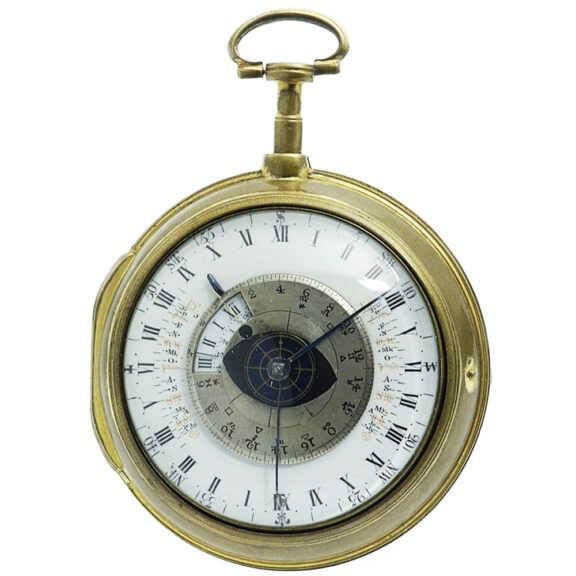
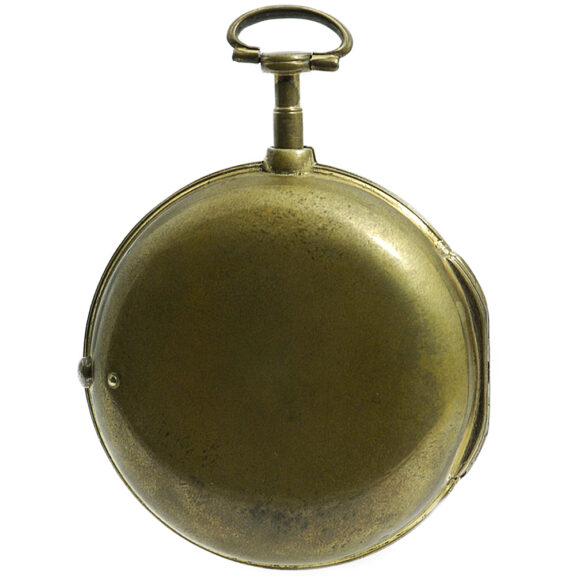
An important astronomical double cased English verge pocket watch, circa 1790. A remarkable piece of English watchmaking.
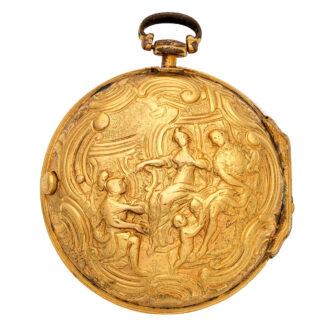
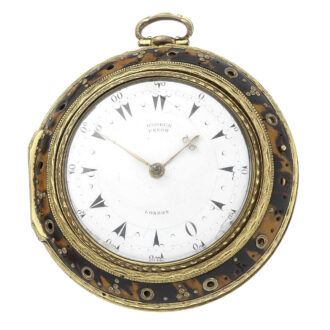
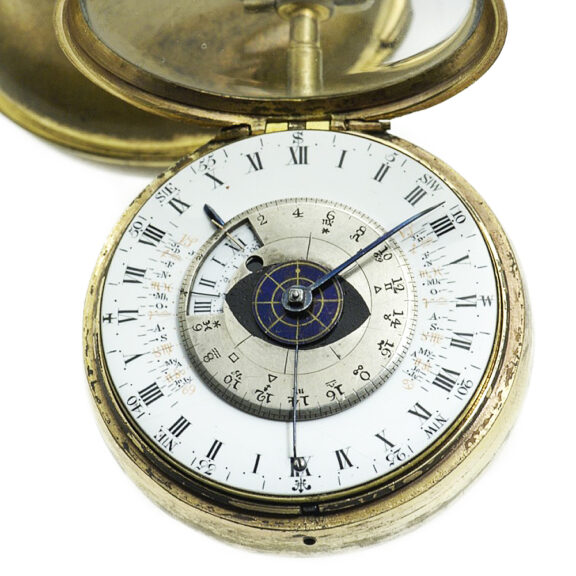
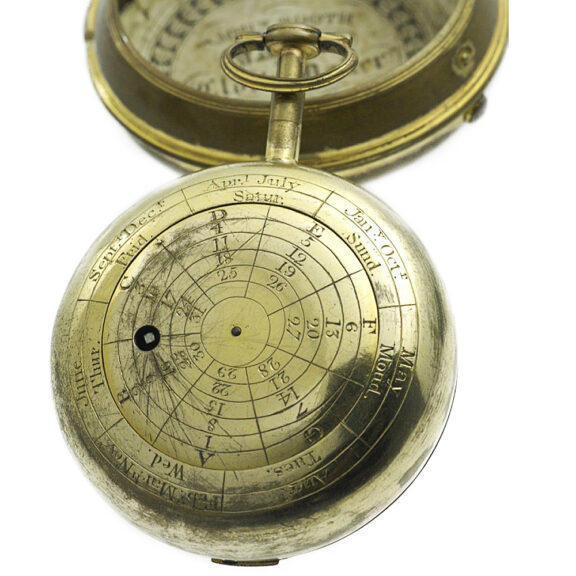
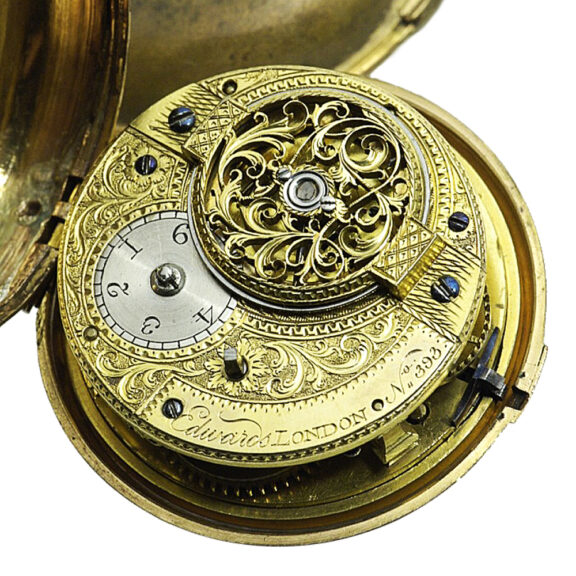
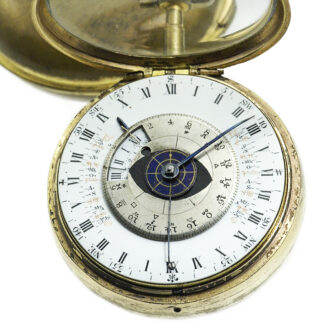
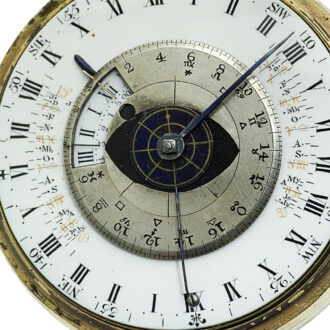
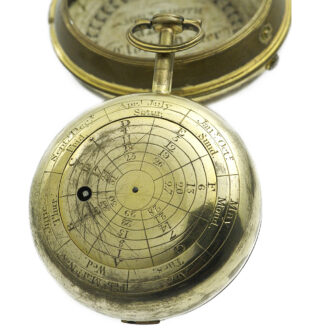
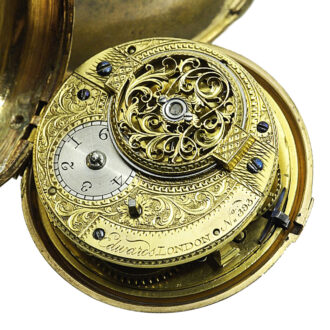
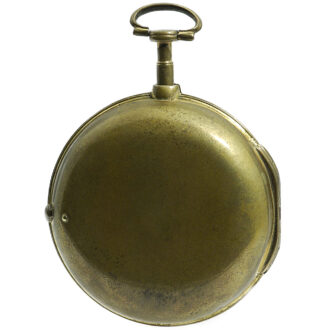
Brass-gilt cases: the inner case with engraved calendar function; and a plain outer case. White enamel, silver complex dial with several indicators: solar time by means of the hour hand on a 24-hour dial and a blued steel minute hand which revolves once per hour (see description below). Signed, full plate movement, key wind, screwed on florally engraved ornaments, chain/fusee, verge escapement, very finely florally engraved and pierced balance cock, and three-arm steel balance.
–
Diameter: 65 mm
–
Weight: 218 g
–
Signed: Edwards, London
–
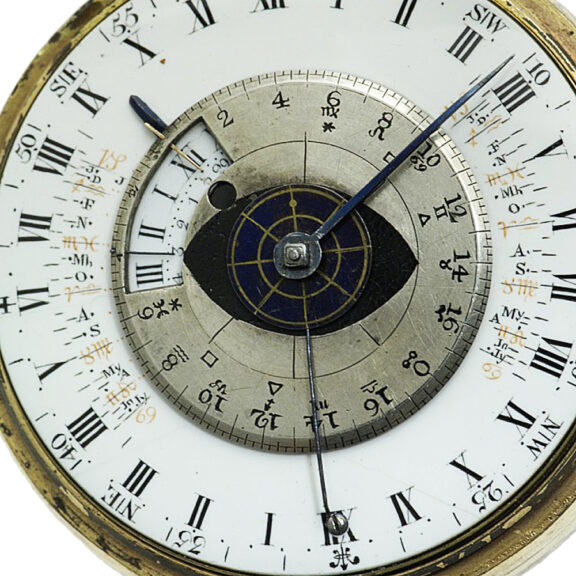
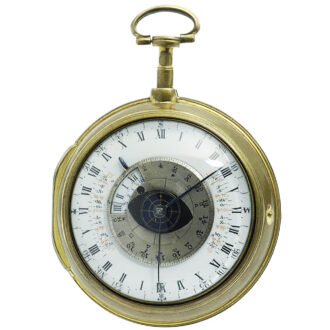
The complex dial has several indicators: solar time by means of the hour hand on a 24 hour dial, and the minute hand revolves once per hour. The central silver shows the lunar indications through an aperture: moon age, the time of the moons’ southing, and the time of high water at London Bridge. The latter is done by a fixed wire at the six o’clock position that registers with an elliptical marker at the rotating centre. The central blued steel disc shows the earth as viewed from the North Pole and the latitudinal and longitudinal position of London. The phases of the moon are shown together with the moon’s age through a hole at the edge of the disc; this is achieved by the retrograde motion of an enamel dial under the square opening in the central disc and differential gearing. The positions of the moon in relation to the sun are shown in miniature and indicated together with the aspects by 2x 180 degrees on the edge of the central disc. They are – opposition (180 degrees) sextile, trine and quartile. Markings on either side of the solar dial show the times of sunrise and sunset throughout the year together as well as the astrological symbols for the months. This is read against the hour hand. There are compass points on the outer dial for North, South, East and West. South is at the top so that when the moon is at its apex, it is pointing south and mirrors exactly what you see when looking at the moon.
–
Britten lists a watchmaker by the name of James Edwards at 180 Fleet Street around 1790-94. Most probably this was the retailer who sold this watch because at the time Fleet Street was the hub of London’s trade-in scientific instruments. Also, the Royal Society was located not far from that area.
Signed: Edwards, London
Share this page: