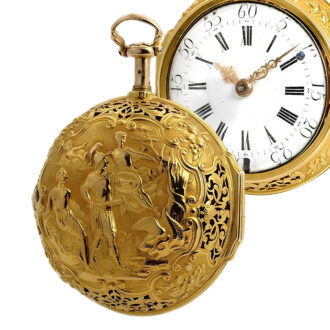
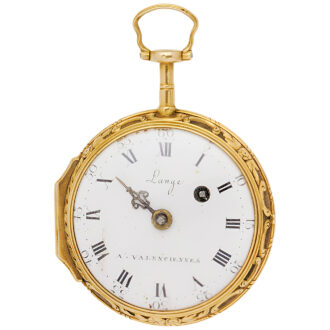
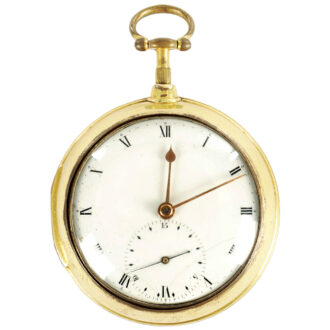
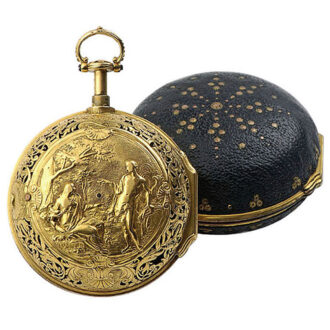
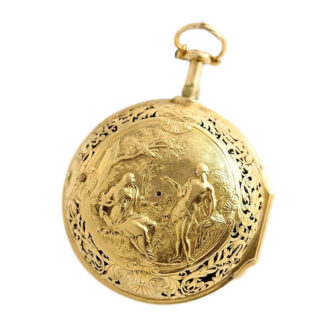
English repeating verge with “repoussé” decoration circa 1720
- Kenmerk
- PD0470
- Diameter
- 58 mm
- Estimate
- € 16.000 - 25.000
- Price sold
- €
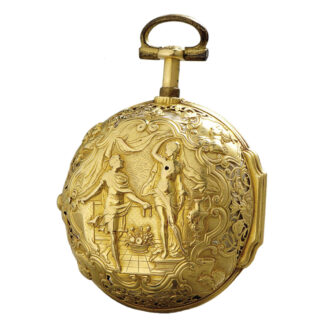
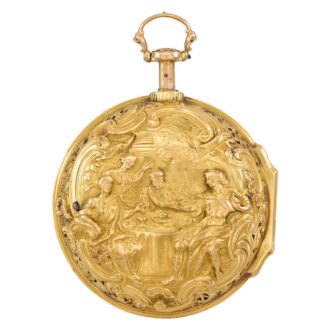
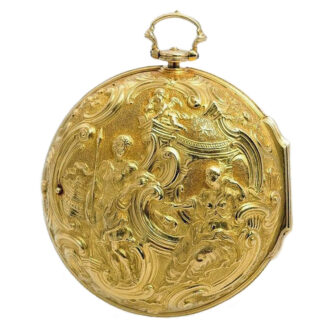
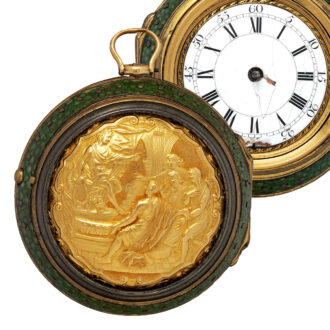
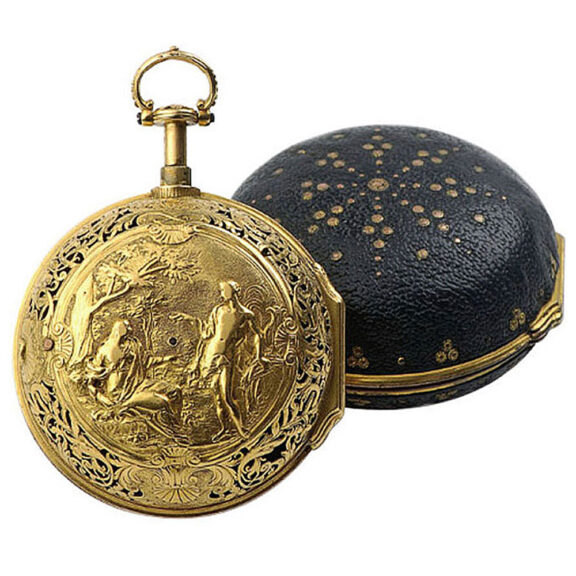
Repoussé case “Orpheus and Eurydice”
–
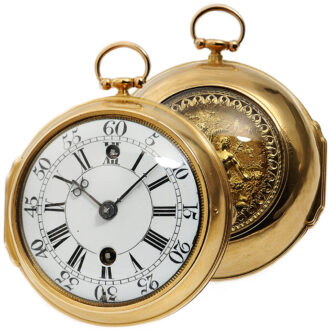
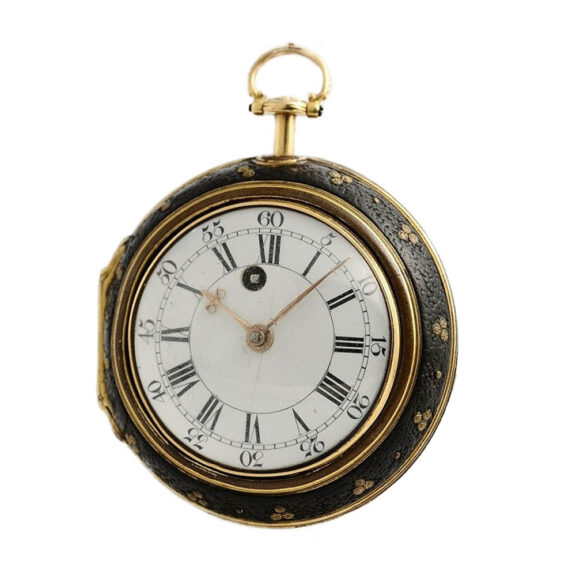
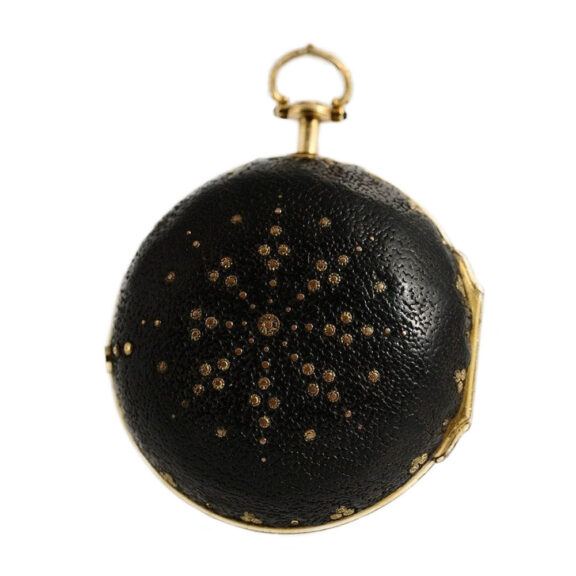
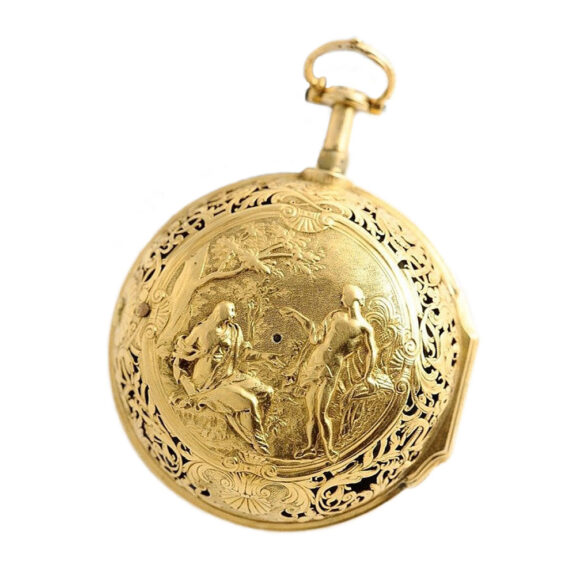
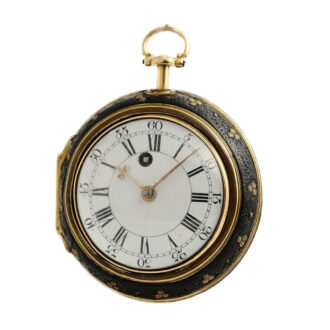
A very fine, rare and heavy quarter repeating verge pocket watch with a very fine outer Repoussé case “Orpheus and Eurydice”, circa 1720.
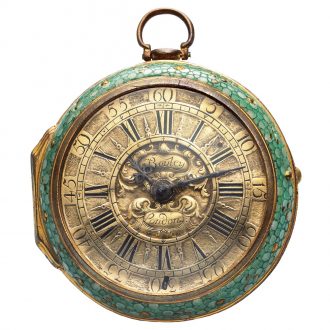
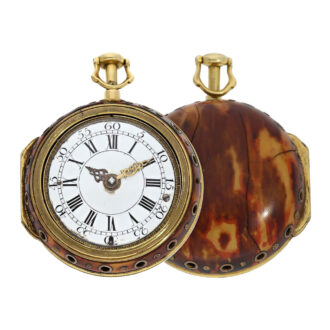
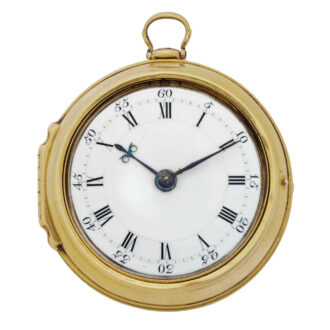
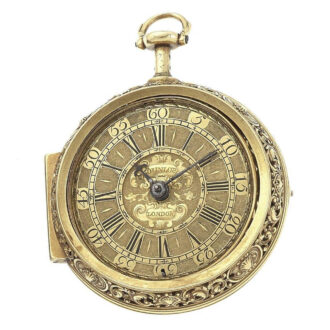
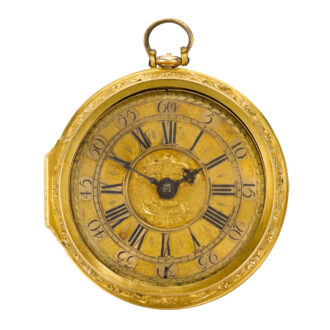
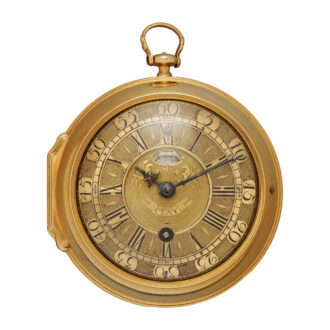
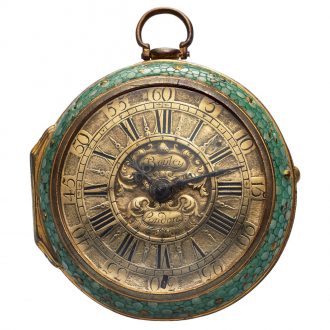
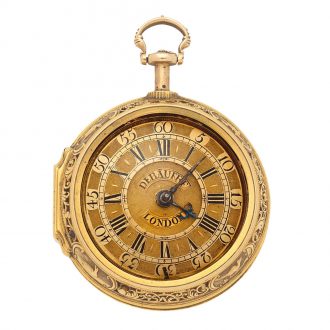
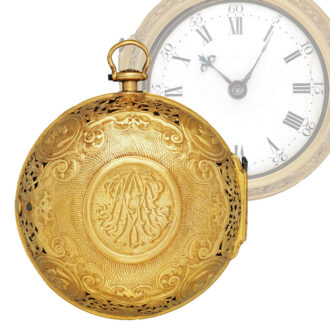
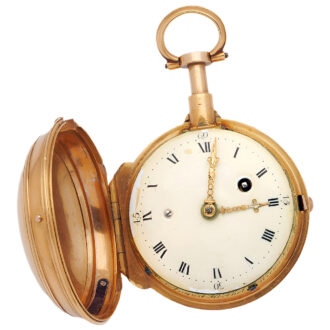
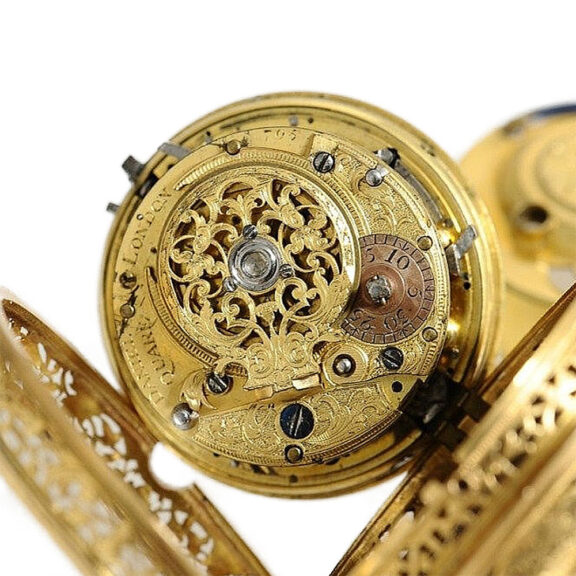
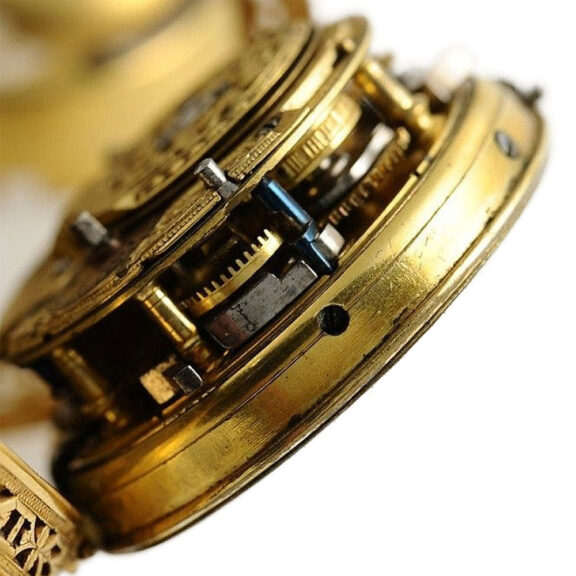
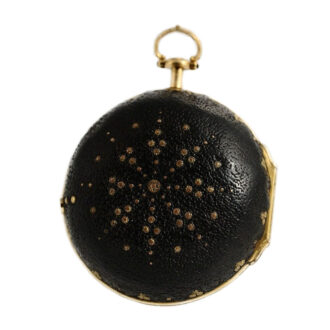
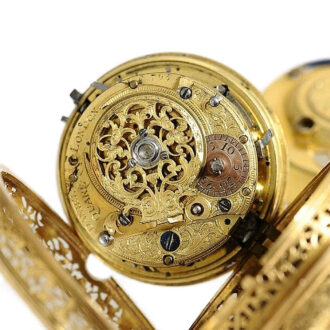
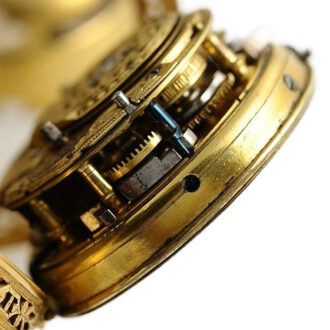
Transport case is brass, gilt, leather covered, applied stud decoration, large lateral hinge. Inner case is gold, pierced and engraved band, foliate decoration, the back side with Repoussé decoration “Orpheus with the harp und Eurydice”, large lateral hinge, signed movement protection cap, rear bell. Enamel dial, radial Roman hours, “Poker & Beetle” gold hands. Full plate movement, keywind, gilt, applied florally engraved ornaments, signed, chain/fusee, baluster shaped movement pillars, 2 hammers, three arm brass balance, very finely florally engraved, pierced balance cock, chatoned diamond endstone on balance.
–
Diameter: 58 mm
–
Weight: 173 g
–
Signed: Daniel Quare, London
–
Daniel Quare
Daniel Quare, one of the most eminent makers was born around 1648 in Somersetshire. He joined the clockmakers company in 1671 and became a master in 1708. He died on March 21, 1724, in Croydon in Surrey. In addition to his legendary clocks and watches Quare created various barometers and mathematical instruments and is credited with the invention of the rack striking mechanism. He came to the attention of the King in 1686, when Edward Barlow tried to patent a repeating mechanism for watches, and Quare, with the support of the clockmakers company, appealed his patent, saying he had been making repeaters since 1680. Repeating was important in the era before easily turned-on electric light, so you could know what time it was in the dark. Barlow’s patent was refused, and the king, testing Barlow’s and Quare’s watches side by side, stated a preference for Quare’s. There are Quare clocks in the royal collections at Buckingham Palace and Hampton Court, as well as in important museums and further private collections.
–
Orpheus and Eurydice
Eurydice was set upon by a satyr. In her efforts to escape the satyr, Eurydice fell into a nest of vipers and suffered a fatal bite on her heel. Her body was discovered by Orpheus who, overcome with grief, played such sad and mournful songs that all the nymphs and gods wept. On their advice, Orpheus travelled to the underworld and by his music softened the hearts of Hades and Persephone, who agreed to allow Eurydice to return with him to earth on one condition: he should walk in front of her and not look back until they both had reached the upper world. He set off with Eurydice following, and, in his anxiety, as soon as he reached the upper world, he turned to look at her, forgetting that both needed to be in the upper world, and she vanished for the second time, but now forever.
Signed: Daniel Quare, London
Share this page: