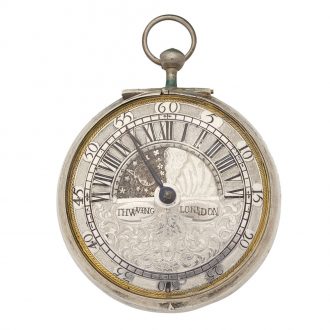
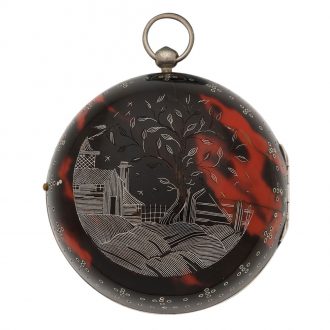
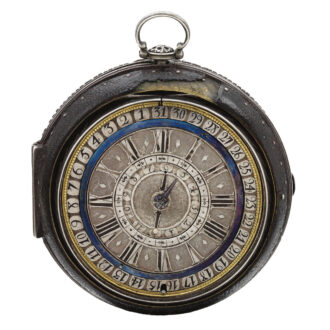
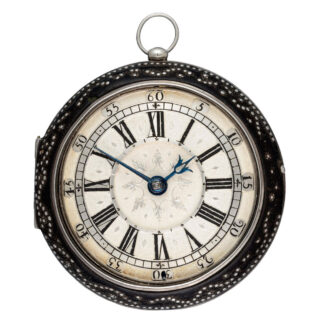
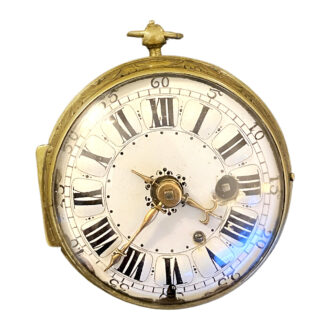
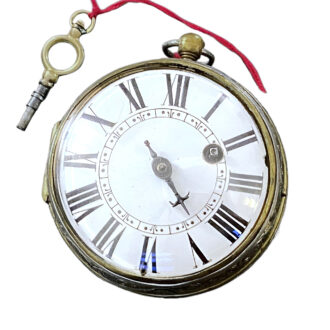
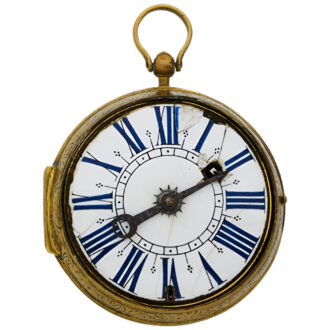
English silver oignon watch with single hand and alarm Circa 1680
- Kenmerk
- AM0021
- Diameter
- 102 mm
- Estimate
- € 50.000 - 125.000
- Price sold
- -
Oignon coach watch with verge escapement by Thomas Tompion
–
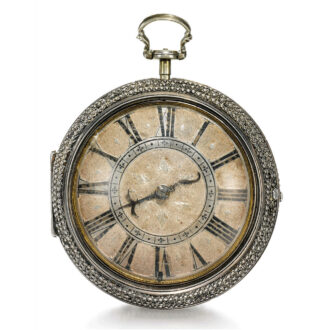
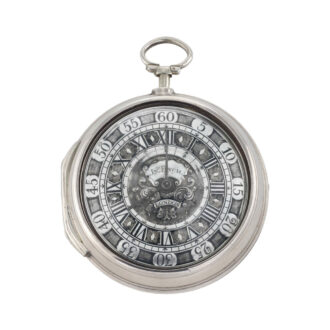
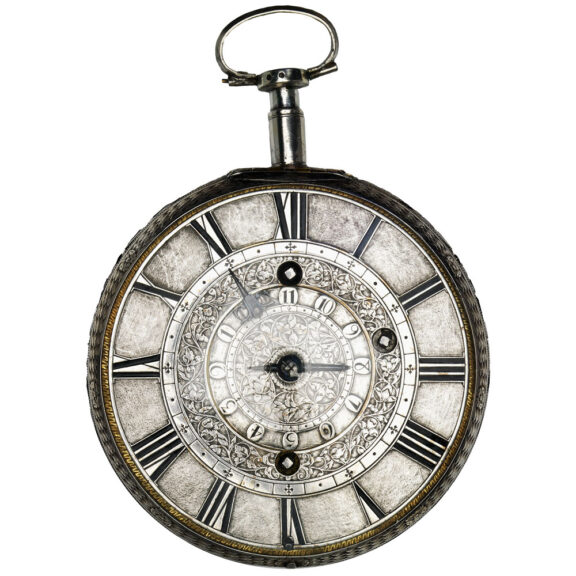
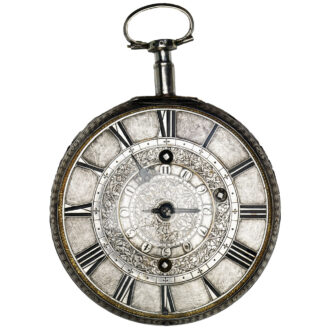
A fine, early and large English silver oignon coach watch with single-hand and alarm, circa 1680. Made by Watchmaker: Thomas Tompion (British, 1639–1713) and case and dial maker: Nathanial Delander (British, 1648–ca. 1691).
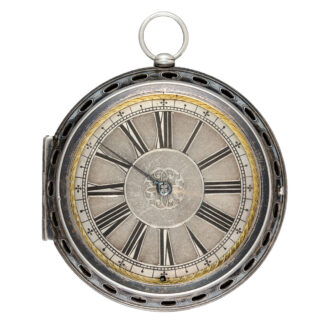
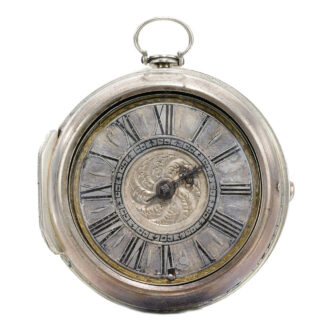
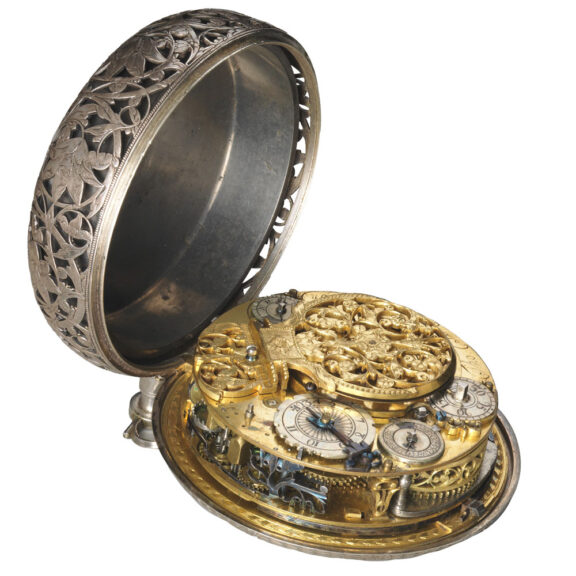
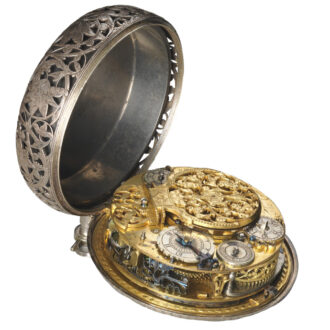
The movement consists of two circular brass plates held apart by five extraordinarily fine tulip pillars. The going train consists of three wheels ending in a verge escapement and a balance spring. It is driven by a mainspring housed in a pierced and engraved brass barrel. The striking train is driven by a spring housed in a pierced and engraved brass going barrel, and it has a three wheel train ending in a fly and controlled by a count wheel. The bracket for the count wheel is an elaborate openwork arm of blued steel. The alarm train is driven by a smaller spring in a pierced and engraved brass going barrel installed between the barrels for the going and striking trains. It drives a brass wheel, a steel contrate wheel, and a steel escape wheel. A hammer mounted above the spring barrel of the special train strikes hours on a bell inside the case, and a crescent shaped steel arm mounted on the opposite side of the movement strikes the alarm. The watch has a duration of thirty hours.
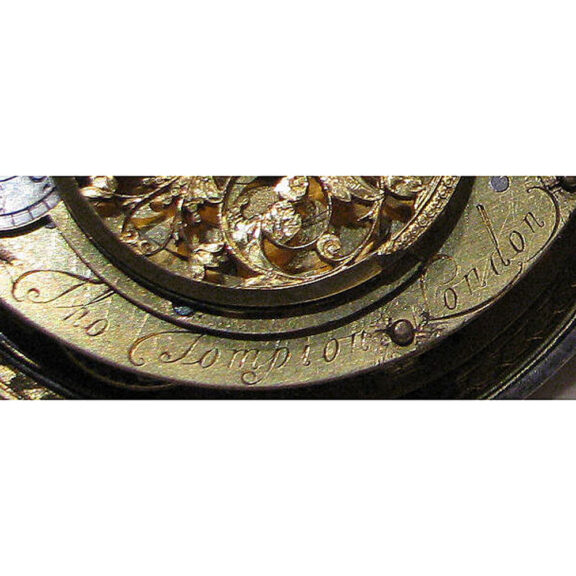
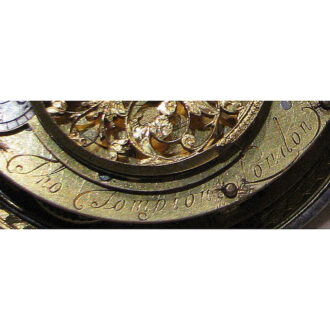
The back plate has a large cock attached by a screw with a symmetrically pierced and engraved design of floral and foliate scroll ornament that ends in an unusual matte finished rectangle enclosing a stylized flower. A circular figure plate marked for adjusting the balance spring and a smaller silver figure plate that indicates the setup of the mainspring of the going train flank the engraved signature: Tho Tompion London. On the left side, above the figure plate for the balance spring adjustment, is a figure plate for the setup of the striking train, and above the figure plate is a silver count wheel for the striking train.
–
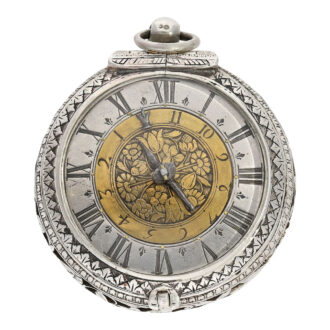
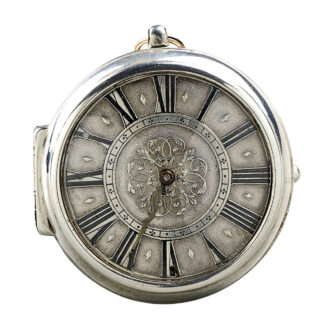
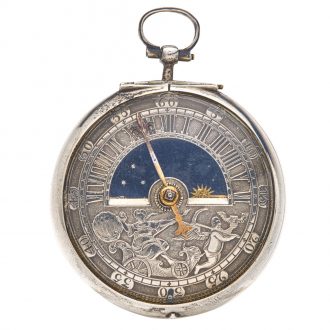
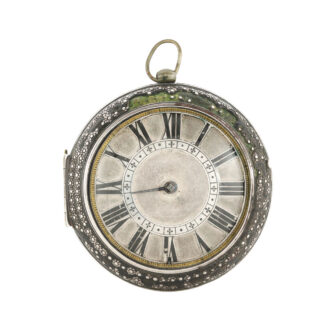
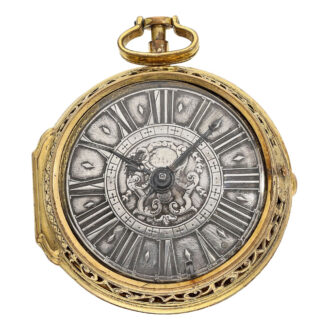
The dial consists of a champlevé silver chapter of hours (I–XII), marked for quarters (lines) and half hours (dots). In the centre is a circular revolving dial for the alarm with a chapter of Arabic numerals (1–11) for the hours and a single, openwork hand attached at the twelve o’clock position. A second single hand attached at the centre sets the alarm. A band of floral scrolls separates the two chapter rings, and the motif is repeated in the centre of the alarm dial.
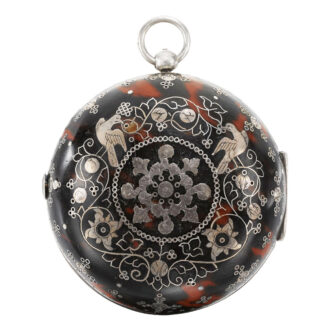
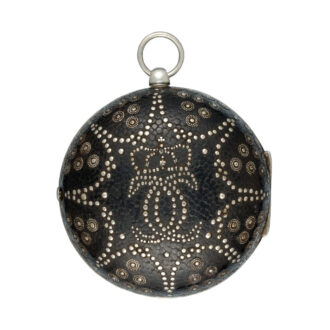
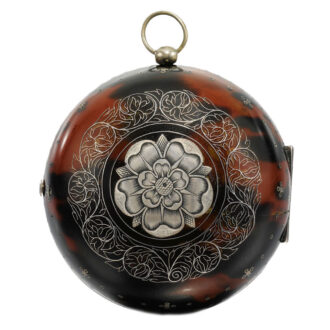
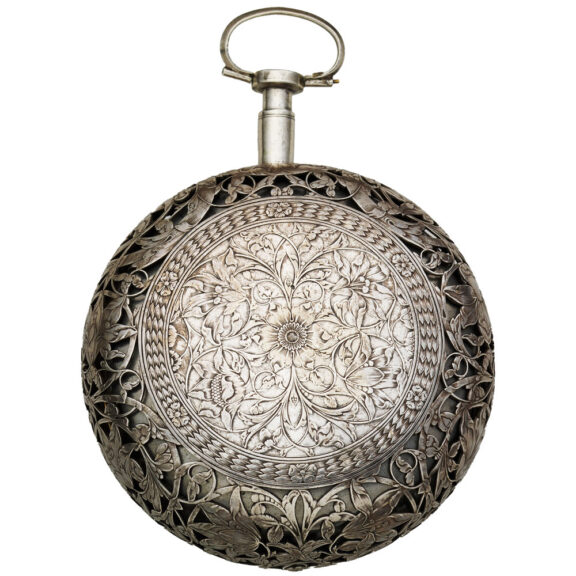
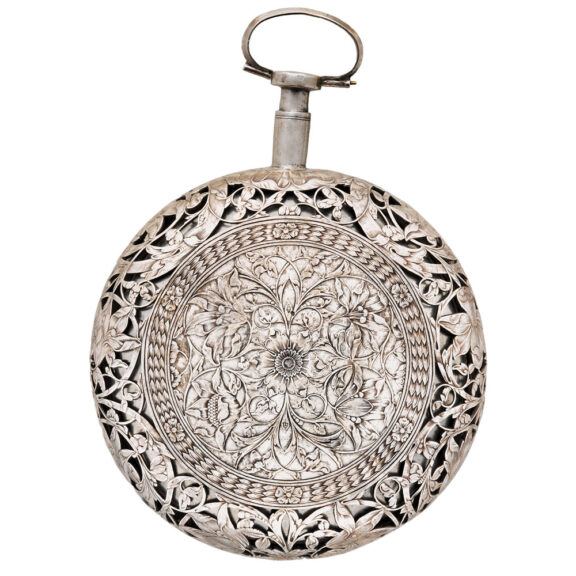
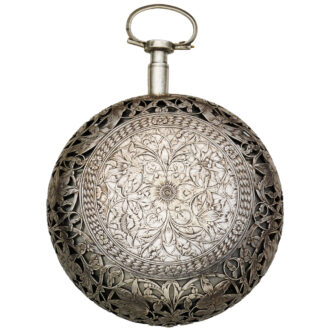
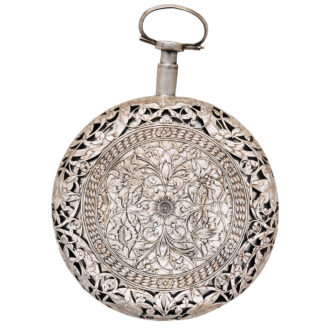
The case has a glass cover for the dial with a hinged silver bezel. The circular design in the centre of the back of the case displays a subtle interplay between the engraved and chased floral scrolls incorporating lilies and anemones and the recessed ground of chiselled silver. The design is framed by a wreath made up of tripartite leaf forms that are punctuated by six rosettes, which are, in turn, encircled by an openwork ring of engraved floral scrolls composed of lilies, daffodils and anemones. These same motifs appear, as well, on the dial, and the circle of leaves and rosettes repeats on the bezel for the glass cover of the dial. The initials ND conjoined (the case maker’s mark for Nathaniel Delander until at least 1682)12 are punched on the case’s interior under the bell. The crab (a mark for small silver articles of .800 standard fineness used by provincial French assay offices beginning in 1838) appears twice on the pendant.
–
Diameter: 102 mm
–
Signed: Tho. Tompion London
–
Oversized watches with sturdy pendants for hanging them in moving conveyances became popular among the wealthy during the second half of the seventeenth century. They are, therefore, often called coach watches. This splendid example has separate going, striking and alarm trains, each with its own power source.
–
There would have been a protective outer case for this watch, but it is missing. The pendant has been slightly bent. The figure plate for the setup of the spring of the alarm train is missing, and the figure plates for the setup of the springs of the going and striking trains have been repaired. The contrate wheel in the going train is a replacement. Otherwise, the watch is reasonably close to its original condition. The French guarantee marks for silver indicate that the watch had at least one owner in France during the nineteenth century before it entered the collection of the British banker Frederick George Hilton Price in 1898. The watch became one of the glories of J. Pierpont Morgan’s collection when he acquired it from Hilton Price.14 cv / jhl.
Signed: Tho. Tompion London
Share this page: