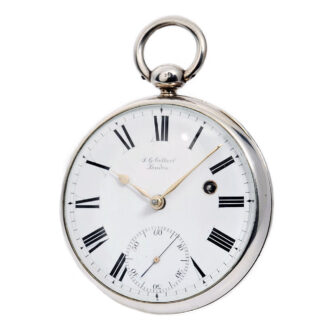
English silver pocket chronometer with deck box Circa 1817
- Kenmerk
- SA0356
- Diameter
- 51 mm
- Estimate
- € 4.500 - 10.000
- Price sold
- -
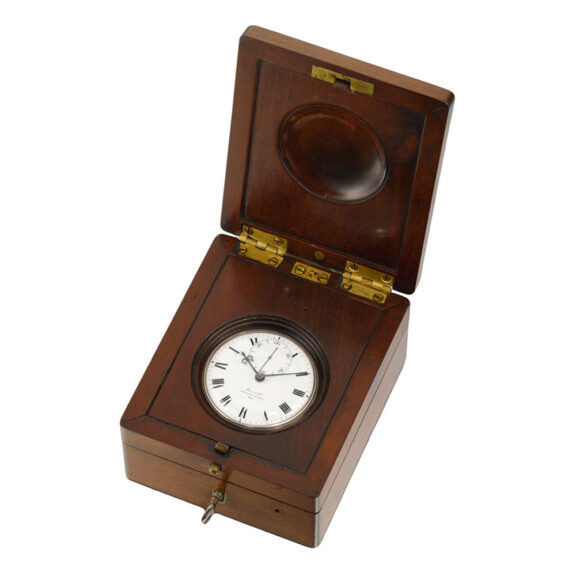
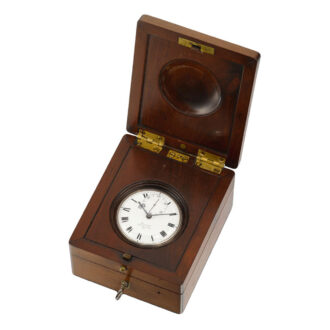
Fine silver pair chronometer with a mahogany deck box
–
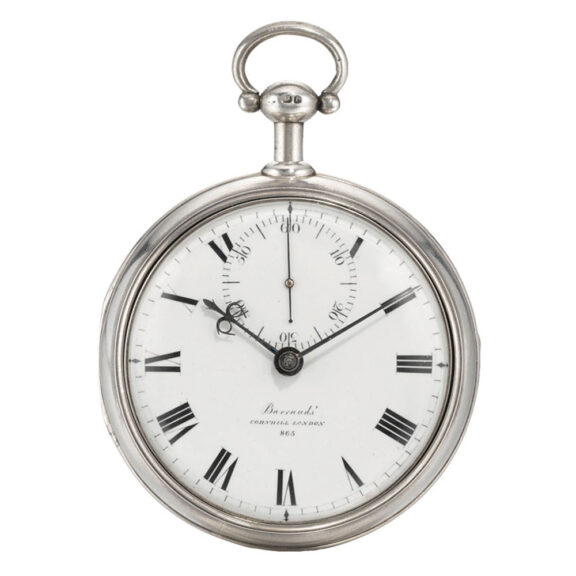
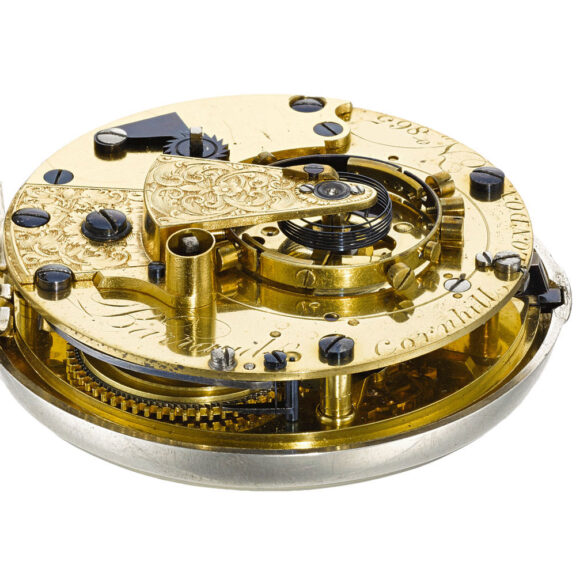
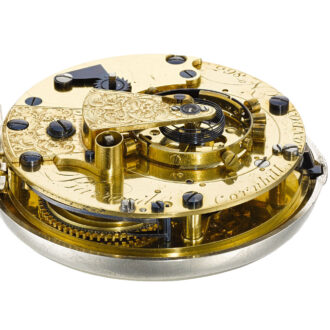
An English fine silver pair cased pocket chronometer with mahogany deck box, circa 1817, gilded full plate movement, Earnshaw type spring detent escapement, decoratively engraved balance cock, Pennington ‘double L’compensated balance, blued steel helical spring, diamond endstone, fusee and chain, cylindrical pillars, signed Barrauds’, Cornhill, London.
White enamel dial, Roman numerals, outer minute ring, large subsidiary seconds at 12 o’clock, blued steel beetle and poker hands, signed and numbered Barrauds’, Cornhill, London.
Silver inner case, the bezel opening below the pendant at 12 o’clock, winding aperture to back, plain outer case with Barraud watch paper, both cases and pendant, both cases with maker’s mark JM incuse for James Melvil.
–
Diameter: 51 mm
–
Signed: Barrauds’ Cornhill London
–
In the supplement to his book, Paul Philip Barraud, Cedric Jagger notes that Barraud’s “first incursion into chronometer manufacture must have been in 1796-1797, with his attempts, in company with Howells and Jamison, to undercut Mudge Junior in copying the elder Mudge’s design of marine timekeeper”. In this watch, it would appear that the movement was supplied by Robert Pennington. Robert Pennington had been an important member of a team assembled by Thomas Mudge Junior to produce marine timekeepers to his father’s design. Pennington supplied the trade with his own escapements and complete watch movements for the majority of his career, as well as selling watches under his own name. Pennington’s contribution to the development of precision timekeeping included an improved and lighter form of bimetallic compensation balance that incorporated screws rather than weights. The movement in this watch has Pennington’s ‘double L’ type compensated balance and his version of the Earnshaw-type detent escapement, helical spring.
Signed: Barrauds’ Cornhill London
Share this page: