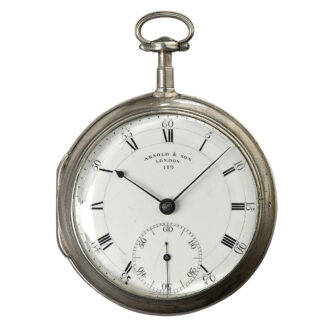
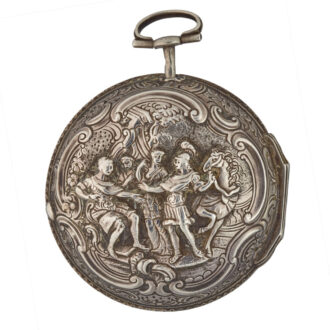
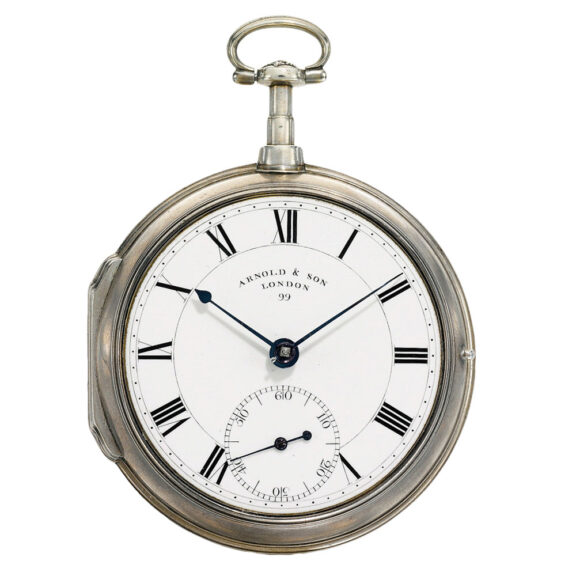
English silver pocket chronometer by John Arnold Circa 1789
- Kenmerk
- SA0142
- Diameter
- 61 mm
- Estimate
- € 22.500 - 45.000
- Price sold
- € 55.000
A silver consular cased pocket chronometer
–
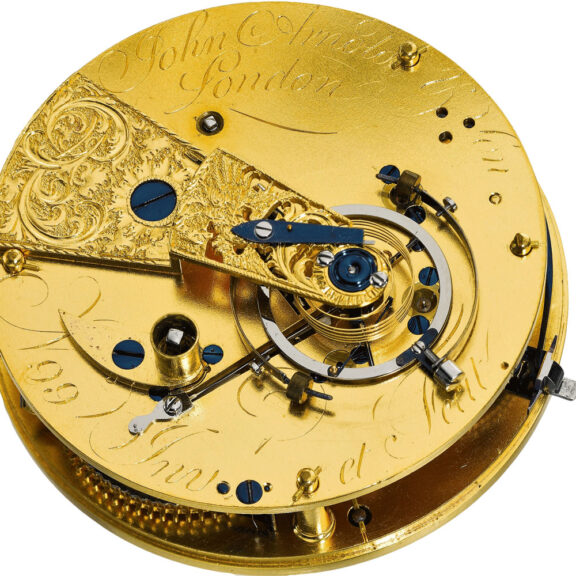
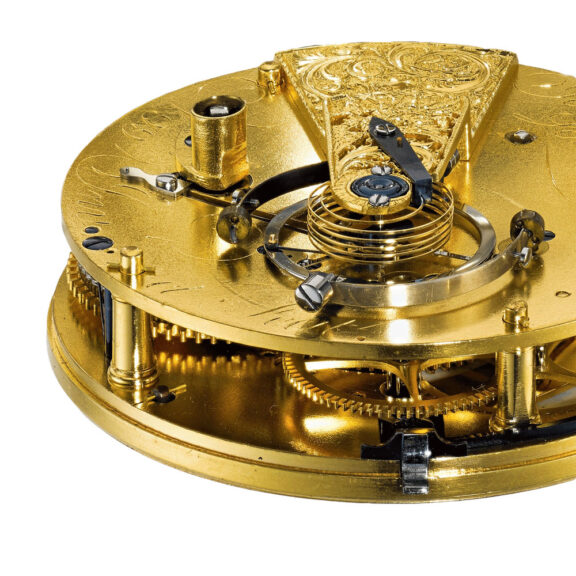
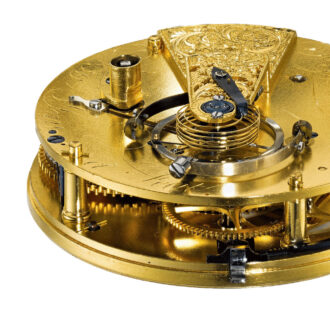
A very fine and rare English silver consular cased pocket chronometer, circa 1789, gilded full plate movement, spring detent escapement, slot and shaped foot finishing adjacent to winding square shroud, jeweled to the fusee, ‘OZ’ compensated
balance, gold helical spring, decoratively engraved balance cock with blued steel stud arm, diamond endstone, movement signed John Arnold and Son, London Inv.t et Fecit
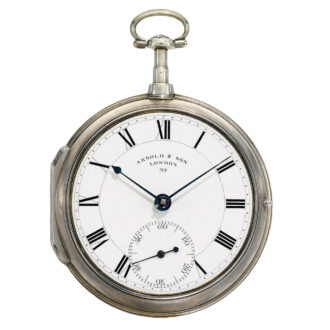
White enamel dial, Roman numerals, outer minute ring, large subsidiary seconds, blued steel hands, signed and numbered.
Plain silver consular case with London hallmarks for 1786 and maker’s mark IL in a cameo for John Laithwait
–
Diameter: 61 mm
–
Signed: John Arnold and Son London Inv.t et Fecit
–
On 2nd May 1782, John Arnold applied for a patent for a new form of escapement and balance. The patent, no. 1328, pertained to Arnold’s new spring detent escapement. The spring detent escapement provided many advantages over the pivoted detent, notably, the latter had relied on a powerful mainspring and necessitated oiling of the pivots and the point at which the return spring rubbed against the locking arm. Over time the strength of the mainspring caused unnecessary frictional wear, whilst the changing condition of the oil altered the friction. Vaudrey Mercer notes in his book, John Arnold & Son, that the earliest known and unaltered spring detent escapement by Arnold is no. 75 which Mercer dates to 1781. The present watch is hallmarked for 1786 and is signed by Arnold in conjunction with his son. Only a handful of large-sized Arnold & Son chronometers have survived and this watch is in exceptional condition. Patent 1328 also covered the balance types he had employed since 1778, i.e. the double T and double S types as well as his newest form, the ‘OZ’ (see Vaudrey Mercer p. 60). The watch is fitted with an ‘OZ’ balance and a gold helical spring. Arnold began fitting gold helical springs sometime before 1784. On 6th March 1784, Arnold wrote to the Board of Longitude: “I have made (after a great number of experiments) gold helical springs which are not liable to be affected by moisture or taking up fresh phlogiston from the human body.” The springs were not pure gold but made from an alloy of 1/8 – ¼ copper to gold.
Signed: John Arnold and Son London Inv.t et Fecit
Share this page: