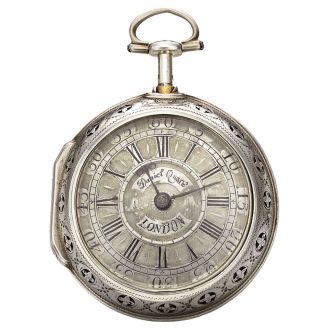
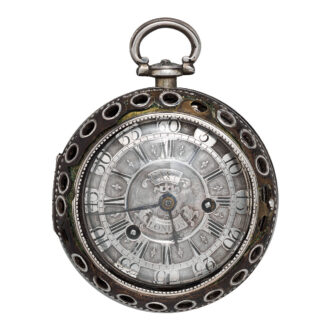
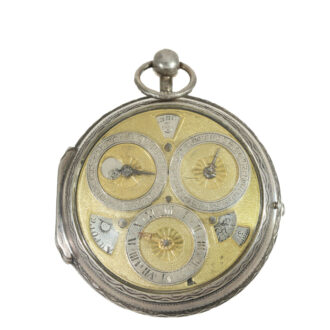
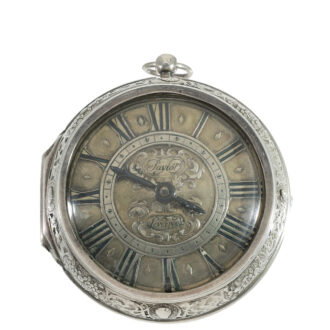
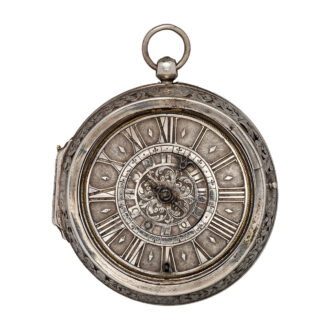
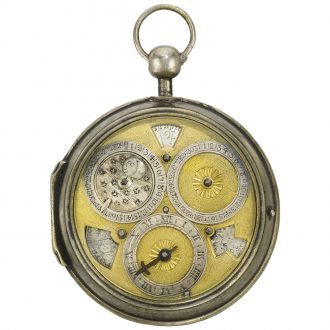
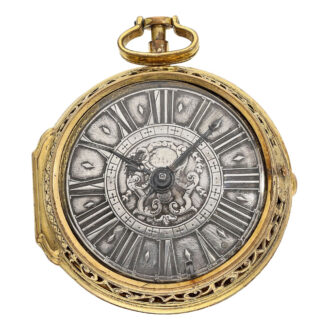
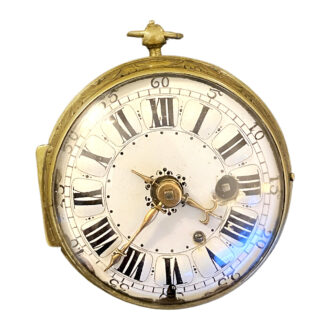
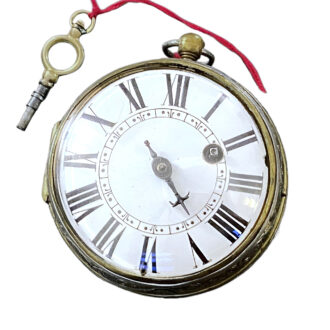
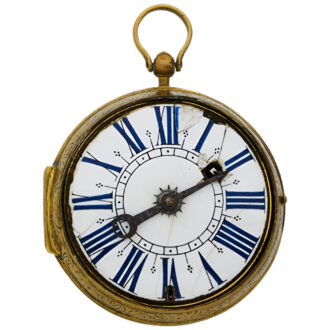
English silver watch with day and night indication Circa 1690
- Kenmerk
- TD0316
- Diameter
- 54 mm
- Estimate
- € 10.000 - 16.000
- Price sold
- €
Silver open faced verge pocket watch
–
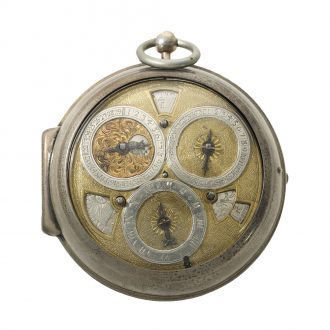
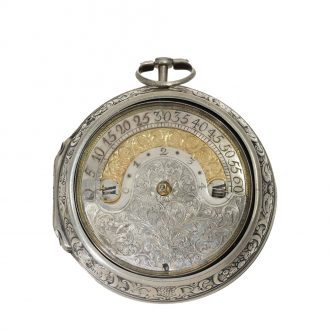
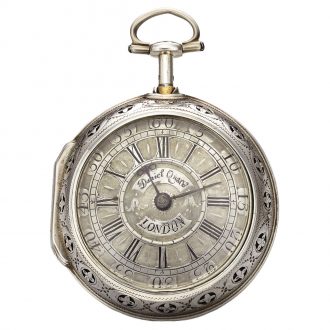
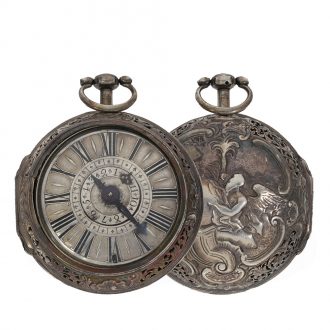
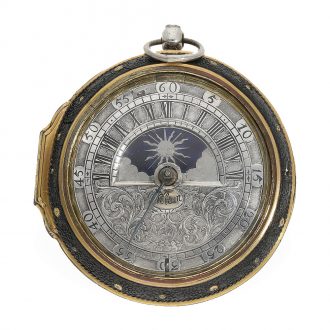
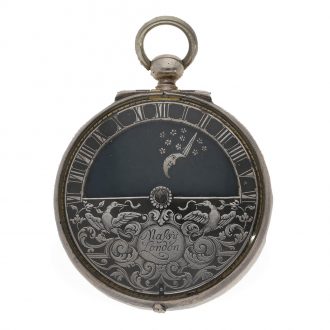
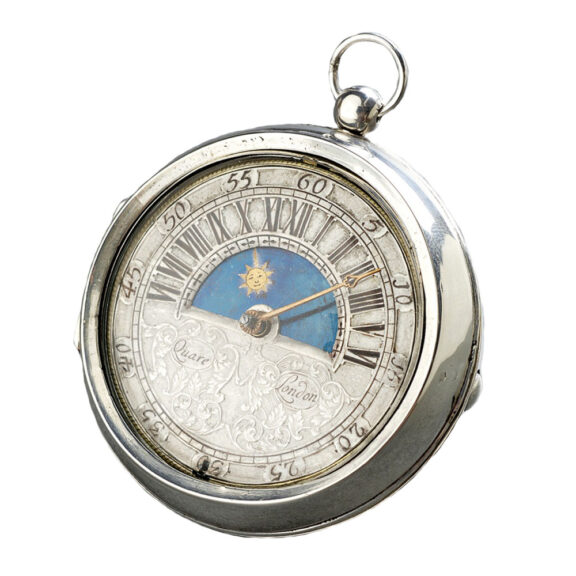
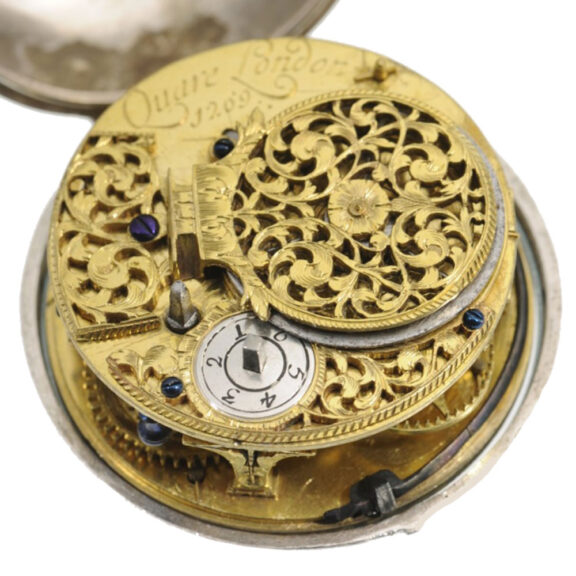
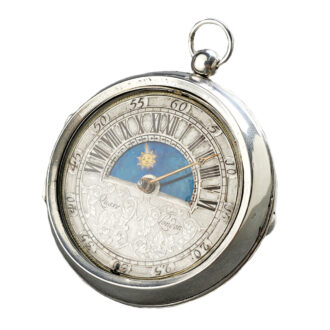
A rare English silver pair cased verge clockwatch with day and night indicator, circa 1690. Full plate movement, chain/fusee, three armed steel balance. Silver champlevé dial with retrograde Roman hours indicated by a blue steel disc which rotates once every 24 hours, viewed through a semi circular aperture engraved to one half with a gilt sun and to the other half with the moon, at the edge of the semi circle the hours are marked from six to twelve and back to six again in Roman numerals, as the sun disappears to the right the moon appears to the left, the bottom half of the dial is punched with foliage and volutes, signed Quare London. Silver inner and outer case.
–
Diameter: 54 mm
–
Weight: 126 g
–
Signed: Daniel Quare London
–
Daniel Quare, one of the most eminent watchmakers, was born around 1648 in Somersetshire. He joined the clockmakers company in 1671 and became a master in 1708. He died on March 21, 1724, in Croydon, Surrey. In addition to his legendary clocks and watches Quare created various barometers and mathematical instruments and is credited with the invention of the rack striking mechanism.
–
He came to the attention of the King in 1686, when Edward Barlow tried to patent a repeating mechanism for watches, and Quare, with the support of the clockmakers company, appealed his patent, saying he had been making repeaters since 1680. Repeating was important in the era before easily turned on electric light, so you could know what time it was in the dark. Barlow’s patent was refused, and the king, testing Barlow’s and Quare’s watches side by side, stated a preference for Quare’s. There are Quare clocks in the royal collections at Buckingham Palace and Hampton Court, as well as in important museums and further private collections.
Signed: Daniel Quare London
Share this page: