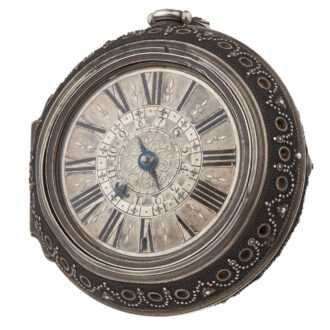
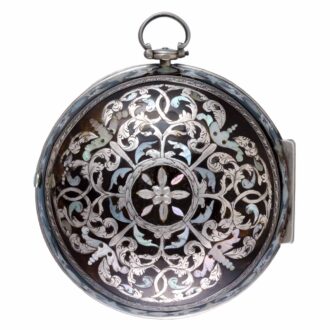
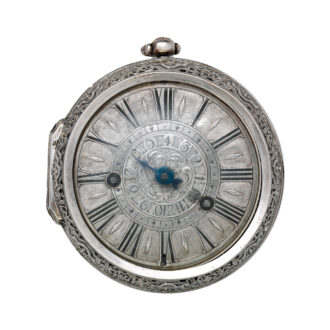
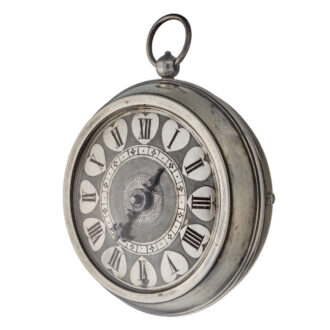
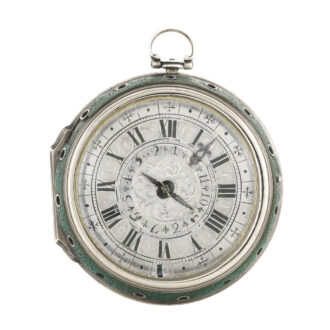
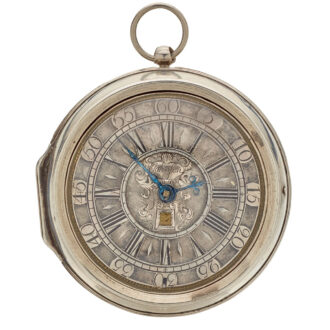
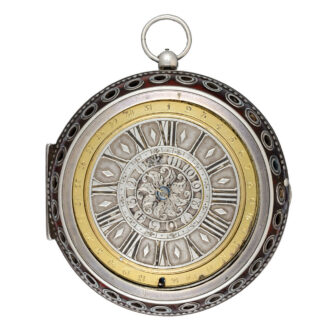
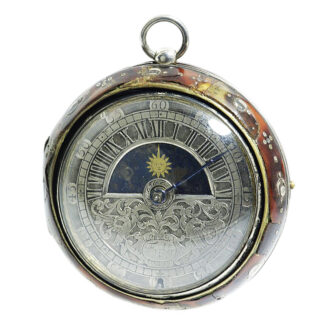
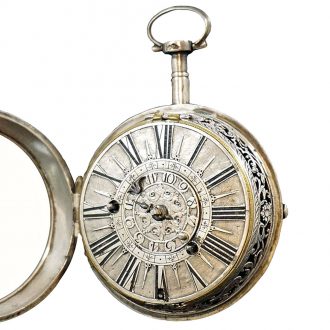
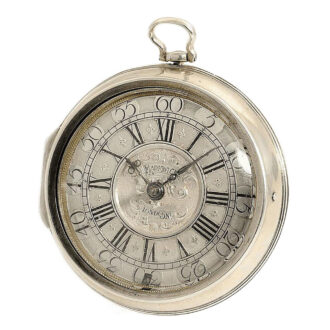
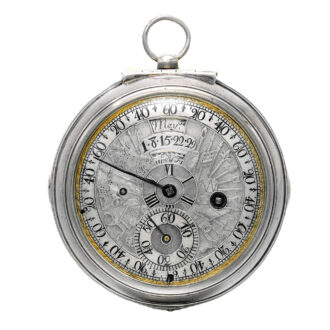
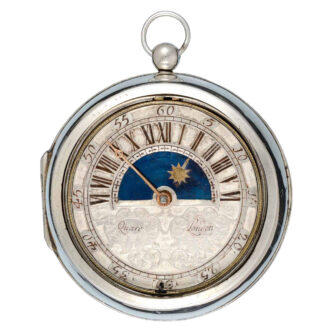
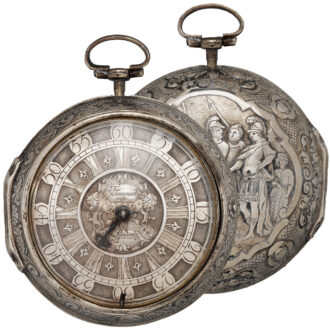
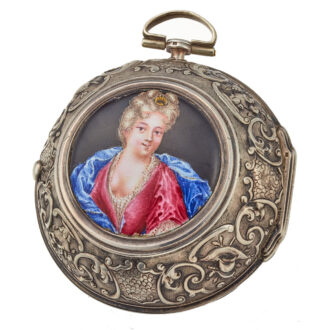
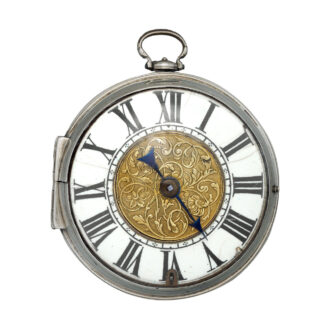
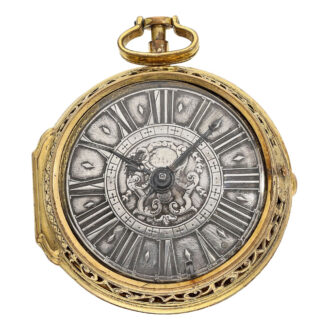
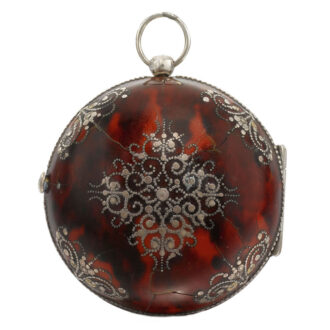
English silver tortoiseshell sun and moon verge Circa 1695
- Kenmerk
- SA0409
- Diameter
- 52 mm
- Estimate
- € 6.000 - 12.000
- Price sold
- € 8.250
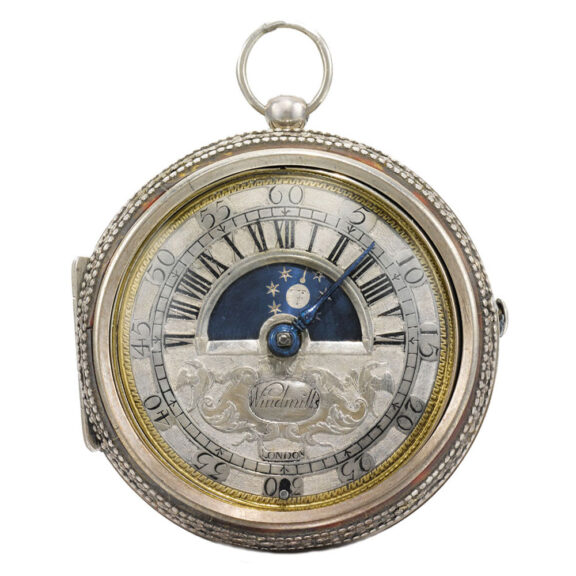
Rare silver and tortoiseshell sun and moon verge watch
–
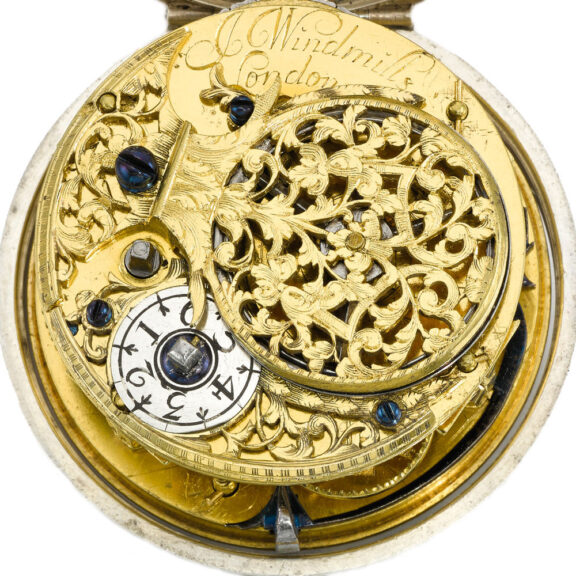
A rare English silver and tortoiseshell pair cased sun and moon verge watch, circa 1695, gilded full plate movement, verge escapement, large decoratively pierced balance cock engraved with foliage and short streamers at the neck, fusee and chain, tulip pillars, signed J. Windmills London.
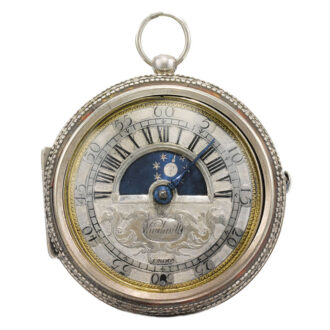
Silver champlevé dial, large aperture with rotating blued steel disc divided into day and night, the hours indicated on an outer semi circular chapter ring with Roman numerals heightened with black wax, the daytime hours indicated by a golden sun with a pointer, the night hours indicated by a silver moon with pointer surrounded by stars, outer Arabic minute ring with single blued steel hand, the lower half of the dial with central cartouches signed Windmills London and surrounded by scrolling foliate flanked by two birds, dial edged with a gilt ring.
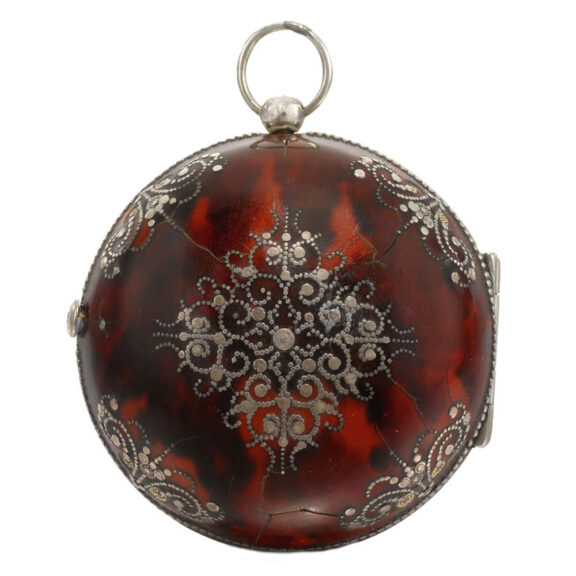
Plain silver inner case, the back with shuttered winding aperture, bezel split for glass retention, with case maker’s mark I.I. with coronet above in cameo for Jonathan Jones, tortoiseshell outer case decorated with symmetrically arranged piqué decoration in the form of stylized foliage, the bezel with three concentric rows of pique, the central row interspersed with fleur-de-lys.
–
Diameter: 52 mm
–
Signed: J. Windmills London
–
Makers at the end of the 17th and beginning of the 18th century were by no means wedded to the standard dial configuration of the concentric hour and minute hands, which had become more universal. As a result, some unusual dial designs were devised, particularly by English watchmakers. During this period there were four principal variations of dial design: the six hour dial, the wandering hour dial, the differential dial and, as in this instance, the sun and moon dial. On the present watch, the sun and moon point to the hours as they move across the large semi-circular aperture, whilst minutes are indicated by the single hand on the outer ring.
–
Joseph Windmills, a highly regarded maker, was made free of the Clockmakers’ Company in 1671 and became its Master in 1702. Shortly after this date, he formed a partnership with his son Thomas and the clocks and watches made by the firm were either signed Windmills, without forename or J and T Windmills. At some time after this, father and son appear to have run more separate businesses and signed their products once again with an individual forename. Four other ‘Sun and Moon’ watches signed by Joseph Windmills are known, one example of which is illustrated in Cedric Jagger’s book, The World’s Great Clocks and Watches.
Signed: J. Windmills London
Share this page: