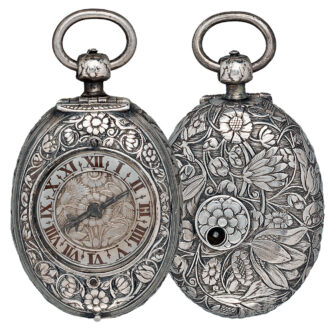
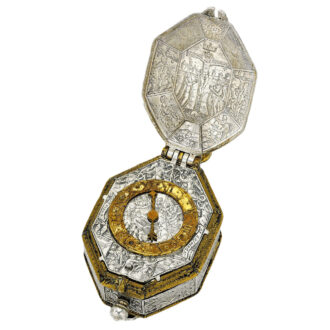
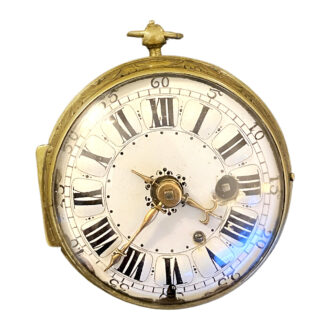
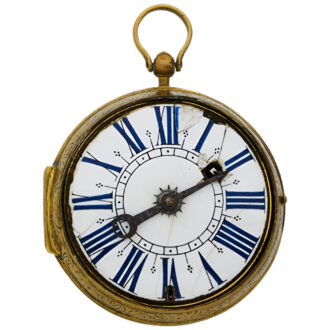
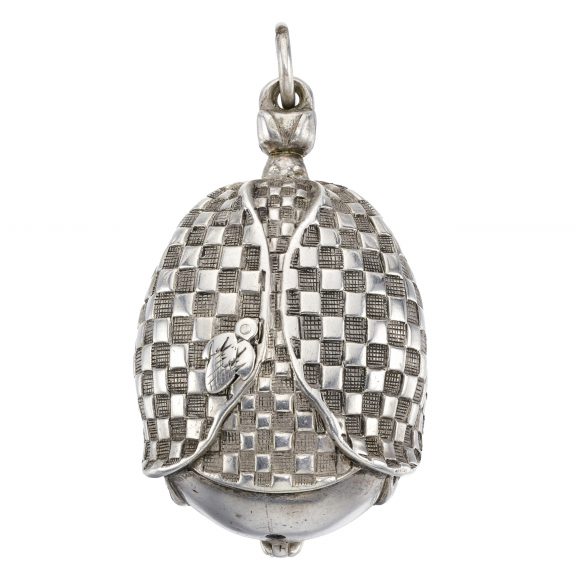
English silver verge watch in the form of a Fritillaria Circa 1630
- Kenmerk
- AS1613
- Diameter
- -
- Estimate
- € 15.000 - 30.000
- Price sold
- € 21.950
Silver verge pendant watch by Henry Beraud
–
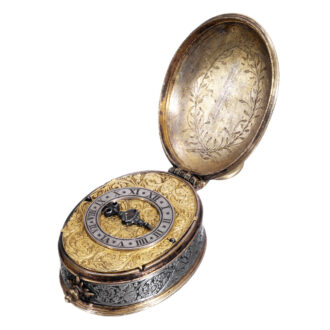
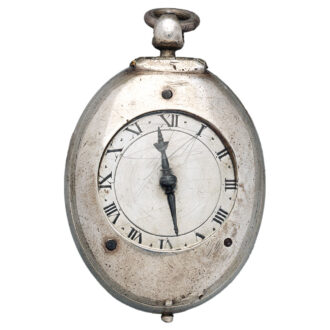
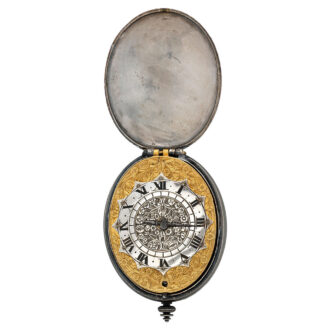
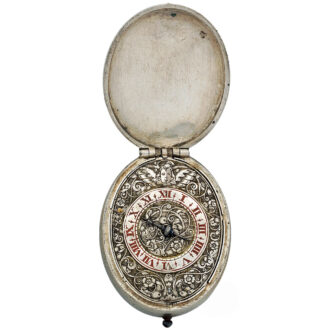
A rare English silver single-handed verge pendant watch in the form of a Fritillaria Meleagris, circa 1630. This timepiece features a gilded full plate signed oval movement with a verge escapement, intricately pierced and floral engraved pinned-on balance cock, simple flat steel balance, wheel and click set-up, fusee and gut line, and round baluster pillars. The silver dial has a chapter ring engraved with Roman numerals and half-hour divisions, a centre adorned with a townscape with trees next to a lake, dial edge engraved with flowers and foliage, and a blued steel floriated hand. The silver case is designed in the shape of a Fritillaria flower, with covers featuring a checkered surface of alternating polished and cross-hatched squares, a bud-form pendant, and a shuttered winding aperture in the form of a bud.
–
Dimensions: 41 x 25 mm
–
Signed: Henry Beraud Fecit
–
The watch case is shaped like a Fritillaria Meleagris, also known as the Snake’s Head Fritillary. The flower has a unique bell shape with checkered petals. Noël Caperon, an apothecary from Orléans, discovered the plant growing wild in the Loire and mentioned it in letters to the Flemish botanist Clusius in 1571 and 1572. In England, the plant was described by John Gerard in his book Herball, first published in 1597. The book includes an engraving by William Rogers on the title page, depicting four male figures, one of whom is holding a Fritillaria Meleagris. A similar watch with a movement signed by Thomas Hande can be found in the collections of the British Museum. Hande’s watch has a case back almost identical to the present watch, suggesting that they may have been produced from the same casting. Other popular flower or bud-shaped cases during the mid-17th century included the tulip and rose.
–
In his book, The Early Clockmakers of Great Britain, Brian Loomes mentions that although Henry Beraud was never officially admitted to the Clockmaker’s Company, he was accepted by them and his own apprentice was presented to the Clockmaker’s Company in 1633. It is believed that Beraud passed away before 1662/63.
Signed: Henry Beraud Fecit
Share this page: