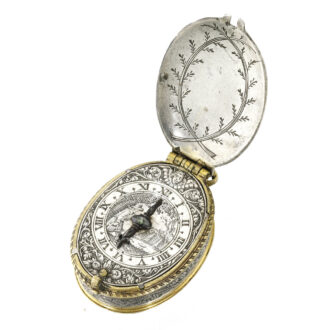
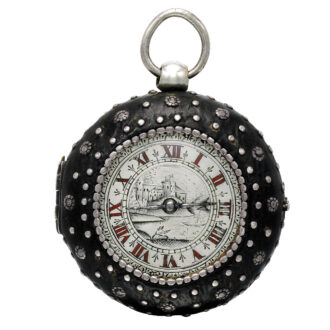
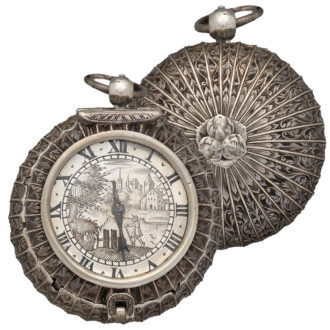
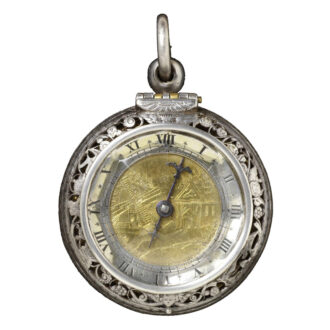
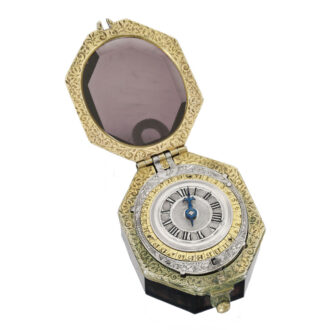
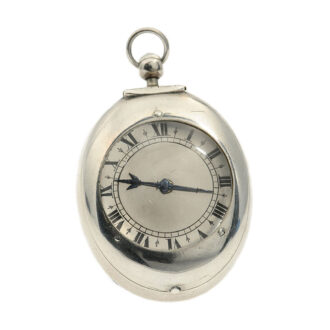
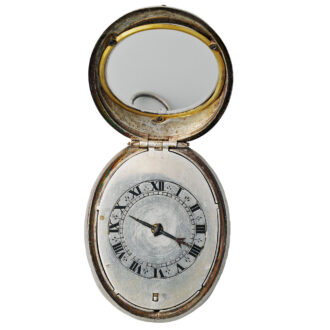
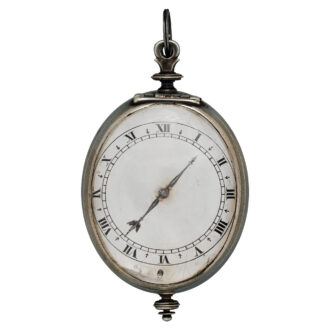
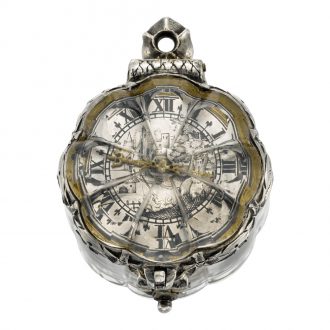
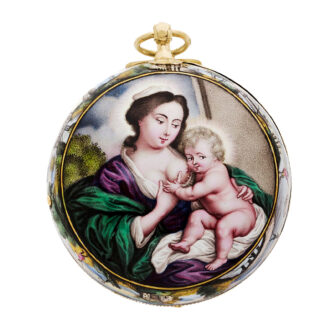
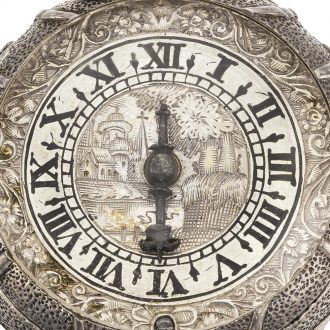
English single-handed watch in the shape of a rosebud Circa 1640
- Kenmerk
- AS1612
- Diameter
- 33 mm
- Estimate
- € 15.000 - 30.000
- Price sold
- € 17.550
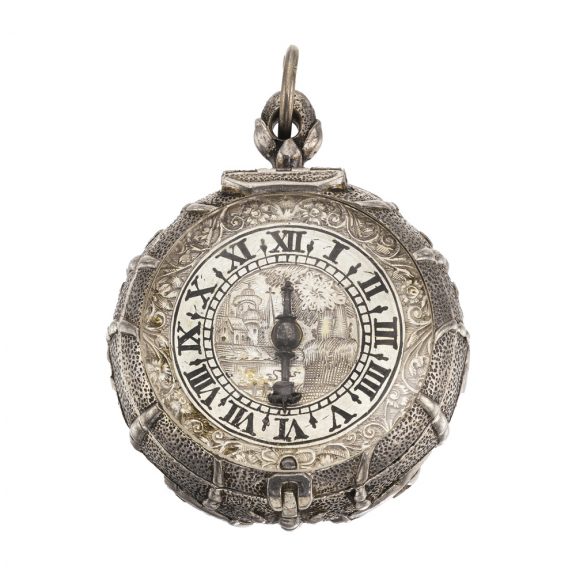
Silver verge pocket watch by Edward East
–
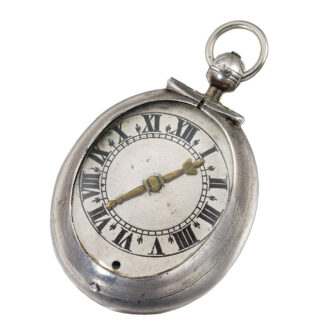
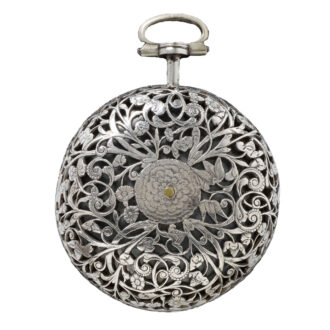
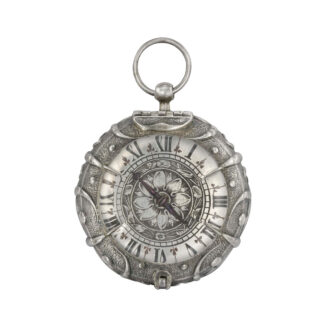
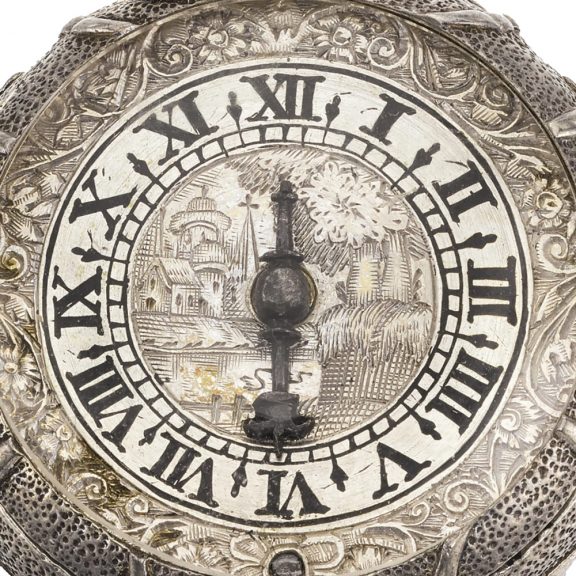
A rare silver English single-handed verge watch in the form of a rosebud, circa 1640. The watch features a gilded full plate movement with verge escapement, intricately pierced and floral engraved pinned-on balance cock, plain flat steel balance, wheel and click set-up with similarly decorated screwed-on balance cock and foot, fusee and gut line, and Egyptian pillars. The silver dial has a chapter ring engraved with Roman numerals and half-hour divisions, an inner ring with quarter-hour divisions, and a centre engraved with a townscape. The dial edge is engraved with flowers and foliage, and it is adorned with a blued steel floriated hand. The silver case has a back of rosebud-form against a matted ground, a front cover possibly later glazed, a bud-form pendant, and a winding aperture to the case back.
–
It includes a later added lyre-shaped key and the movement is signed.
–
Diameter: 33 mm
–
Signed: Eduardus East Fecit
–
A watch with a similar rosebud-shaped case was part of Stanley Burton’s collection. This watch, signed by Francis Torado, a watchmaker working in London (Free of the Clockmaker’s Company 1633), was purchased by Burton from Christie’s in 1967 and is featured in Antiquarian Horology, June 2002, p.653. Another rosebud-shaped watch was in the Mallet collection and is illustrated in Baillie, Watches – Their History Decoration and Mechanism, (1929) p. 126. The latter watch was signed by Edmund Gilpin (Free 1632).
–
Edward East was born in 1602. He was a watch- and clockmaker to King Charles I of England. A notable horologist who succeeded David Ramsay. East was apprenticed to Richard Rogers by the Goldsmiths’ Company in 1618 and was one of the founding members of the London Clockmakers’ Company in 1631. He was named on the charter and held at the same time in its proceedings. After serving in subordinate capacities, he was elected master in 1645, a position he again occupied in 1652. East was then based in the Pall Mall in London, near the tennis court. When tennis and other games were played in the Mall, the King noticed that His Majesty often provided one of East’s watches as a prize. Later, Edward East moved to Fleet Street, where he lived in 1635. According to the London Gazette of 22 and 26 January 1690, he was resident “at the Sun, outside Temple Bar” in The Strand. He presumably died in 1696. Jeremy East was possibly a son of Edward. Jeremy was acquitted by the Clockmakers’ Company in 1641.
Signed: Eduardus East Fecit
Share this page: