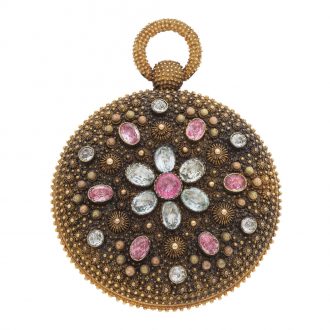
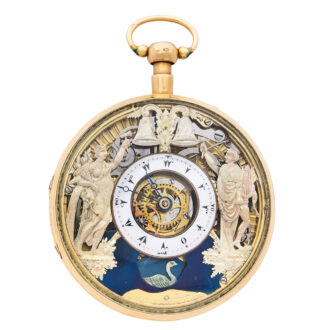
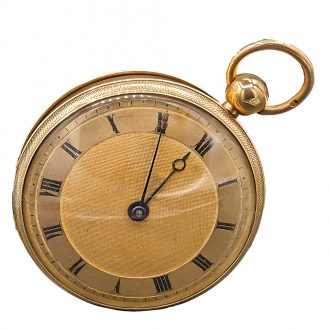
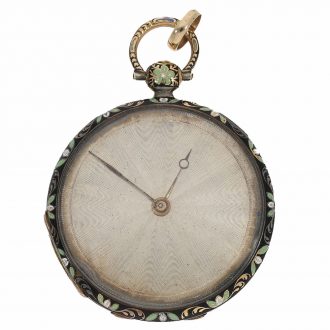
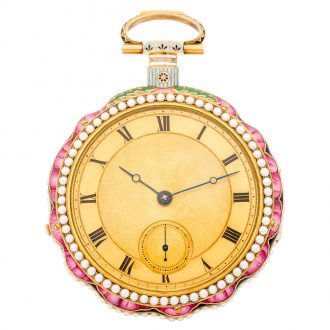
Exceptionally large gold, enamel and pearl set clockwatch Circa 1820
- Kenmerk
- BA3521
- Diameter
- 70 mm
- Estimate
- € 100.000 - 200.000
- Price sold
- € 153.950
Swiss enamelled striking cylinder watch
–
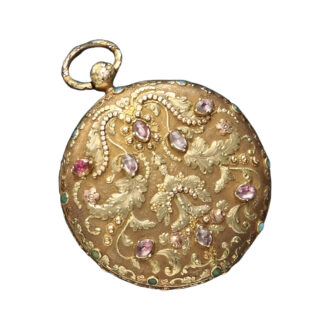
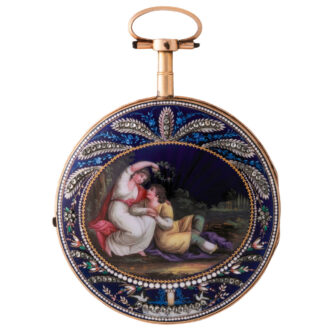
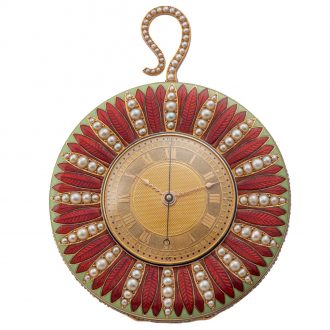
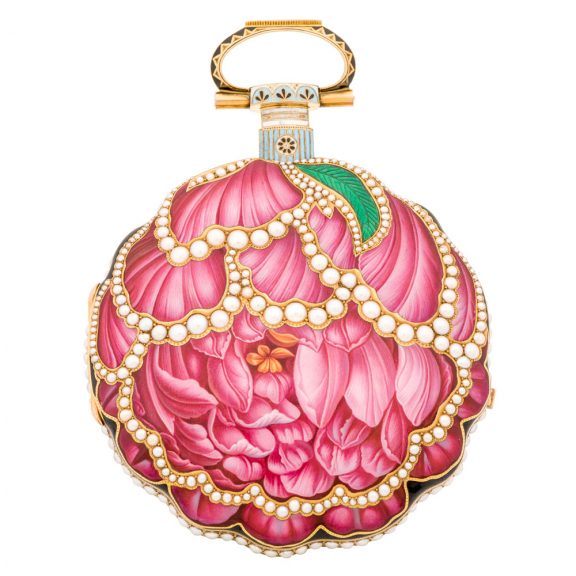
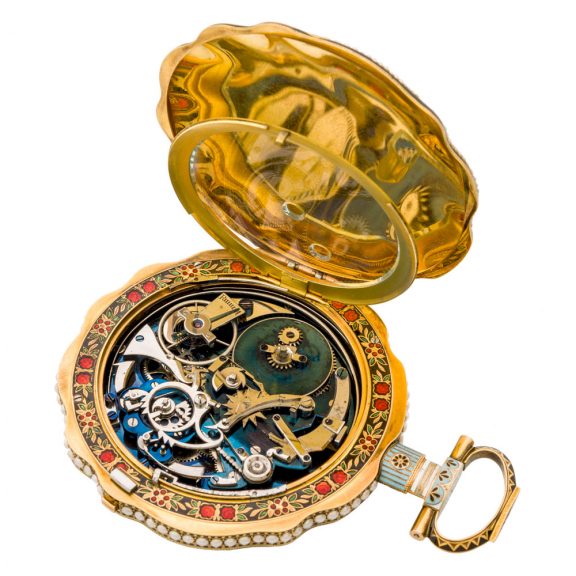
An exceptionally fine and rare Swiss 18 carat gold, enamel and pearl set open faced quarter striking clockwatch, made for the Chinese market, circa 1820. The glazed movement in blued and polished steel with a matte gilded plate, standing barrel and cylinder escapement.
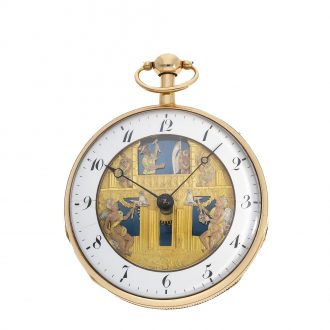
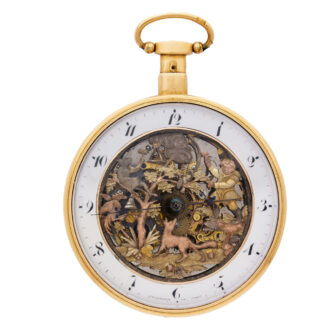
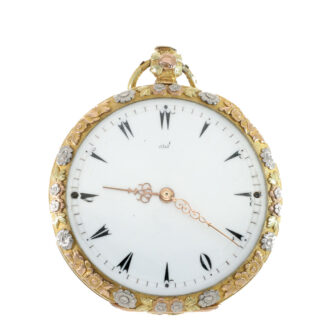
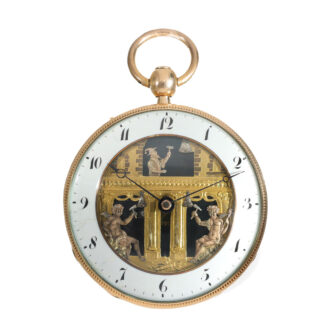
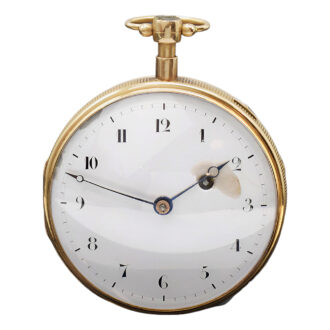
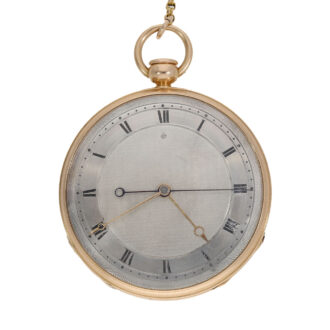
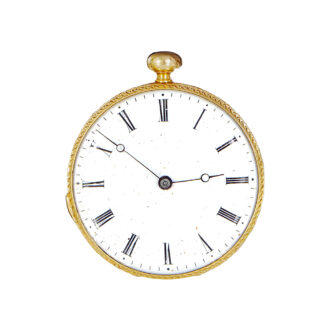
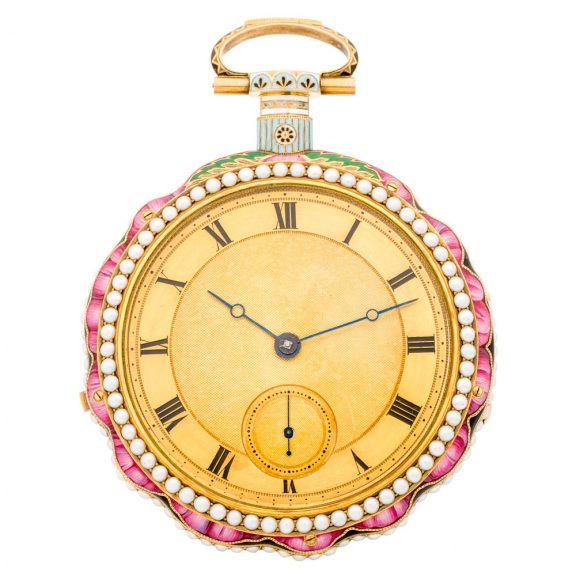
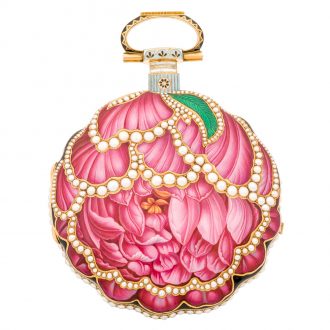
Silver gilt, engine turned dial with black champlevé Roman hour numerals on a brushed chapter ring, outer dot minute divisions, sunk engine turned subsidiary seconds with dots on a brushed chapter ring at 6 o’clock and blued moon hands. The case is realistically painted like a peony, the leaves trimmed with pearls, the front bezel enamel painted to match and set with pearls, the band is also pearl set and enhanced with champlevé enamel decoration, the pendant and bow with light blue, black and white champlevé enamel and the inside rim surrounding the movement decorated with red and green floral and foliage champlevé enamel on a black enamelled ground.
Dial and movement signed, case signed and numbered. Comes with the original pearl set key.
–
Diameter: 70 mm
–
Signed: No name
–
The incredible realism and depth of the painted on enamel flower show that it is certainly done by one of the best Genevan enamel painters, evidently the same one that decorated the case of an almost identical watch sold as part of the Albert Odmark Collection by Christie’s in London on March 11th, 2005 and another sold by Antiquorum in Geneva on May 15th, 2005 as lot 204. A watch decorated with a peony flower, sold by Antiquorum in Geneva on April 18th, 1998 as lot 51 also belongs to this series. Further such watches were sold by Antiquorum on November 13th and 14th in 2004 as lot 48 and April 21st in 1996 as lot 267 (almost identical to the one sold in 2004). Another example in the form of a pink rose sold at Sotheby’s, Masterpieces from the Time Museum, December 2nd in 1999.
The enamel flower extends to the very edges of the case with the effect of allowing the full beauty of the flower to be appreciated as a work of art. The artist was clearly an experienced painter of botanical specimens because the watch is decorated as a true representation of the flower it depicts, a spectacular example of the art of enamelling.
The peony flowers have great symbolic importance for the Chinese. By their form, aspect and fragrance, they are considered to be highly spiritual, reflecting the profound nature of the Chinese people. Poems and proverbs like “There is no flower without beauty in the world” and “A flower gives us a glimpse of paradise” show the importance of flowers in the culture. Flower motifs are often used in art objects and objects of value. Certain flowers have a particular importance. The lotus symbolizes purity, the chrysanthemum perseverance, the plum blossom integrity, etc. The importance of flowers is so great that a country’s destiny can become linked to that of a flower. The peony, with its generous forms, brilliant colours and heady fragrance, thus became the most important flower for the Chinese. It is considered to symbolize wealth, nobility, power and happiness. Known as the “queen of flowers” or the flower of riches and honor, the peony symbolizes wealth and distinction. Paintings of peonies are often hung in Chinese homes for good luck and in offices to bring success in business.
The complimentary of opposites is another traditional Chinese theme associated with the peony, which is thought to be a positive influence for woman and man living harmoniously together. The Chinese peony is also an emblem of love and a symbol of feminine beauty. In the ancient Chinese “Book of Odes”, amorous youths and maidens give each other peonies. White peonies traditionally symbolize young girls who are distinguished mainly by their wit but also by their beauty. Red has long been regarded as a life giving colour, so red peonies are admired and highly valued. The peony is one of the flowers of the four seasons and corresponds to late spring and early summer. Subtle lines are often employed in Chinese paintings of peonies in order to depict the life force of the plants. The deep and rich symbolism attached to the flower for the Chinese would have made it an ideal subject for expensive watches and those destined for exalted patrons, even for the Emperor himself. The flower’s symbolism would have been immediately recognized and appreciated by China’s elite, who would have seen in it a flattering reference to their own wealth and power.
Share this page: