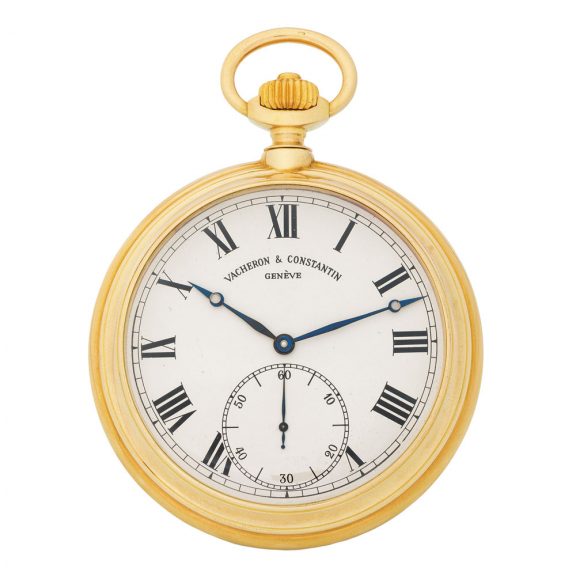
Swiss gold tourbillon chronometer pocket watch Circa 1945
- Kenmerk
- TA9003
- Diameter
- 65 mm
- Estimate
- € 50.000 - 100.000
- Price sold
- € 56.250
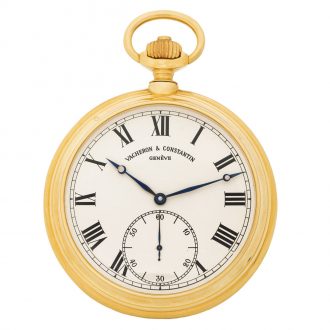
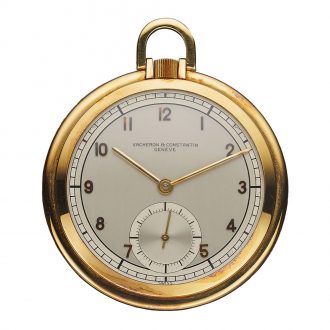
Gold watch by Vacheron & Constantin
–
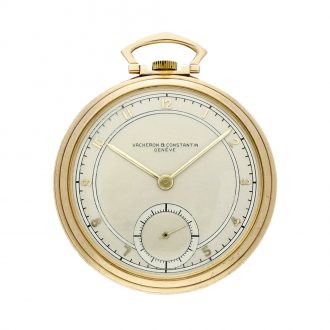
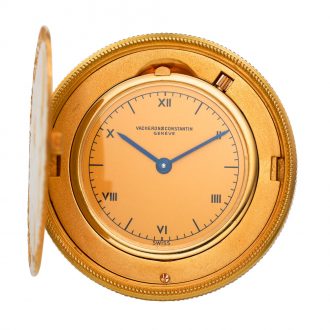
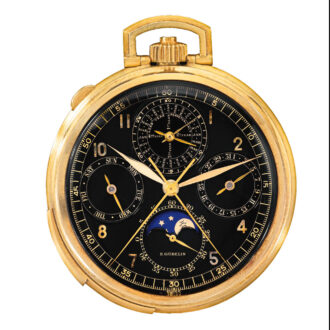
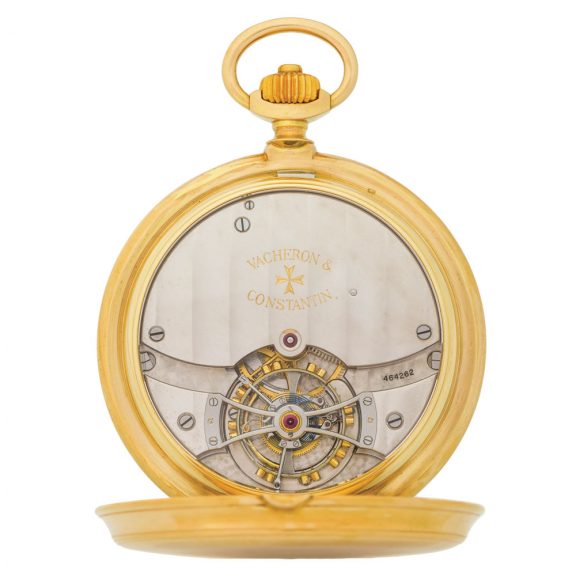
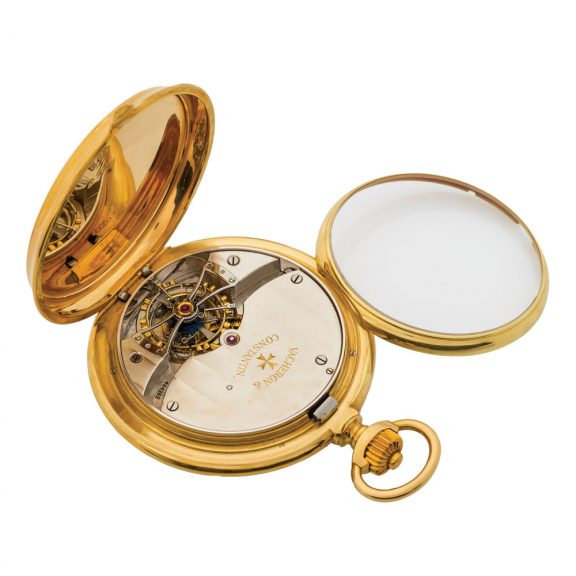
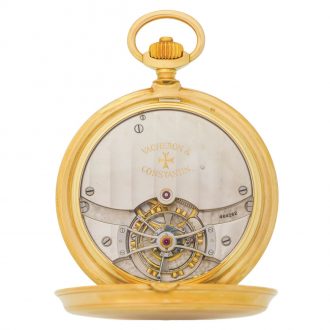
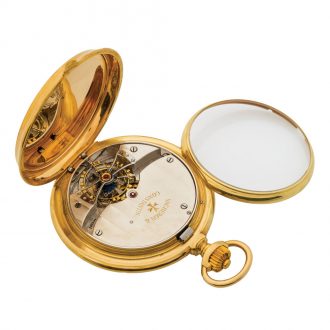
An extremely rare and very important Swiss 18 carat gold open faced keyless lever pocket chronometer with a one minute tourbillon, circa 1945. Accompanied by the extract of the Geneva Observatory in which it participated in 1967. A polished case with concealed hinges and glazed gold cuvette. Silver dial with Roman hour numerals, an outer minute track, subsidiary seconds and blued steel heavy moon hands. Rhodium plated movement by LeCoultre, a going barrel with overwinding protection click, 20 jewels, tourbillon regulator with a three arm equidistant carriage, lateral calibrated lever escapement, anibal brass Guillaume balance with gold timing screws, Breguet balance spring and micrometric regulator with pin gap closing option. Signed on the dial, case and movement.
–
Diameter: 65 mm
–
Thickness: 19 mm
–
Signed: Vacheron & Constantin Genève
–
On March 27, 1930, the Horological School of Le Sentier registered specifications for a tourbillon regulator which was tremendously successful. Vacheron Constantin used this ébauche for their best tourbillons destined for Observatory trials. The design of this watch is very well thought out: the arbour of the pallet fork is set outside the fourth wheel, allowing for a longer fork and facilitating manufacture. The carriage is very elegant with symmetrically placed components, the escape wheel is symmetrical with the fork and the stud with the regulator base, but is placed on the opposite side for equilibrium.
–
The poising bar is placed on the opposite side of the escape wheel and the fork bridge has threaded holes for poising screws similar to a compensation balance, also a very useful feature. The train from the third wheel is placed on a separate plate. The winding system, a combination of Adrien Philippe’s and Lecoultre’s rocking bar designs, creates a very stable system, eliminating the necessity for intermediate setting wheels and thus decreasing the resistance of the motion train, which has a high number of teeth to ensure smooth transmission. The regulator has a provision for closing the pin’s gap, assuring a high level of isochronism. Many of these movements were kept by the company.
Signed: Vacheron & Constantin Genève
Share this page: