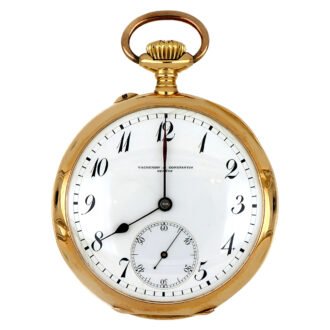
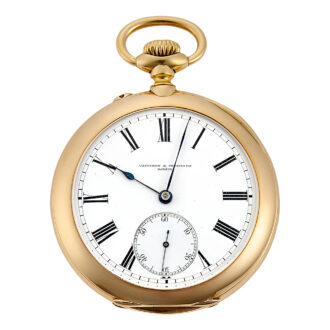
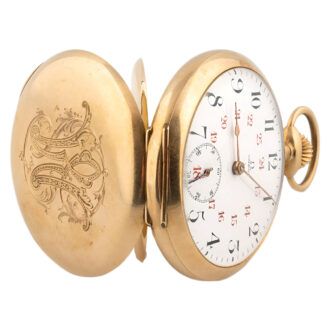
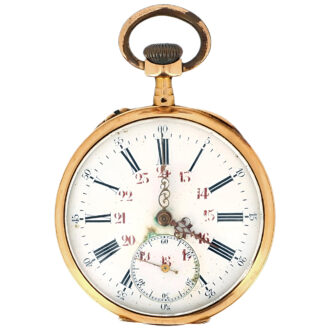
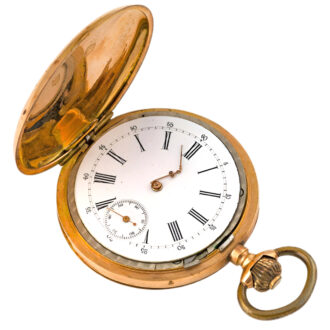
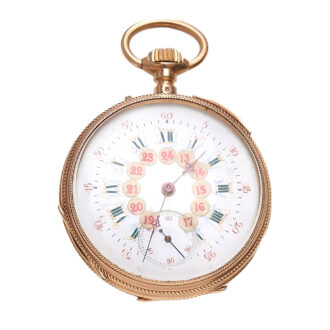
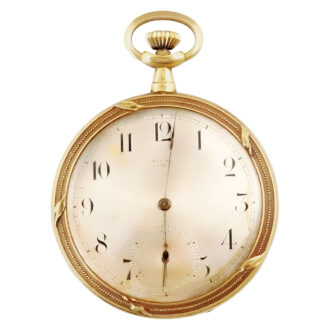
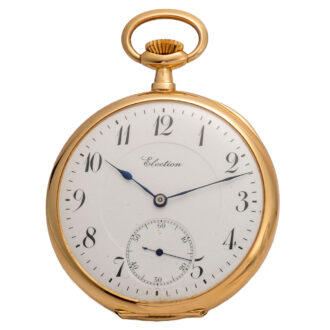
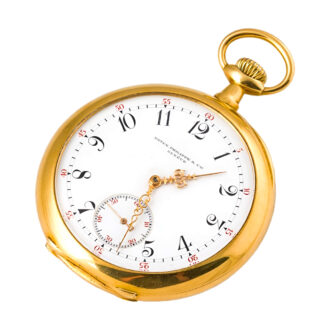
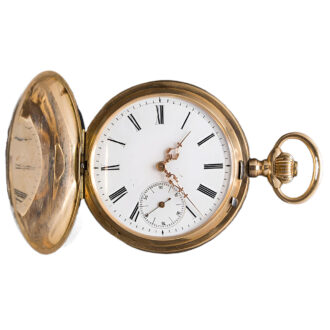
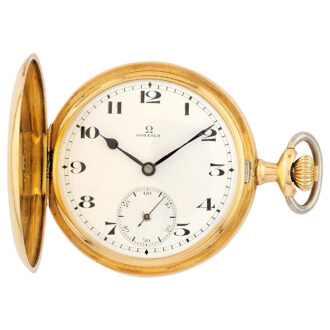
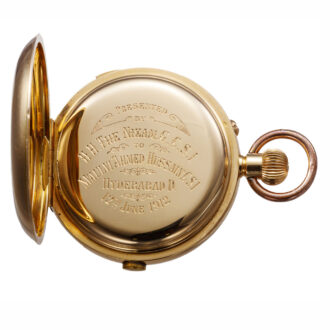
Extremely rare Swiss Grande Complication watch Circa 1910
- Kenmerk
- FA0473
- Diameter
- 56 mm
- Estimate
- € 40.000 - 60.000
- Price sold
- -
Gold hunting cased complicated lever
–
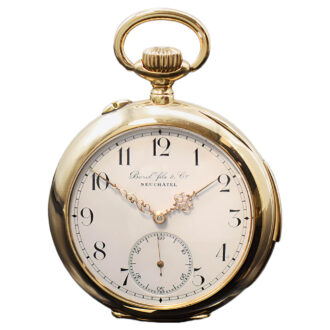
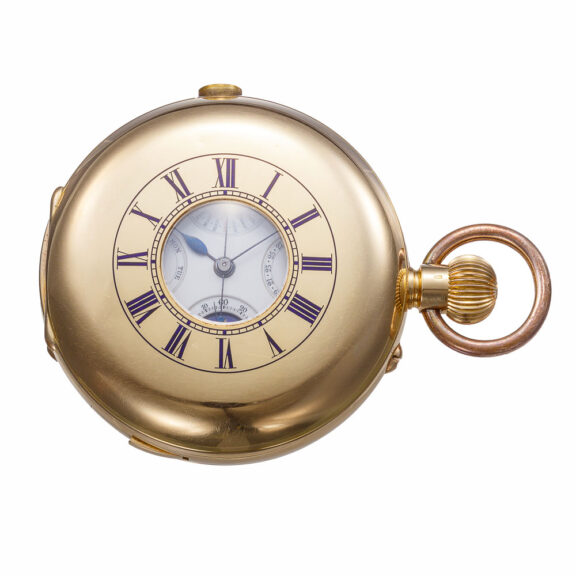
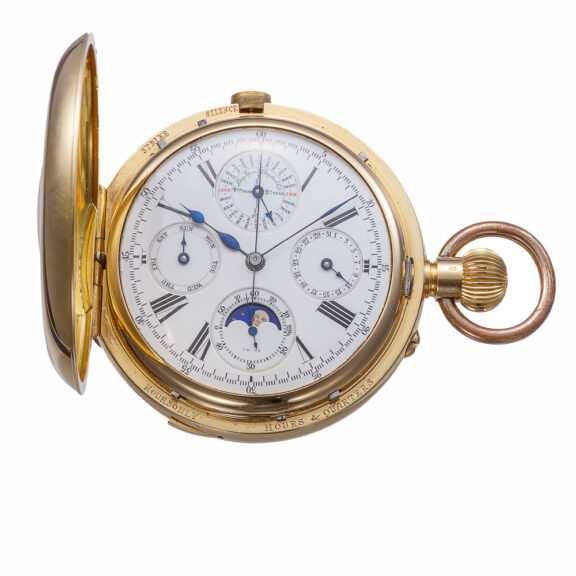
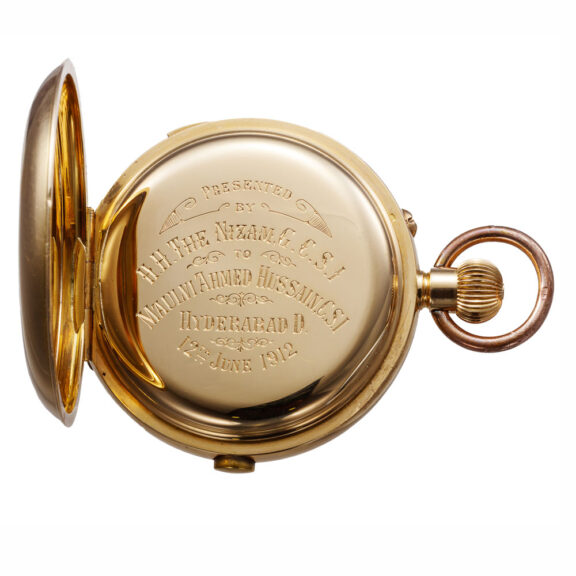
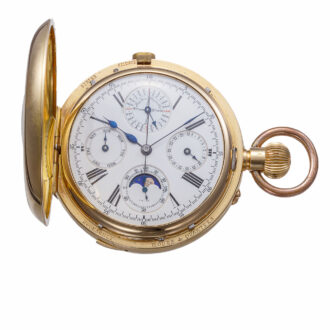
An extremely rare Swiss 18 Carat gold hunting cased historical Royal presentation Grande Complication watch with eleven horological complications, circa 1910. Retailed by P. Orr & Sons, Madras, India. Gilded brass movement, 4/5 plate, with going barrel, screwed chatons, English lateral equilibrated lever escapement, compensated Guillaume balance and blued steel hairspring with terminal curve. Gold hinged cuvette.
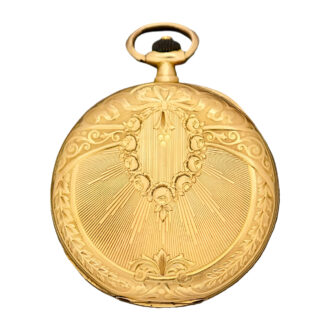
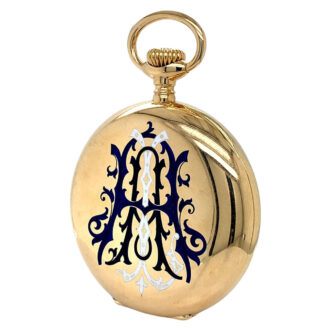
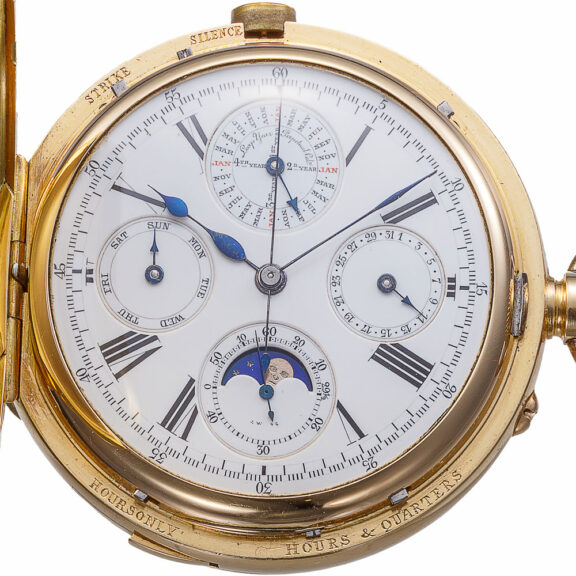
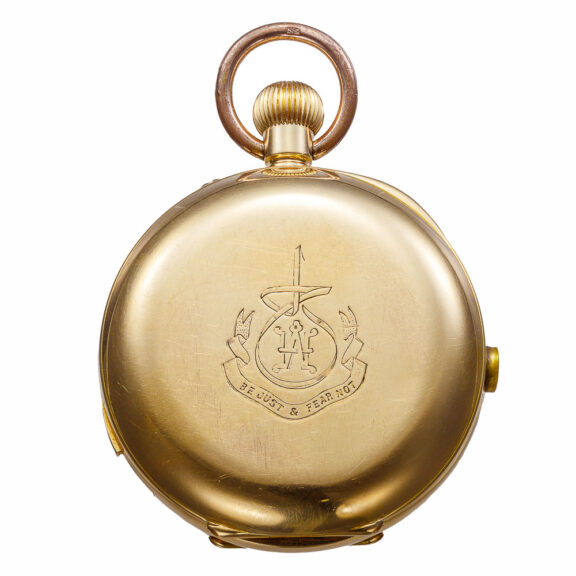
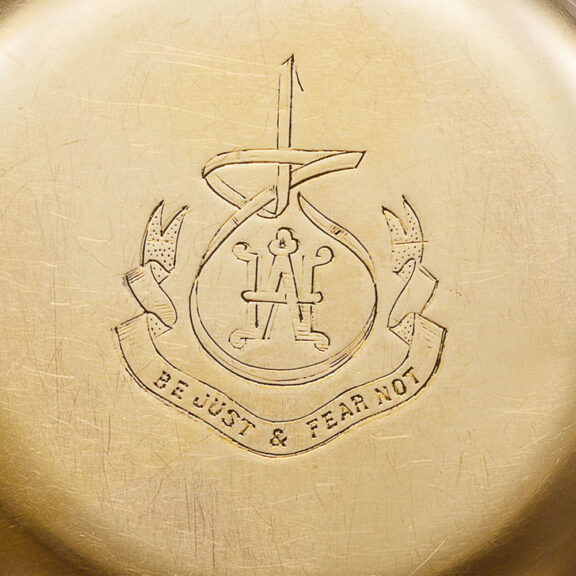
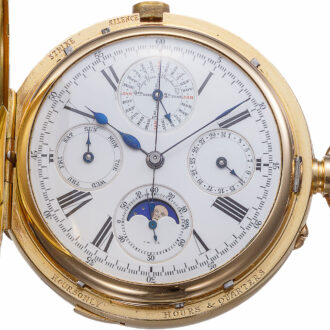
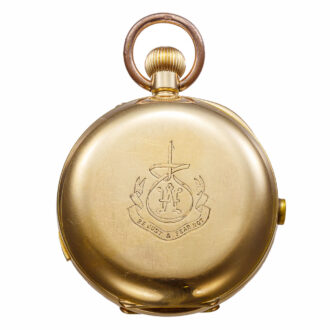
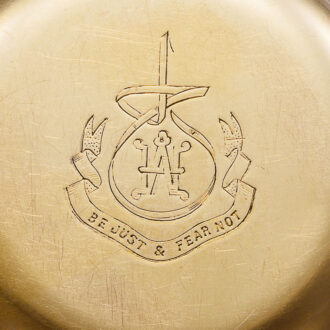
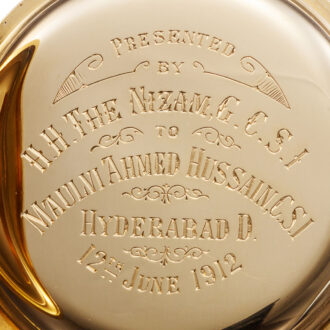
18 Carat yellow gold, half hunting case, keyless winding, round shaped, pocket watch, hinged case back, subsidiary seconds at 6 o’clock and eleven horological complications, made for the Indian market: Minute repeater on two steel gongs, activated by the slide at 7 o’clock. Grande Sonnerie, Petite Sonnerie, position lever of Strike and Silence, at 11 o’clock; position lever of Grande Sonnerie and Petite Sonnerie – Hours & Quarters and Hours only – at 5:40, Twin barrel differential winding, 1/5 second chronograph, activated by the push piece located on the case band at 12 o’clock. Perpetual calendar. Date of the month, subsidiary dial at 3 o’clock. Day of the week, subsidiary dial at 9 o’clock; indications given in English. Month of the year, subsidiary dial at 12 o’clock; indications given in English, Age and phases of the moon (subsidiary dial, graduated from 0 to 29 A1/2, and aperture at 6 o’clock. Four year cycle of leap years, subsidiary dial at 12 o’clock. Case back engraved in taille douce with the coat of arms and the motto BE JUST & FEAR NOT of Maulvi Ahmed Hussain.
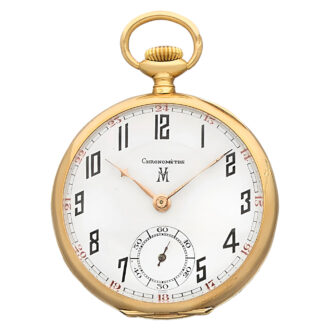
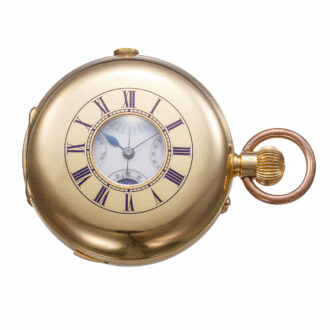
White enamel dial with Roman numerals, outer minute track, outermost chronograph divisions with fifths of a second divisions and Arabic five second/minute numerals. Inside case back stamped AFC.
–
Diameter: 56 mm
–
Signed: No name
–
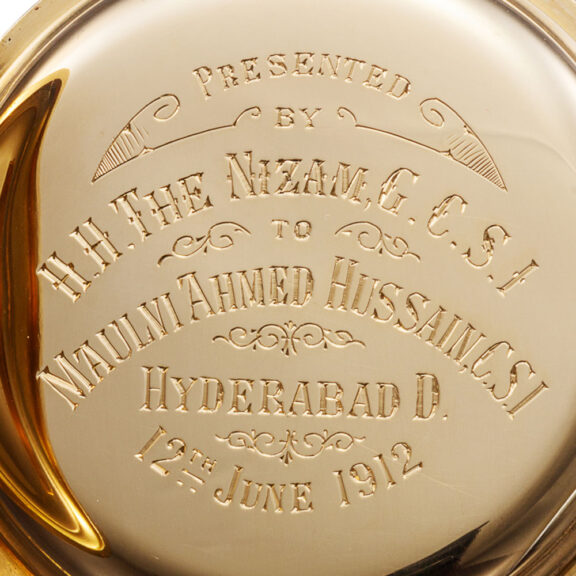
Presentation Watch A presentation watch is a watch offered by, or on its behalf, by a ruler/leader (Emperor, King, President, Prime Minister, Company Director, etc.) as an acknowledgement or thanks to a third person. Mir Osman Ali Khan (1886-1967), 7th Nizam of Hyderabad Maulvi Ahmed Hussain was a subject of Mir Osman Ali Khan (1886-1967), the Seventh Nizam of Hyderabad and was presented with the watch we have here for his loyalty. The Ali Khan family had been ruling in Hyderabad since 1719 and had become extremely prosperous over the years. The Seventh Nizam came to power in 1911 and reigned until 1948 when Hyderabad merged with the Union of India. The Nizam, whose fortune was estimated at USD 2 billion in the early 1940s, was at the time thought to be the richest man in the world. A loyal ally of Britain, the Nizam supported the British financially all through the First and the Second World War. He was an avid collector who accumulated vast collections; among them were a fleet of 200 Rolls Royce cars and a long list of outstanding diamonds that includes the 184.5 carats, Jacob Diamond. P. Orr & Sons, Madras (India) They were the most renowned retailer of fine watches and exquisite jewellery in the region, so it is evident why the Nizam turned to them when looking for something as magnificent as this watch to present a loyal subject with. “Grand Complication” No.11 966 This Swiss-made watch, bearing the number “11 966”, is undoubtedly executed in the Vallée de Joux at the beginning of the 20th century. At this time a few workshops are specialised in the production of pocket watches with many horological complications, a type of manufacture initiated in the mid-19th century by the children of Louis-Benjamin Audemars (1782-1833), whose house founded in 1811 at the Brassus is unfortunately dissolved in 1885. Research carried out in recent years by several historians of watchmaking has put forward the names of several watchmakers and today allow us to begin to understand the way of working their workshops or intertwine many family alliances and various associations. It should be remembered that the Vallée de Joux has been populated in previous centuries by some families who have made it and that, despite the work of local genealogists, it is sometimes difficult to understand who is who. We find the surnames of some twenty families, many of whom have marked the history of watchmaking: Aubert, Audemars, Berney, Capt, Cart, Dépraz, Golay, Goy, Guignard, Humberset, Lecoultre (or LeCoultre), Longchamp, Lugrin, Maréchaux, Meylan, Mignot, Nicole, Piguet, Reymond, Rochat and Simond. In terms of watchmaking, resulting from this “heroic” period of the 19th century, only two manufacturers have survived: Jaeger-LeCoultre, LeCoultre, founded at Le Sentier in 1833 by Antoine LeCoultre (1803-1881); Audemars Piguet, founded at Le Brassus in 1875 by Jules-Louis Audemars (1851-1918) and Edward-Auguste Piguet (1853-1919). Like their competitors at the time, these manufacturers are often the subcontractors of older watchmaking factories or major trading houses, from Geneva, Paris or London, but also from Germany and America. These customers then put forward their own names and require that the manufacturer’s name be hidden or simply non-existent. It is therefore difficult for us today to formally assign to a particular workshop the creation of a watch. In addition, very few Archives of these manufacturers have survived: part of the Louis Audemars Archives are in England; the Audemars Piguet Archives are in the manufactory (but are incomplete partly because of the cyclone of 1890); the bulk of the Archives of the workshop of Louis-Elisée Piguet (1836-1924) is kept in the Cantonal Archives of the State of Vaud in Lausanne; where we also find some of those of Jaeger-LeCoultre, the rest being within this company. Another collection of Archives exists, that of the Aubert family, now in the hands of Daniel Aubert, master watchmaker and historian of watchmaking and of the Vallée de Joux. In the current state of our knowledge and research done at the Archives Louis Audemars and Audemars Piguet, then those of Aubert (we thank them all), we can attribute this “Grand complication.. 11 966″ (made for the house P. Orr & Sons, Madras, India) to the workshop of Aubert Frères at Le Brassus. Aubert Frères, Derrière-la-Côte (Vallée de Joux) The three brothers Aubert – David-Louis (1806-1890), Henri-Daniel (1809-1884) and Georges-Constant (1815-1876) – founded the firm of the same name, at the locality of Derrière-la-Côte in the Vallée de Joux (between Le Brassus and Le Sentier), in the first third of the 19th century. From 1839, they used a worker, David-Henry Piguet. They then make simple watches as well as complicated pieces (with calendars and / or quarter- or minute repeaters, then chronographs with or without slip seconds device). If they produce bridges calibres, they also produce three quarter plate movements, with fusee and chain, in the English style. They provide their customers with all calibres, ranging from 4”’ to 24”’. We owe them the first miniature calibre of 4”’, with lever escapement; a real tour de force of watchmaking Art. One of their workers, Jules-Louis Piguet, makes the first piece with a double chapter and a simplified setting mechanism. Paul-Henri-Constant Aubert (born in 1841), son of Georges-Constant, excels in the design of new calibres, and those, from an early age. Over the years, the firm creates a great reputation with its complicated watches. It won a First Class medal for it products at the National Exhibition of Horology in La Chaux-de-Fonds in 1881. The Aubert Frères have produced watches with complications for Cartier, Patek Philippe and Vacheron Constantin. At the turn of the 19th and 20th centuries, they excelled in the production of watches called “Grande Complication”. The company is still active in the Vallée de Joux in 1989 in the hands of Aubert. Today it is part of Vacheron Constantin.
Share this page: