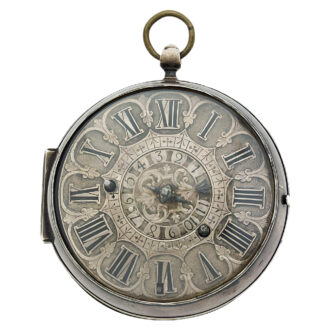
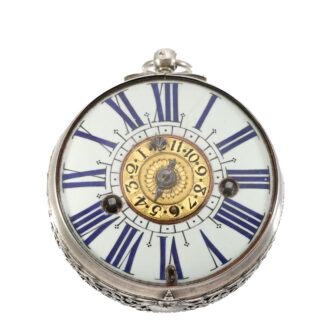
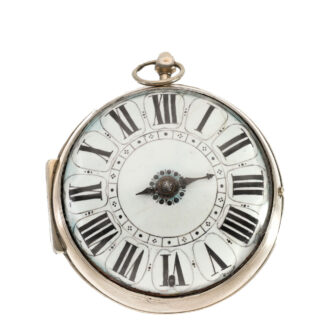
Fine English historically important silver verge watch Circa 1648
- Kenmerk
- DB1066
- Diameter
- -
- Estimate
- € 150.000 - 250.000
- Price sold
- € 187.500
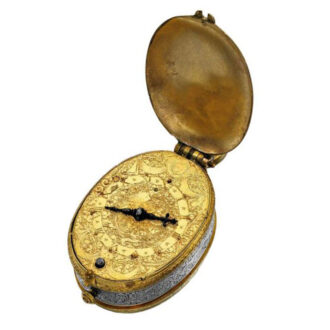
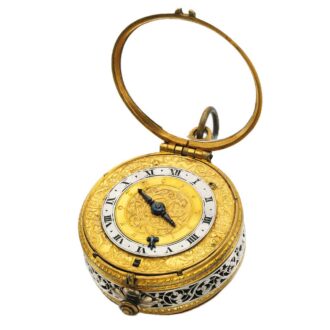
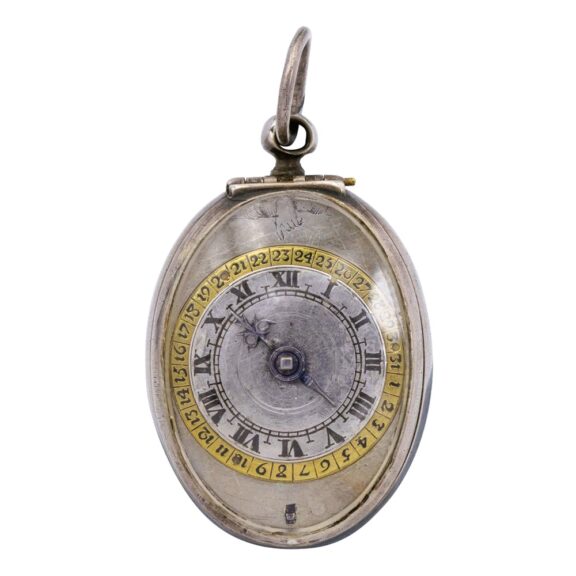
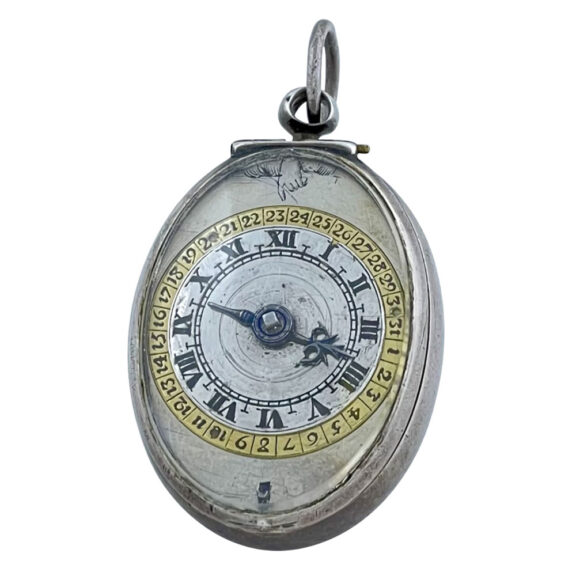
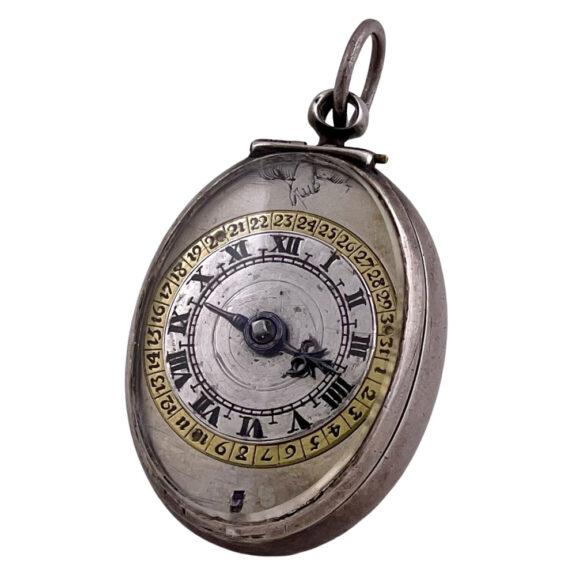
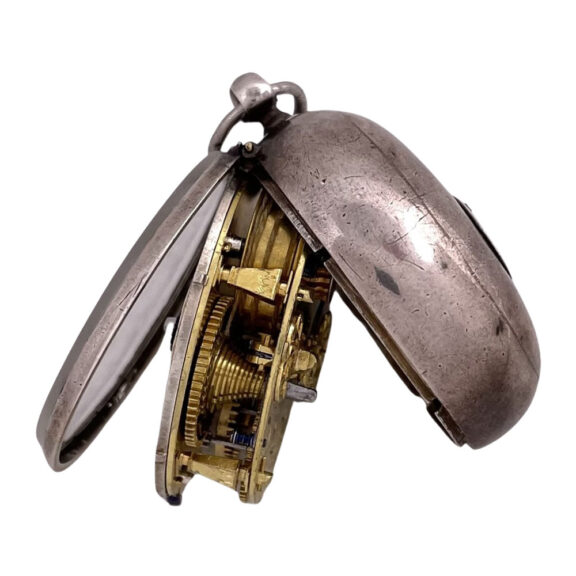
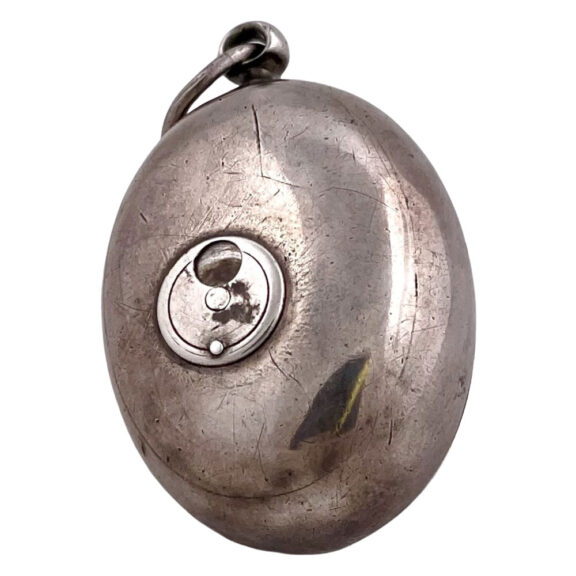
Silver single handed oval watch
–
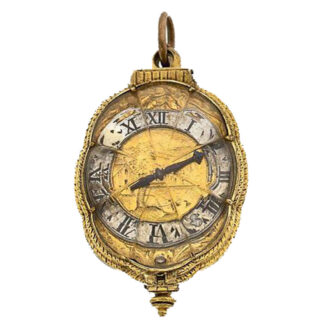
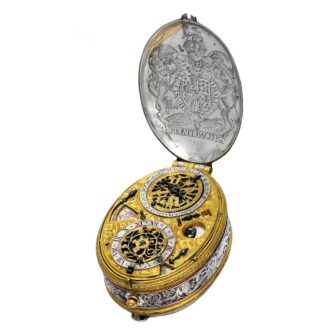
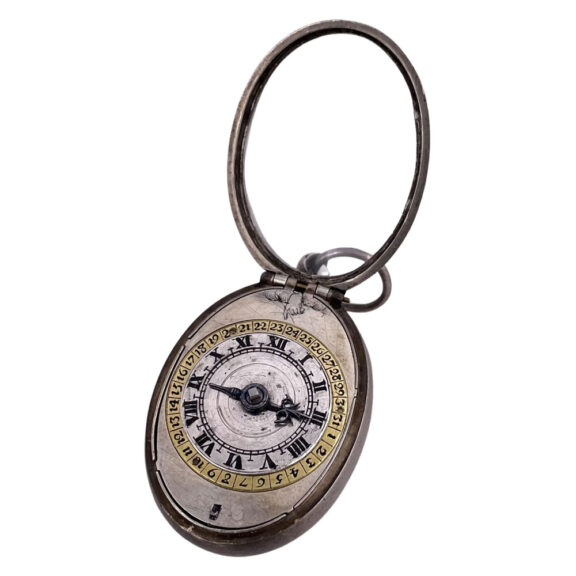
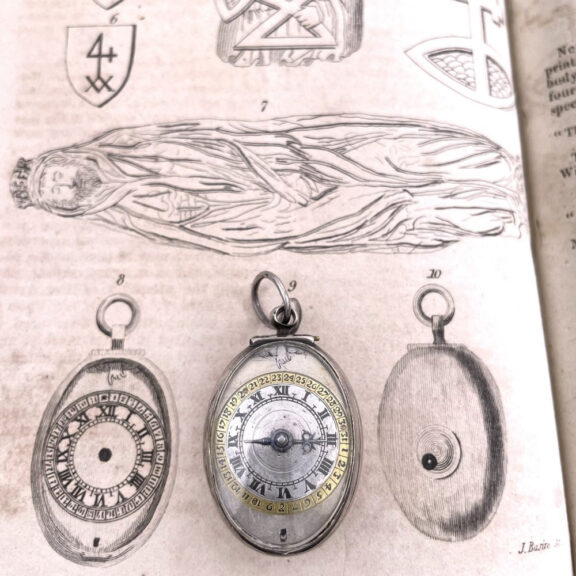
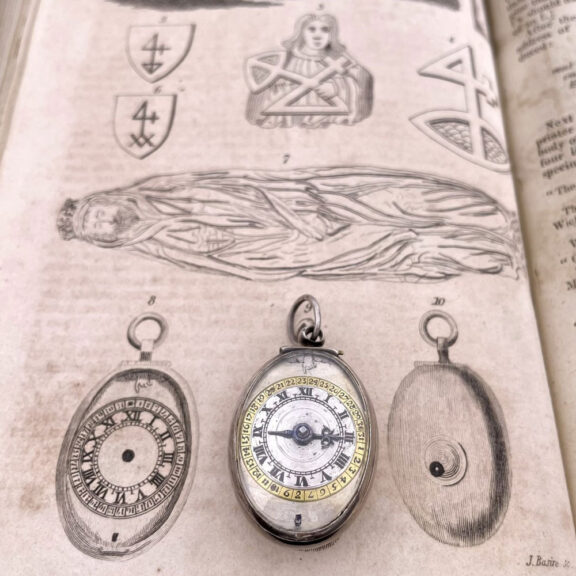
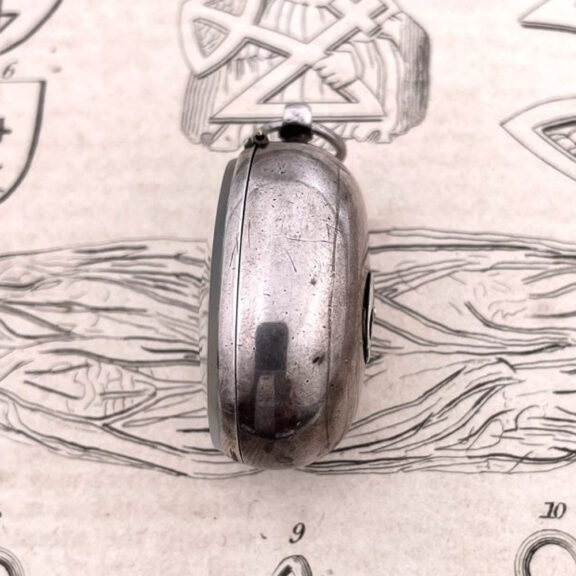
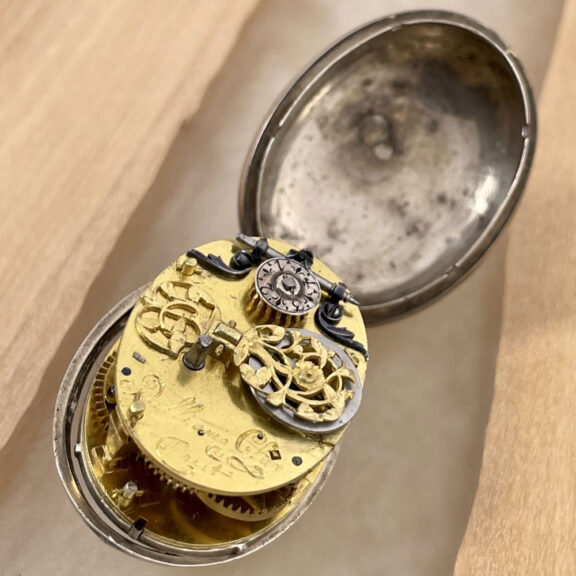
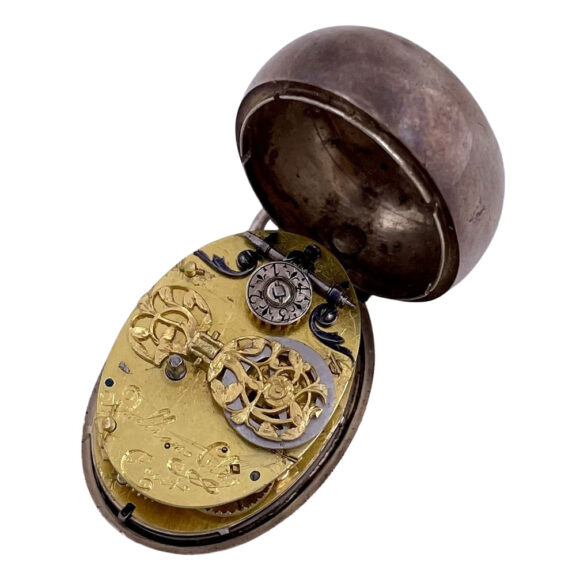
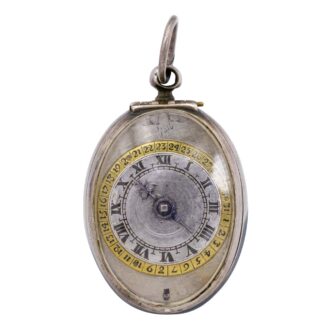
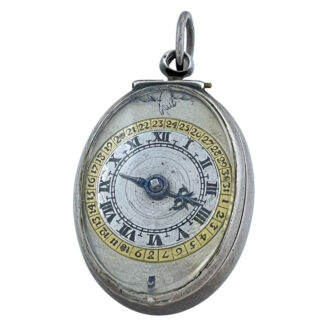
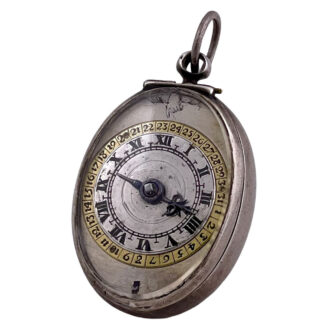
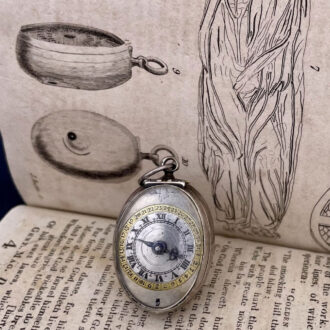
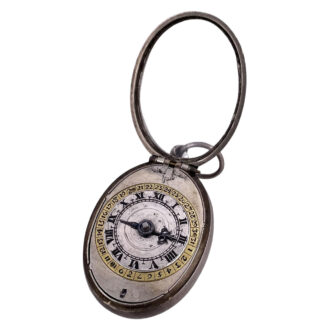
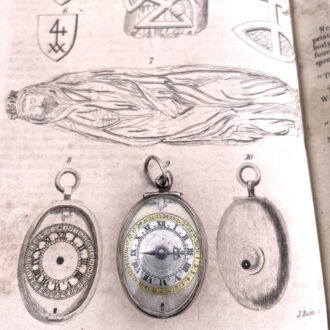
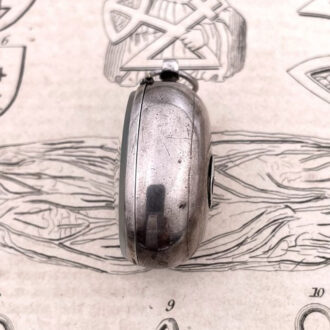
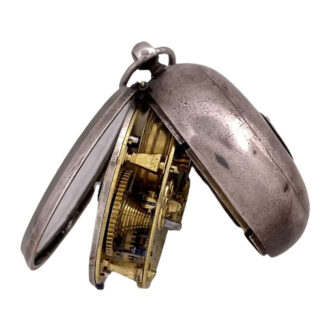
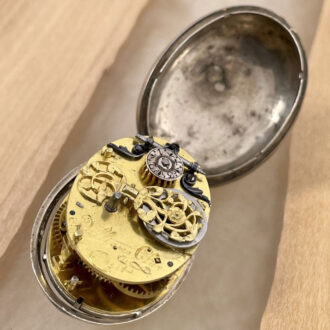
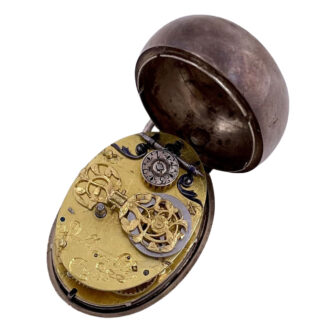
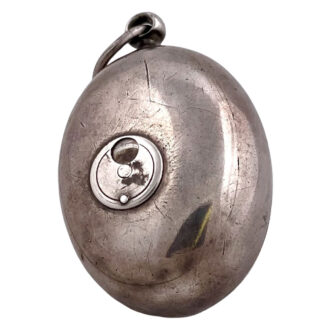
A historically important English silver open faced single handed oval Puritan pocket watch with date made by William Clay in London, circa 1648. An oval full plate movement with chain and fusee, a verge escapement and two arm steel balance.
The silver dial features Roman hour numerals, an outer gilt Arabic date chapter with
an engraved hand indicating the day, and a fine cut steel hand. A plain case. Movement signed.
–
Dimensions: 31 x 25 mm
–
Weight: 25 g
–
Signed: William Clay fecit
–
This watch was formerly owned by English statesman Oliver Cromwell, and has been in the Blackwell family since 1650.
–
Connoisseur of historical and extraordinary watches, Jonathan Wachsman, said this is perhaps the most important and rarest piece he ever held in his hands. With this watch come together a watchmaker who is not easy to pin down but nevertheless is famous, an owner who is one of the most important figures in English history, and the story of a timepiece that has never been forgotten in the long period of its existence and has only been presented to the public once since it became family property 370 years ago.
–
This magnificent watch is always mentioned when it comes to William Clay’s work: an excellent lantern watch and a piece that Oliver Cromwell bought after the siege of the Irish town of Clonmel by his comrade-in-arms John Blackwell in 1650.
–
The London watchmaker William Clay died around 1662, and even though his few known timepieces were of the best quality, little is known about his life and work. The names of three apprentices he took on in his workshop on King’s Street, Westminster, between 1646 and 1659 are known, and although he was associated with the Clockmakers’ Company as a so-called Brother, he was never an official member.
–
In 1599, Oliver Cromwell was born in Huntingdon, about 90 km north of London, into a wealthy family of the landed gentry. After Huntingdon Grammar School, he moved to Cambridge, where he studied at Sidney Sussex College, laying the foundations for his later career and absorbing the ideas of Puritanism.
–
Cromwell’s political career began in the 1620s when he served as a member of Parliament. He was known for his Puritan beliefs and his opposition to the rule of King Charles I. During the English Civil War, which lasted from 1642 to 1651, Cromwell quickly rose through the ranks of the Parliamentary Army. He founded the Ironsides, a band of brave and disciplined, mostly Puritan, soldiers who became a backbone of his power. At the battles of Marston Moor in 1644 and Naseby in 1645, he led the Parliamentarian army to decisive victories that would change the fate of England forever.
–
After the execution of King Charles I, which he supported, and the proclamation of the Republic, Cromwell found himself at the forefront of a new era in England. As Lord Protector, he ruled the Commonwealth of England, Scotland and Ireland with an iron fist. He implemented reforms to improve administration and promote religious tolerance, while at the same time taking authoritarian measures against political opponents. Many of his decisions were controversial, especially the events during the brutal reconquest of Ireland from 1649 that continue to burden the history of both countries to this day.
–
Oliver Cromwell died on September 3rd, 1658 at the age of 59. After his death, his son Richard briefly assumed the role of Lord Protector, but his government was unstable and was eventually overthrown. The monarchy was restored in 1660 with the Restoration of King Charles II, and Cromwell’s body was exhumed, publicly hanged and beheaded.
–
Cromwell’s Clock and John Blackwell
John Blackwell (1624-1701), was the eldest son of John Blackwell (1594-1658), a wealthy London merchant and grocer to King Charles I with strong Puritan ideals. Although not spared from setbacks, he was a respected officer who was given command of his Ironside force by Cromwell. He was also appointed Assistant War Treasurer. Through Blackwell’s marriage to Elizabeth Smithsby, one of Cromwell’s cousins, they both had a family connection.
–
During the aforementioned campaign to Ireland, which was intended to affect the alliance that had developed there between the Irish Confederacy and the royalists around Charles II, the son of the executed Charles I, the siege of Clonmel took place from April to May 1650. According to family tradition, Blackwell received the watch there as a gift. If you consider the shared beliefs of the two men, who were strongly committed to Puritanism, Cromwell’s watch is a very meaningful gift.
–
Despite his close proximity to Cromwell, Blackwell survived the Restoration after his death. However, he was permanently barred from public office and went to America in 1684 with his second wife, a daughter of the famous Republican general John Lambert. They settled in Massachusetts Bay, where he was offered the governorship of Pennsylvania by William Penn. In 1693 or 1694 they returned to England, where Blackwell died in Bethnal Green in 1701.
–
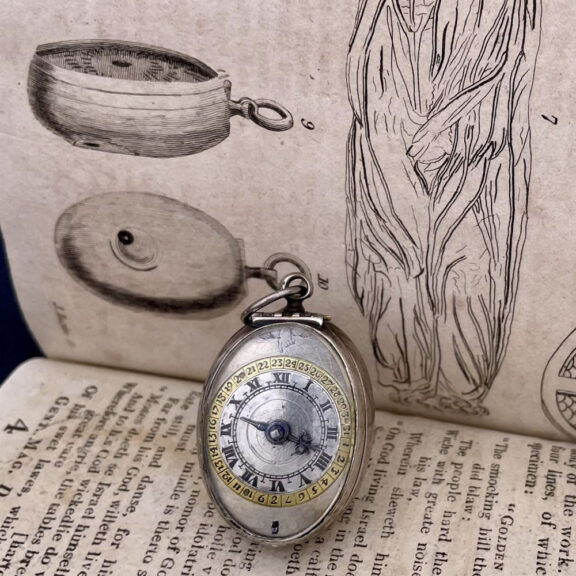
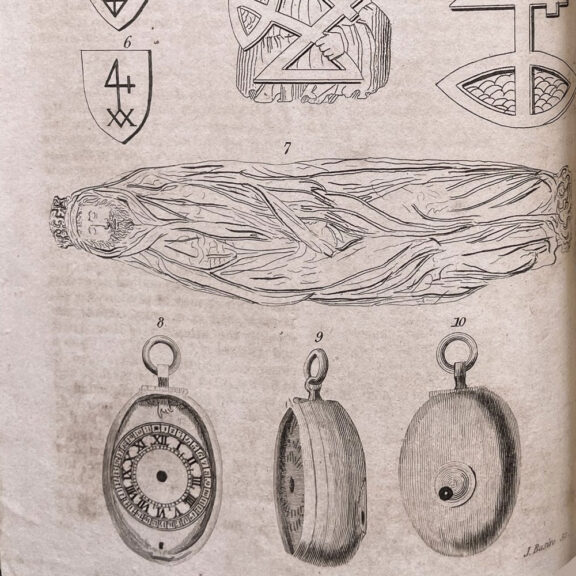
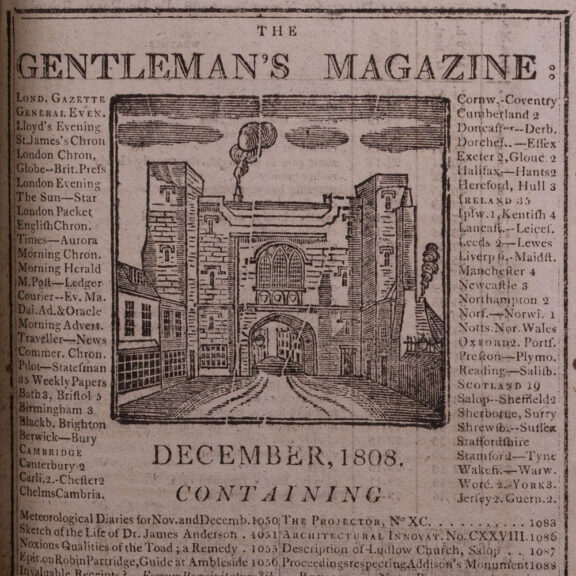
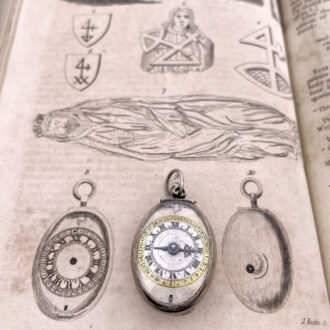
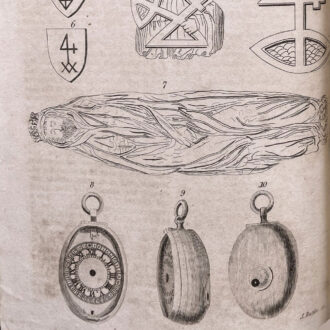
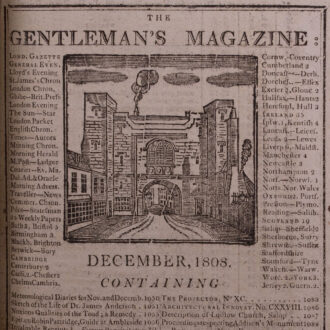
Cromwell’s watch passed on to the Irish branch of the Blackwell family, who had settled on the island before Cromwell and bore the name Bagwell. In 1808, Colonel Bagwell (1751-1816), the then owner, showed the clock to Richard Gough (1735-1809), a respected antiquarian and author of “A short genealogical view of the family of Oliver Cromwell” (London, 1785). Gough had Cromwell’s watch sketched in three positions before publishing the drawings in “Gentleman’s Magazine” under the pseudonym PQ.
–
Since then, the watch has only been seen in public once. At the time it was owned by Colonel Bagwell’s great-great-granddaughter Elizabeth Langley (1864-1953) and was exhibited at the Somersetshire Archaeological and Natural History Society in December 1914. A photo of it appeared years later in The Connoisseur magazine in 1919.
–
100 years later, Cromwell’s watch was still in the possession of the Blackwell descendants when they decided to part with the valuable piece. Not only because of its long past, but also because of its Puritan attitude and posthumous condemnation, it is one of the extremely rare objects that can be directly linked to Oliver Cromwell, one of the most important statesmen in the history of England. A piece of great historical value that has survived the centuries in perfect condition.
Signed: William Clay Fecit
Share this page: